Scorecards do more than quality assurance. The same mechanic, built as a rating, pass/fail, or observation question, can predict customer outcomes, meet UK regulatory requirements like FCA Consumer Duty, surface commercial opportunities, and build a data-backed case for where to introduce AI agents. This guide covers 13 ways to use one, plus how to build each use case in MaxContact.
In This Article
- How Scorecards Work
- Predicting Customer Outcomes
- Compliance and Regulatory Risk
- Commercial and Sales Performance
- Operational and Product Insights
- Getting Started
- FAQs
For years, the case for automated QA rested on one number: most contact centres only review 2-5% of their calls. That's no longer the gap. According to MaxContact's 2026 UK Conduct Risk Report, 46.7% of regulated contact centres now use AI to review every call, nearly matching the 49.5% still sampling manually. Coverage, in other words, is largely solved.
What isn't solved is what happens next. The same research found that 54% of contact centres had a compliance breach or harm issue surface outside their routine QA process, and 16.5% found more than one. Reviewing every call tells you what happened. It doesn't tell you what's about to happen. It won't flag who's about to churn, which calls should never have happened at all, or which agent needs help before their next review cycle.
That's the real opportunity in a scorecard. Not just scoring compliance after the fact, but turning every call into a signal you can act on, for coaching, for commercial performance, and for risk. Here are 13 ways to do it.
How Scorecards Work
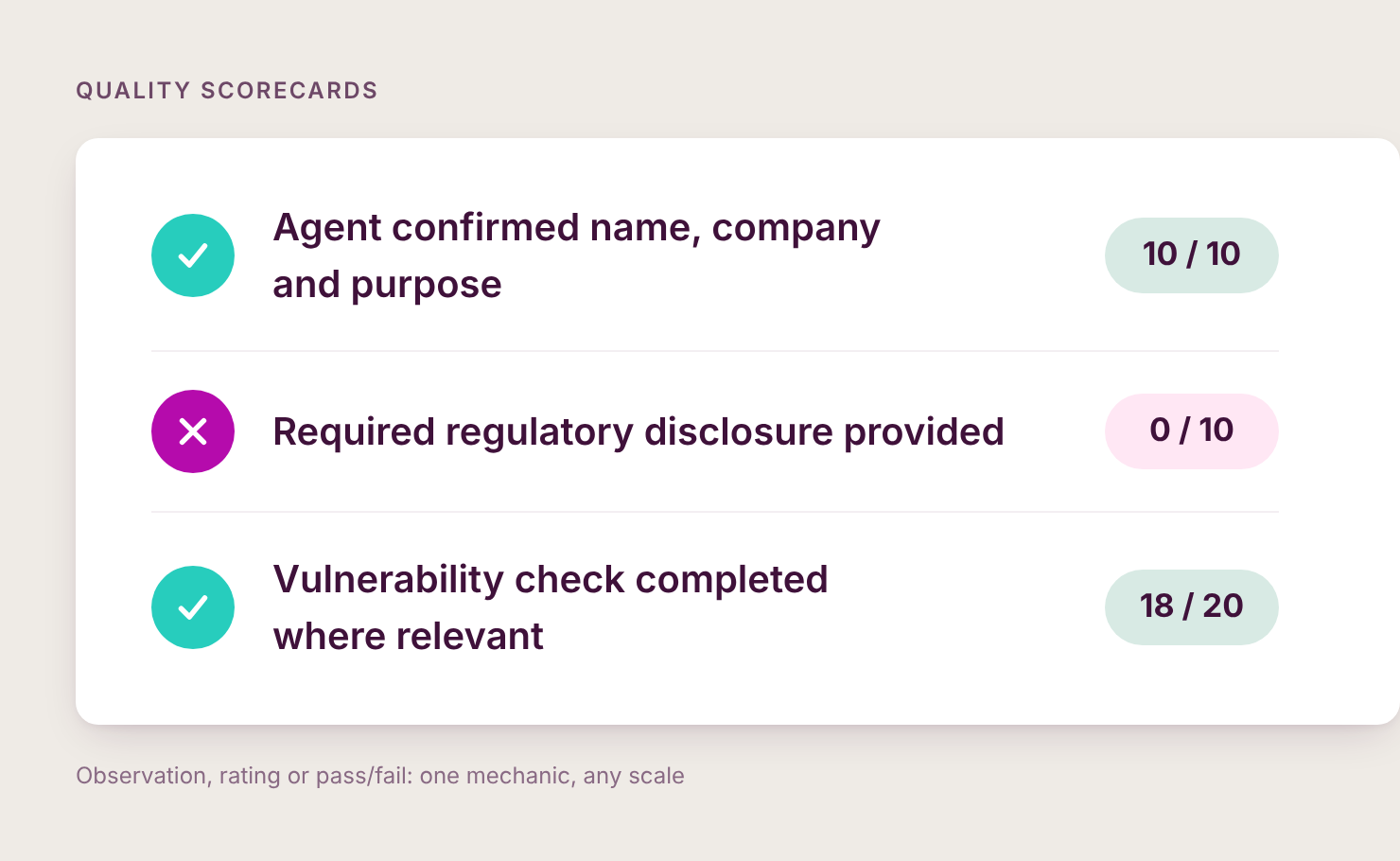
Before diving into the use cases, a quick note on mechanics. It's what makes all of this possible in MaxContact Conversation Analytics, rather than needing a different tool for every job.
A MaxContact scorecard question can be built as an observation (a few lines of AI commentary on what it found), a rating (a score on any scale you choose, such as 1 to 5, or a simple true/false), or a pass/fail. The same underlying mechanic, "based on this transcript, did X happen?", powers everything from a compliance check to a churn prediction.
Scorecards can also run two ways. An always-on schedule scores every new call as it lands, continuously. A one-time schedule runs against a historical sample instead, useful for testing a new use case against last quarter's calls before switching it on for good.
Results then roll up into question-level reporting, so you're not digging through individual calls to see which questions are failing, where, and for whom.
Predicting Customer Outcomes
Predicted CSAT and NPS
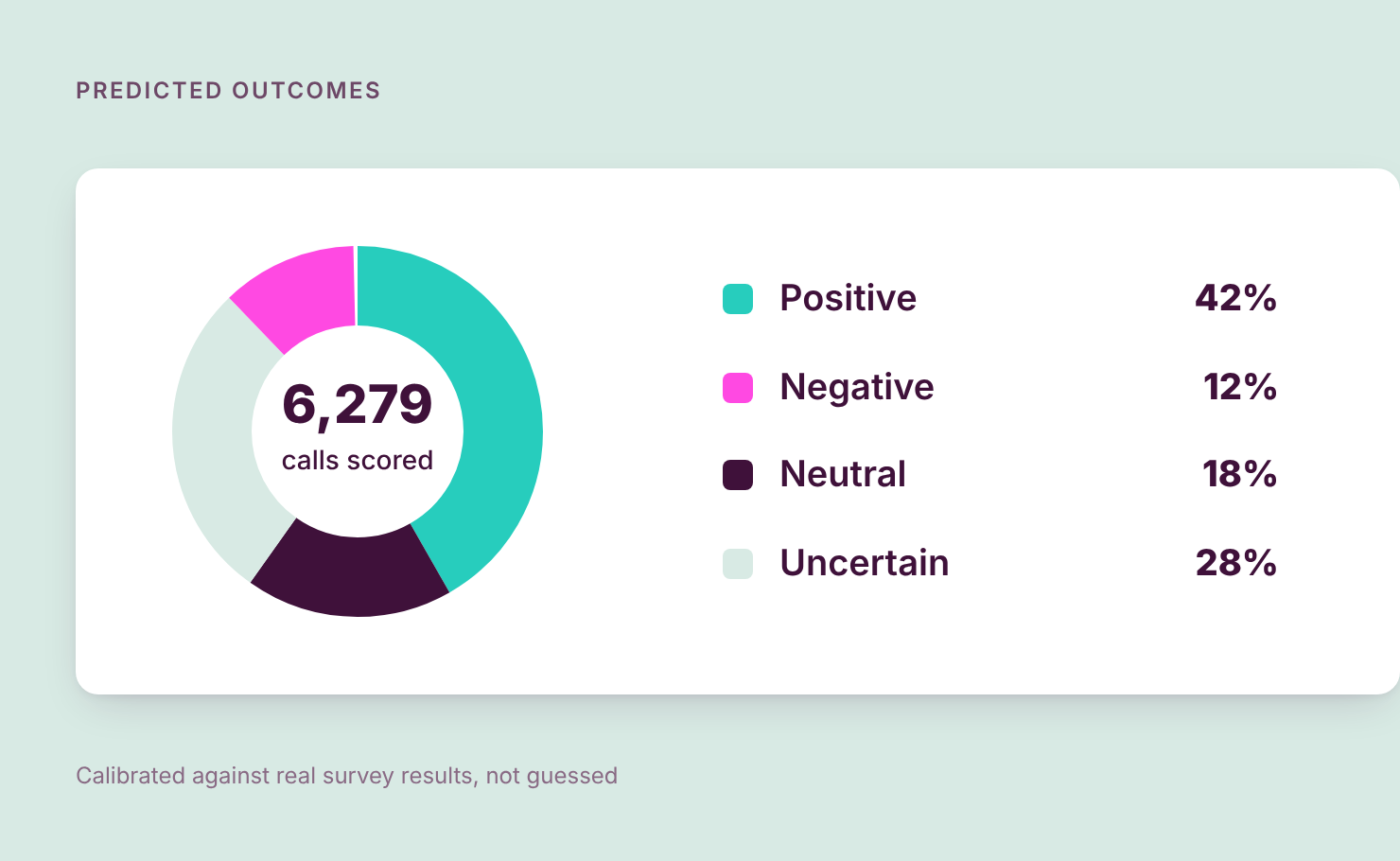
A scorecard question can ask, in plain terms: based on this transcript, what would this customer's CSAT score likely be? Because it runs on every call, you get a sentiment read on 100% of conversations, not the 5% or so that respond to a post-call survey.
The catch: this is only credible once you calibrate it against your real survey results. Run the question alongside your existing survey data, check how closely the predictions track the real scores, and adjust until they're reliably close. Skip that step and all you've got is a sentiment score, not predicted CSAT. You have a sentiment score wearing a more exciting name. Once calibrated, the same logic extends to NPS.
Repeat Contact and FCR Likelihood
Was the issue actually resolved on this call, or is the customer about to ring back? A scorecard can score first-contact-resolution (FCR) likelihood directly from the transcript. Did the agent confirm the issue was fixed, or leave it open, vague, or dependent on another team?
This is arguably more actionable than CSAT, because failure demand has a direct, calculable cost. At roughly £5 per service call, every repeat contact doubles the cost of that interaction. That's before you've factored in agent time or the churn risk a frustrated second call brings with it.
Promise-to-Pay Likelihood
For collections teams, a scorecard can rate how firm a payment commitment was. Not just whether a promise to pay was logged, but whether the language was definite ("I'll pay Friday") or hedged ("I'll try to sort something"). The question can be scoped so it only applies when an arrangement-to-pay or promise-to-pay outcome has been set, rather than running on every call.
Because the strength of that commitment is directly tied to revenue collected, this gives collections leaders a leading indicator: a queue of weak promises worth a follow-up call, before the due date passes and it becomes a broken promise instead.
Customer Churn Intent
A scorecard question can rate whether a call shows real churn risk: cancellation language, competitor mentions, or complaints that keep repeating across contacts. Score it as a simple true/false, or as a numeric risk rating to see customers nudging from low to high risk before they act on it.
Either way, the output is the same: a retention queue built from what customers are saying, not from account age or a generic risk model.
Compliance and Regulatory Risk
Vulnerability Detection
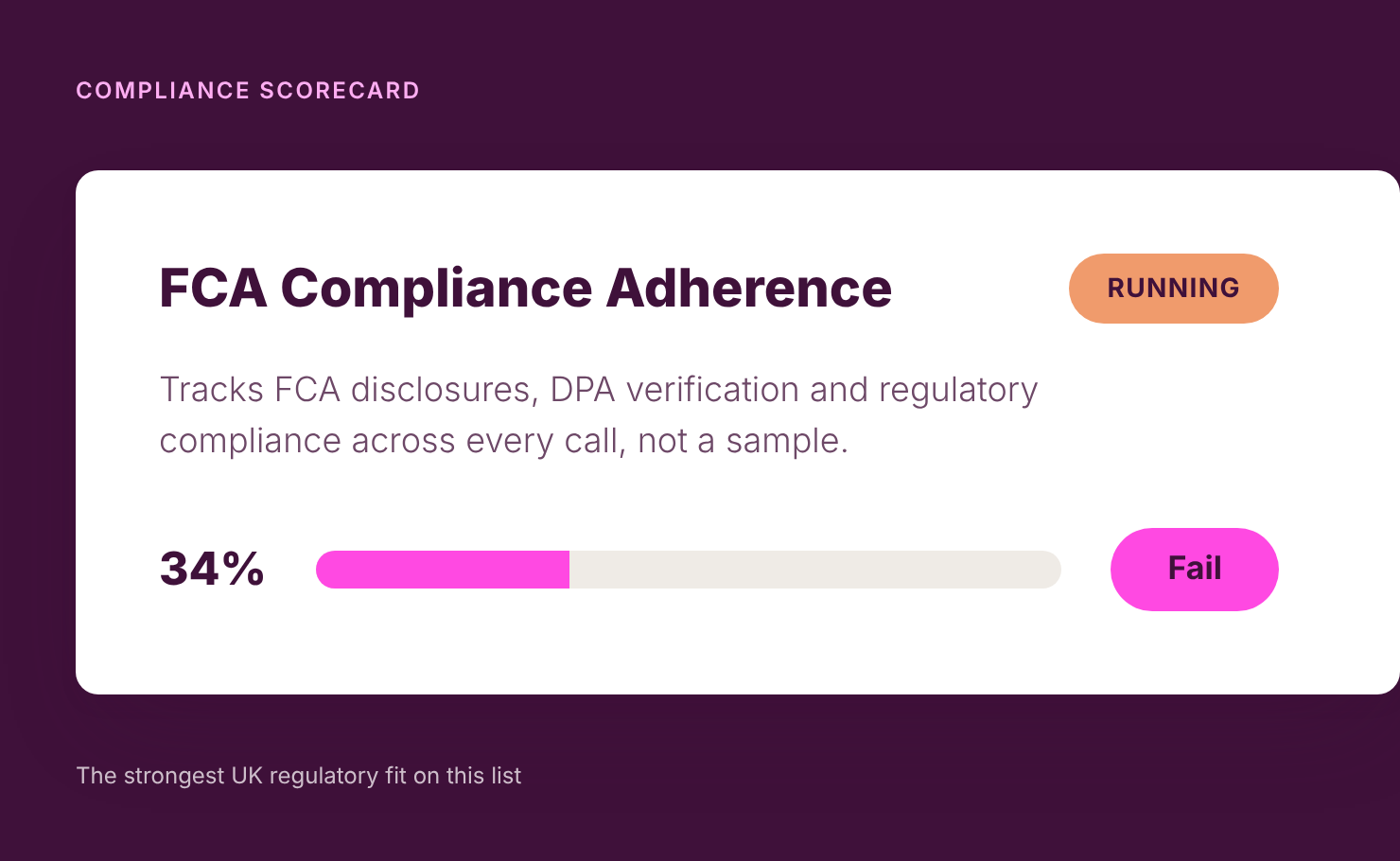
Under FCA (Financial Conduct Authority) Consumer Duty, firms have to identify and respond appropriately to vulnerable customers, and increasingly, prove they did. The FCA's own framework names four drivers of vulnerability: health, life events, resilience, and capability. A scorecard question can be built to listen for the language that signals each of these. It scores whether the agent picked up on it, and flags whether they fully acknowledged it, only partially addressed it, or missed it entirely.
This is the strongest UK regulatory fit on this list, for a simple reason: firms already know they struggle with it. Last year, the FCA reviewed 180 board reports and found the most common failure wasn't a lack of effort. It was an inability to evidence outcomes for vulnerable customers specifically. A scorecard that runs on every call, not a sample, is a direct answer to that evidence gap.
Complaint Detection
Under FCA rules, an expression of dissatisfaction counts as a complaint whether or not the customer ever uses the word "complaint." A scorecard can be built to catch that distinction, flagging calls where a customer expressed real dissatisfaction, even phrased as a passing comment, so they get logged and handled as complaints rather than closed out as routine queries.
This is a clear compliance win with a direct cost attached. MaxContact's 2026 UK Conduct Risk Report found the average regulatory fine paid by UK contact centres in the past 12 months was £81,000, across everyone surveyed, including businesses that paid nothing at all. Nearly a third paid £50,000 or more. Since February 2026, the stakes have risen further still. The Data Use and Access Act raised the maximum PECR (Privacy and Electronic Communications Regulations) fine from £500,000 to £17.5 million or 4% of global turnover, whichever is higher. For the first time, company directors can also be held personally liable, for up to £500,000 individually.
Fraud and Social Engineering Signals
A scorecard can be trained to listen for the patterns that indicate fraud risk on a call: pressure tactics, inconsistent answers to identity questions, or signs that a third party is coaching the caller in the background. Scored consistently across every call, a pattern that's easy to miss in a single conversation becomes visible at scale, and auditable after the fact.
Fines aren't the only cost at stake here either. The same research found non-compliant sales cost UK contact centres an average of £22,000 in lost revenue over the past year through refunds and cancellations. Just over half of respondents (50.2%) said they'd lost a sale, a contract, or a customer entirely over a compliance issue.
Commercial and Sales Performance
Missed Sales Opportunities
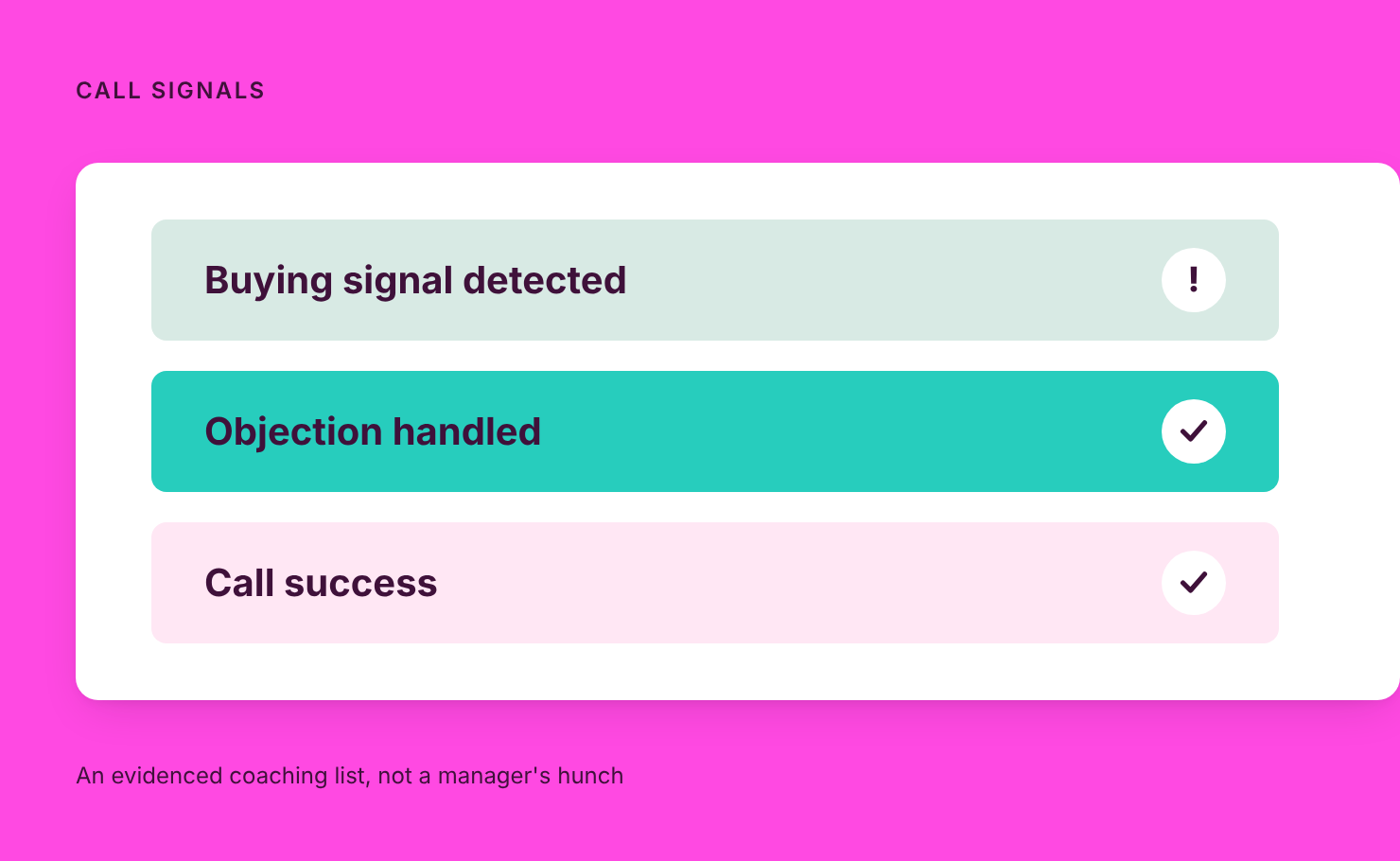
A scorecard question can flag buying signals an agent didn't act on: a customer who asked about an upgrade, mentioned a competitor's offer, or hinted at a bigger need the agent never followed up on. Run across every call, this builds a clear, evidenced coaching list, rather than a manager's hunch about who's leaving revenue on the table.
Sales Methodology Scorecards
A scorecard can also check whether an agent followed a specific sales methodology, not just whether they spotted an opportunity. A BANT scorecard, for example, scores a call against the four areas the framework is built on: Budget, Authority, Need, and Timeline. Each becomes its own rating question, usually scored on a 0-5 scale in this example (ratings can run on any range you choose), with a minimum score needed to pass (3 out of 5 was the bar in the original demo), plus an observation question at the end to pull the whole picture together.
The same approach works for any other sales methodology your teams are trained on, including FAB, AIDA, or SPIN. Because every call gets measured against the same criteria, you get a consistent read on how closely the team is actually following the methodology, not just whether revenue came in.
Script and Campaign Effectiveness
Because scorecards score consistently and at scale, they're a ready-made engine for A/B testing. Run the same scorecard against calls using different script versions or campaign approaches, and compare outcomes directly: which version holds objections better, which closes faster, which gets flagged for compliance issues less often. The scorecard becomes the measurement layer for commercial experiments you're already running, instead of a side project in a spreadsheet.
Operational and Product Insights
Automation Candidacy
This is where a scorecard stops being purely a QA tool and starts building your automation roadmap. Start with one scorecard and one pass/fail question: is this call type a good candidate for automation? Pair it with an observation question asking what, specifically, makes it one. Run it across your calls and your candidates start to emerge: complaints, vulnerability checks, simple status updates, whatever they are for your business.
From there, write a dedicated scorecard with one question per candidate type, each scored pass/fail. Run that as a one-time scorecard against a historical sample, and you get a hit rate per candidate: this type of call could have been automated 87% of the time, that one only 20%. That gives you a data-backed, evidenced pipeline for deciding what to automate first, not a guess about where AI Agents could help, but a ranked list built from your own call data.
Contact Reason and Failure Demand
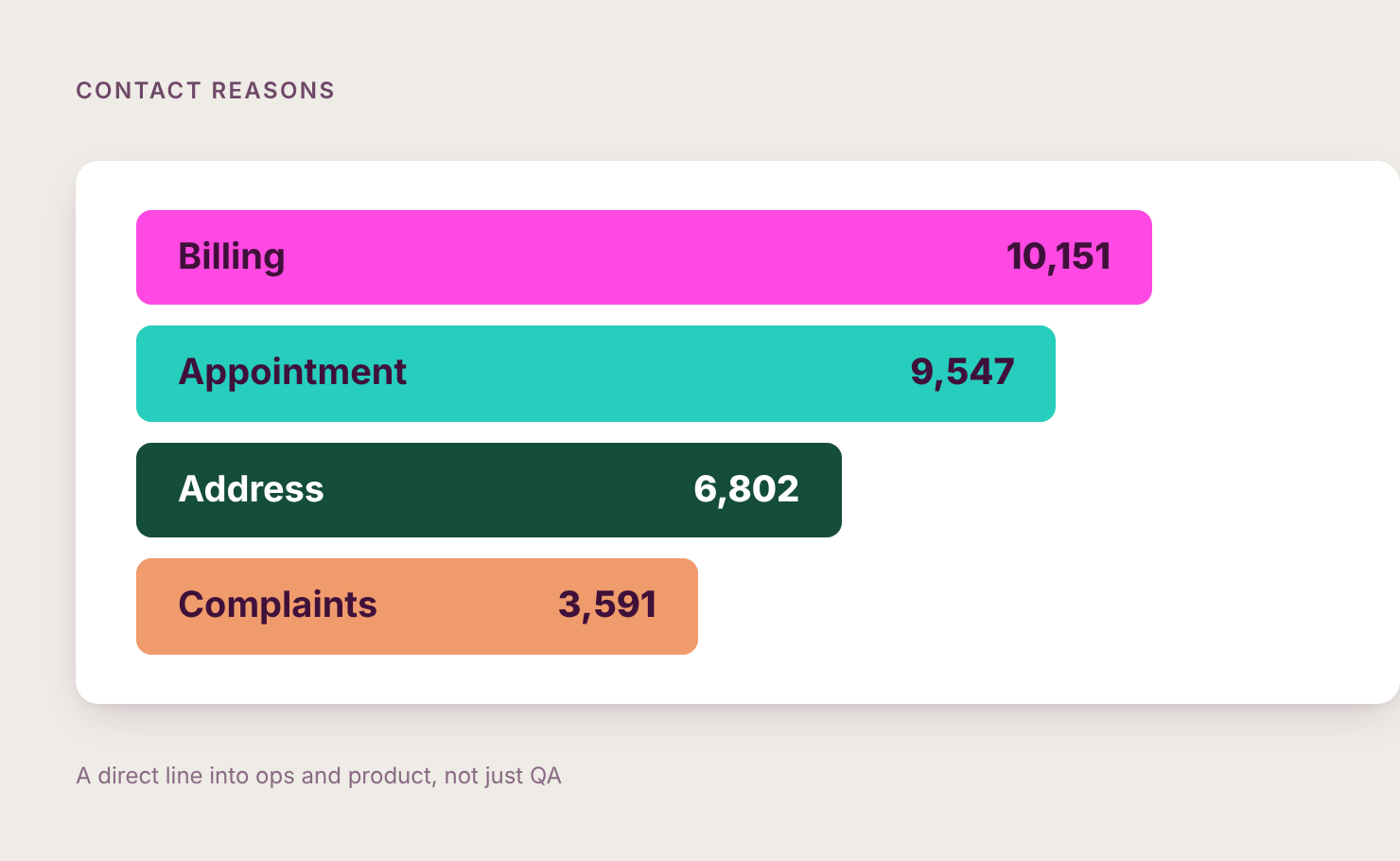
A scorecard can categorise why a customer called, and more usefully, flag which of those calls shouldn't have needed to happen at all. A customer chasing an order update because a text alert never arrived is failure demand: a problem created somewhere else in the business that lands on your contact centre's call volume. This is valuable well beyond QA. It's a direct line into your ops and product teams about where the underlying process is broken.
Knowledge Gaps
Agent uncertainty, excessive holds, and unnecessary transfers are all symptoms a scorecard can detect and score consistently. Rather than treating this as an individual performance issue, use it to point at the knowledge-base articles or training modules that need fixing. The same hesitation showing up across multiple agents on the same topic is a knowledge gap, not a coaching gap.
Getting Started
Here's how to turn any of these into a live scorecard in MaxContact.
1. Start with one use case, not all 13. Pick the one with the clearest payoff for your team right now. Vulnerability detection if Consumer Duty evidence is your biggest exposure, churn intent if retention is the priority.
2. Write or import the scorecard. Describe the question in plain English and let the scorecard builder turn it into evaluation criteria, or import an existing scorecard if a similar methodology already exists elsewhere in the business.
3. Choose your question type. Decide whether the use case needs an observation (a few lines of commentary), a rating (true/false, or any numeric scale, such as 1 - 5), or a straight pass/fail.
4. Scope it, if it needs scoping. Some questions only make sense in context. A promise-to-pay question, for example, should only fire when an arrangement-to-pay outcome has actually been logged on that call. Scorecards can be scoped to specific products, outcomes, or campaign types so you're not scoring irrelevant calls.
5. Test it against a historical sample first. Run it as a one-time scorecard against last month's or last quarter's calls before switching it on live. This matters most for anything predicting an outcome: CSAT, churn, automation candidacy. Check the results against what you already know before trusting it at scale.
6. Switch to an always-on schedule. Once you're confident in the results, move the scorecard to an always-on schedule so it scores every new call automatically, with no manual sampling involved.
7. Review through question-level reporting. Don't just watch an aggregate score. Use question-level reporting to see which specific questions are failing, for which agents, teams, or call types, so the next action is obvious rather than buried in an overall pass rate.
FAQs
Does this replace manual QA entirely? Not necessarily. Many regulated contact centres run scorecards alongside manual spot-checks, especially while a use case is new or being calibrated against real outcomes. What it replaces is reliance on a 2-5% sample as your only evidence base.
How accurate is predicted CSAT? It depends entirely on calibration. Run it alongside real survey data first, check how closely the predictions track actual scores, and adjust the scorecard question until they align. An uncalibrated predicted CSAT score is just a sentiment score with a different name.
Can I run a scorecard on calls that already happened? Yes. One-time scorecards can run against a historical sample, which is useful for testing a new use case or auditing a past period, rather than only scoring calls as they come in.
Do I need a different tool for each use case? No. Every use case on this list runs on the same scorecard mechanic: observation, rating, or pass/fail questions, inside Conversation Analytics. What changes is the question you ask, not the platform.
Does automation candidacy mean an AI agent takes over immediately? No. It identifies and ranks which call types are good candidates for automation based on real call data, giving you an evidenced starting point for deciding where to introduce AI Agents, rather than a guess.