AI debt collection uses AI voice agents to handle the routine, high-volume conversations in a collections operation: first contact, payment reminders, payment arrangements and out-of-hours payments. Human agents keep the complex, sensitive and high-value cases. Used this way, AI lets you reach more customers without removing the human contact that regulated collections depend on.
This guide covers what an AI voice agent does in collections, where to use AI and where to use people, what UK compliance requires and how to measure results.
What an AI voice agent does in collections
An AI collections agent holds a spoken conversation with the customer, understands what they say and takes the next step in your systems. MaxContact's AI Collections Agent covers four main scenarios:
- First contact and account tracing. It makes the first call, confirms it is speaking to the right person, verifies account details and opens a payment conversation in line with treating customers fairly.
- Payment reminders. It calls with a reminder, explains the payment options, can send an SMS payment link and schedules follow-up based on the customer's response and history.
- 24/7 payments. It takes payments outside business hours, sets up payment arrangements and direct debits, and confirms payment straight away, with PCI-compliant payment handling.
- Handover to a person. It passes the call to a human agent when the situation needs judgement or empathy, with the full conversation history, so the customer does not have to repeat themselves.
Where to use AI and where to use people
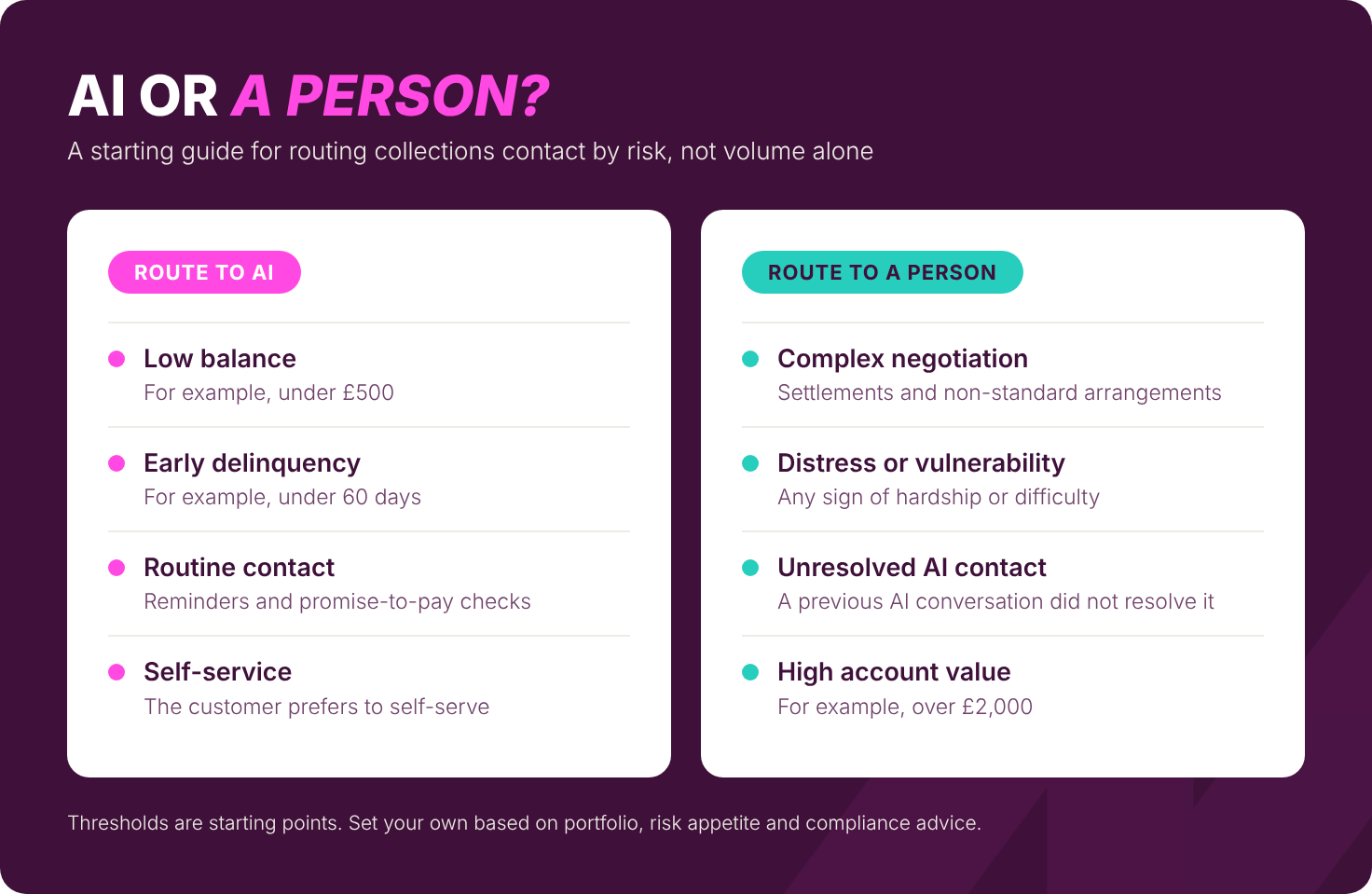
The strongest deployments split the work by risk, not by volume alone. Use this as a starting guide for routing:
These thresholds are starting points. Set your own based on your portfolio, risk appetite and compliance advice.
A phased approach to deployment
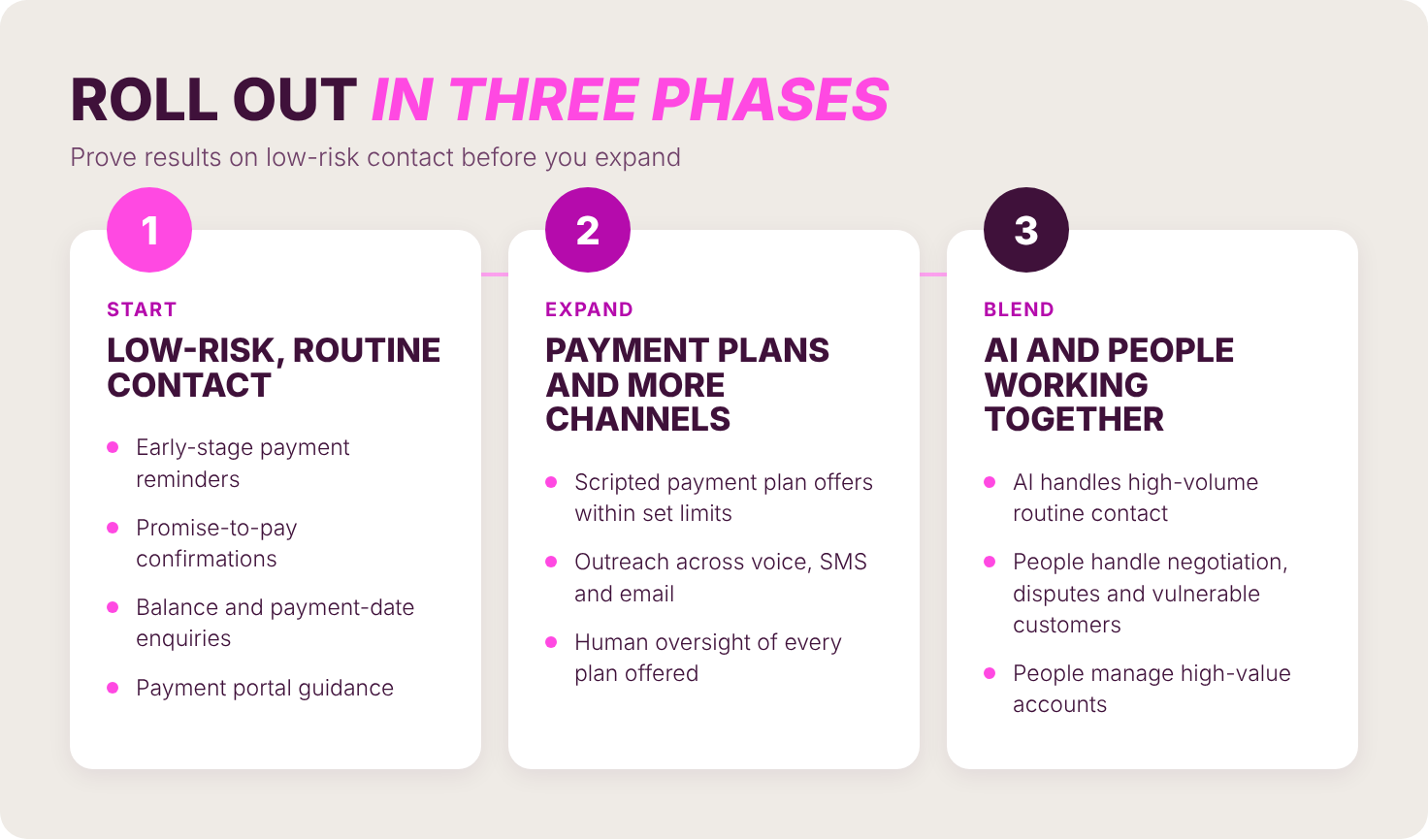
1. Start with low-risk, routine contact
Begin with early-stage payment reminders, promise-to-pay confirmations, simple balance and payment-date enquiries, and guidance on using your payment portal. These conversations pass on information rather than persuade, so a weak call is unlikely to damage your chances of collecting.
2. Expand into payment plans and more channels
Once the first phase has proved its results, add scripted payment plan offers within set limits, and coordinate outreach across voice, SMS and email. Keep human oversight of every payment plan the AI offers.
3. Move to a blended model
AI handles the high-volume, routine contact. Your people focus on complex negotiation, vulnerable customers, disputes and high-value accounts.
For the full deployment guide, read our playbook for deploying AI voice agents in debt collection.
What UK compliance requires
AI does not change your obligations under the FCA's Consumer Credit sourcebook (CONC 7) or the Consumer Duty. It means you need to evidence them for automated conversations as well as human ones.
- Consumer Duty and fair outcomes. Monitor outcomes for customers, not only operational efficiency, and check regularly that the AI treats all customer groups fairly.
- Vulnerability. The agent needs a reliable route to a person when it detects distress or signs of financial difficulty.
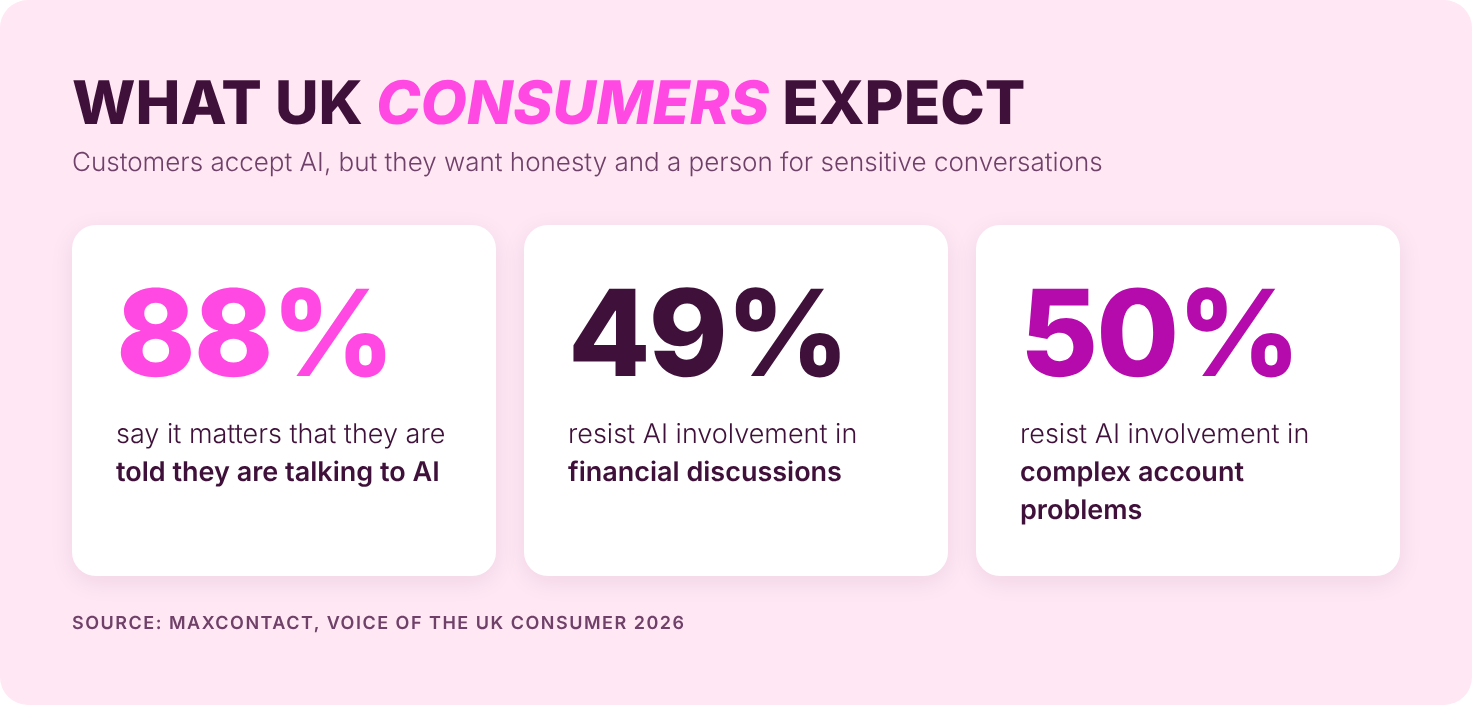
- Transparency. Tell customers at the start of the conversation that they are speaking to AI. In MaxContact's Voice of the UK Consumer 2026 research, 88% of consumers said being told they are talking to AI matters to them.
- Data protection. Establish a lawful basis for processing personal data, and support access and erasure requests.
- Payments. Take card details through PCI DSS-compliant processing so that card data does not reach agents.
- Audit trail. Keep call recordings and records of each conversation, so you can show how decisions were made if the FCA or a customer asks.
Customers also want a person available for sensitive situations. The same research found that 49% of consumers resist AI involvement in financial discussions, and 50% resist it for complex account problems. That is why the handover to a person is built into the design from the start.
What results to expect
Published figures vary widely and depend on the portfolio, the use case and how the agent is deployed, so treat headline numbers with care.
- Cost and recoveries. McKinsey reports that organisations using advanced generative AI in customer assistance and collections can reduce operating costs by up to 40% and improve recoveries by about 10%.
- The persuasion gap. A study by researchers at Yale and NBER found AI callers were substantially less effective than human callers at getting borrowers to repay. Switching to human callers six days into delinquency closed much of the gap, but borrowers first contacted by AI still repaid less a year later.
This is why routine contact comes first, why persuasive conversations stay with people, and why you should measure whether promises are kept, not only how many are made.
How to measure success
- Efficiency: cost per contact, cost per successful resolution and agent productivity.
- Effectiveness: promise-to-pay rate, promise fulfilment rate and long-term recovery rate.
- Quality and compliance: whether escalations happen at the right time, complaint rates, audit trail completeness and breaches found.
- Testing: run a controlled pilot with a large enough sample to be meaningful, and track repayment behaviour over 6 to 12 months before scaling.
You can model the potential impact on your operation with our AI Agents ROI calculator.
Frequently asked questions
What is AI debt collection?
AI debt collection uses AI voice agents and digital channels to carry out routine collections conversations, such as first contact, reminders and payment arrangements, and hands complex cases to human agents.
Can an AI voice agent take payments?
Yes. MaxContact's AI Collections Agent can take payments, set up payment arrangements and direct debits, and send SMS payment links, with PCI-compliant payment handling.
Is AI debt collection compliant in the UK?
It can be, if it is designed around the Consumer Duty, CONC 7, vulnerability handling, transparency, data protection and a full audit trail. Compliance remains the firm's responsibility, so involve your Risk and Compliance teams before launch.
Does the AI tell customers it is not a person?
It should. Customers should be told at the start of the conversation that they are speaking to AI.
What happens when a customer is vulnerable or distressed?
The AI agent hands the call to a human agent and passes on the full conversation history.
Will AI replace collections agents?
No. AI takes the repetitive, high-volume contact. People handle complex negotiation, vulnerable customers, disputes and high-value accounts.
Which accounts should I start with?
Start with early-stage delinquency, low balances and routine reminders, then expand as results are proven.
See the AI Collections Agent in action
Find out how MaxContact's AI Collections Agent handles routine collections contact and hands sensitive cases to your team, or book a demo.