knowledge hub:
resources & insights
Get the knowledge and tools you need to improve contact centre performance, deliver better customer experiences and grow your business.
the latest
downloads
South African BPO Briefing 2026
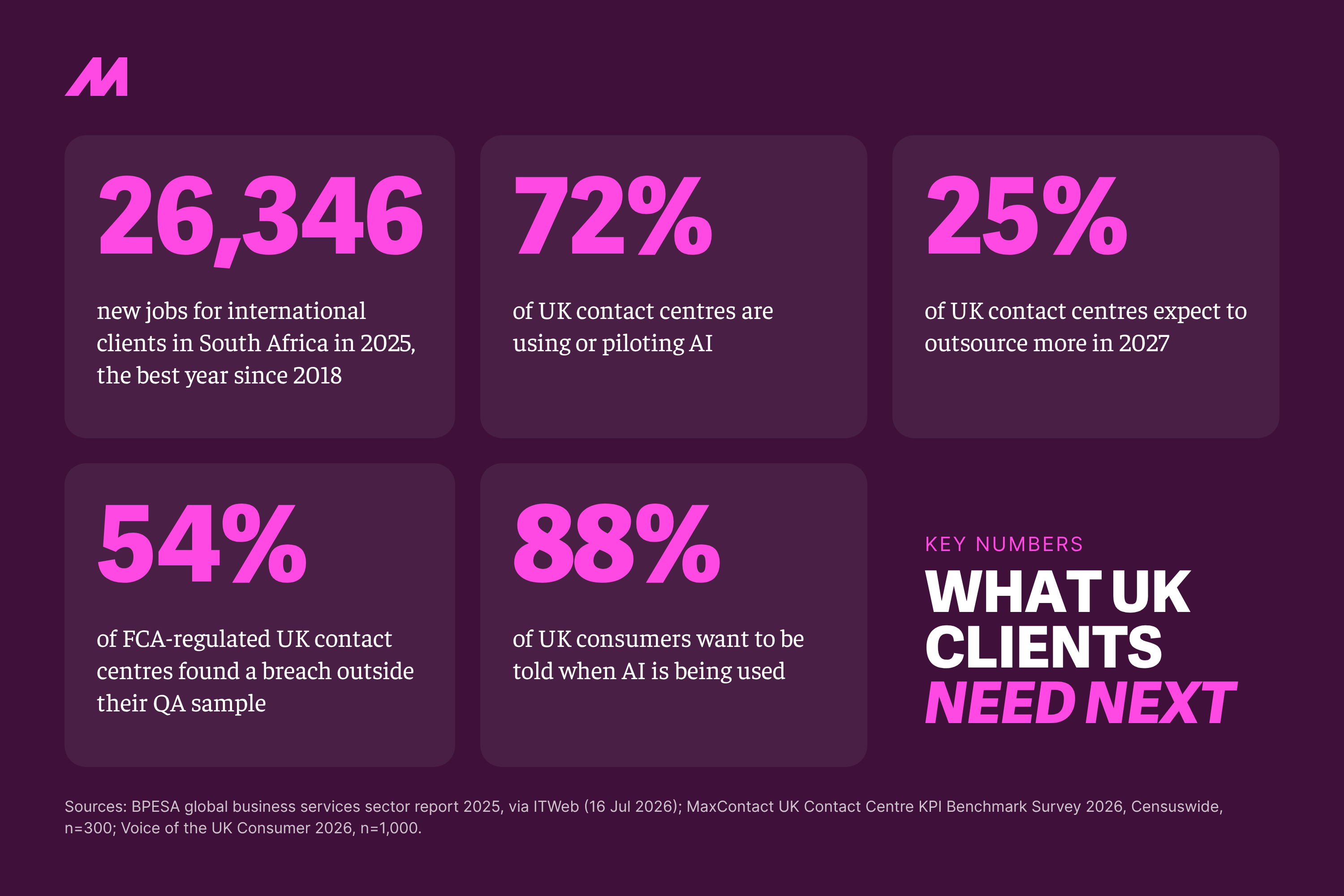
A briefing for South African BPO leaders, combining BPESA market data with MaxContact’s 2026 surveys of 300 UK contact centre leaders and 1,000 UK consumers. It covers UK demand, AI, compliance, data rules and pricing, with six recommendations for 2027.
- 26,346 new jobs created for international clients in 2025, the sector’s best year since 2018.
- 72% of UK contact centres are using or piloting AI. Half say agent workload still went up.
- 25% of UK contact centres expect to outsource more operations in 2027.
- 54% of FCA-regulated UK contact centres have found a compliance breach outside their routine QA sample.
- 88% of UK consumers say it’s important that companies tell them when AI is being used.
- The demand is there. The bar for winning it is higher.
The 2026 UK Contact Centre Conduct Risk Report
Independent research with 285 FCA-regulated UK contact centre managers and directors. Covers detection, commercial pressure, cost, and time-to-consequence - with five questions for your next Consumer Duty board report.
85.6% are confident they could evidence fair treatment under Consumer Duty if the FCA reviewed them tomorrow.
54.0% have found a compliance breach or harm issue outside their routine QA sample. For 16.5%, it has happened more than once.
31.2% paid £50,000 or more in regulatory fines in the last twelve months.
3.08 days is the average time between a call and the agent getting feedback on it. Only 10.9% manage it inside a day.
77.5% agree that pushing sales or collections performance increases compliance risk — and it's the leaders setting those targets telling us so.
Confidence is high. Detection is patchy. The gap between them is already on the balance sheet.

The Assisted Agent Playbook
A practical guide to AI-enabled agent assistance for contact centre leaders. Covers the before, during, and after of every call - with the ROI case, a real-world scenario, and three actions you can take this week.
- 42% of UK consumers have already switched provider due to poor contact centre experience - Voice of the UK Consumer 2026
- 69% rate AI worse than humans for understanding their issue - the gap isn't the technology, it's the context being lost between calls
- £175,000 - illustrative annual saving potential for a 50-agent team from a 50% reduction in wrap time alone, without reducing headcount
- 50% wrap time reduction - what Agent Wrap Up Summary delivers, returning hours of capacity back to productive contact time every shift
- 100% call coverage - from QA sampling to full-call insight, without adding resource
the latest
webinars and events
2027 The Year of Optichannel: Right Channel, First Time
Send each customer to the channel that resolves their need, and stop spending your best agents on calls that never needed one.

Build High Performing Outbound Teams
The average contact centre takes 3.08 days to get feedback back to an agent after a call. By the time it lands, that agent has already had another day or two of calls to repeat whatever needed fixing. That gap is costing you deals, not just compliance evidence.
Let Compliance Sleep: See what full coverage QA looks like
New PECR penalties. Active FCA enforcement. Directors personally on the hook. Automated QA is no longer a "nice to have".
the latest
videos
AI Agents - Inbound Customer Service
Say hello to MaxContact’s AI Customer Service Agent: a digital team member that answers in seconds, resolves issues instantly, and hands over to humans when empathy is needed.
AI Agents - Outbound Sales
Meet MaxContact’s AI Sales Agent—your always-on, always-consistent team member that instantly reconnects with old leads, qualifies new ones, and books meetings while your reps focus on closing.
AI Agent - Payment & Collections
Meet MaxContact’s AI Payment & Collections Agent: a compliant, always-on team member that drives more payments without adding more people.
the latest
client stories

From 3% Coverage to 90%+: How Goodlord Built a Compliance-First QA Programme
Goodlord’s Compliance Team used to check three to nine calls per agent a month. Today, with Conversation Analytics and Auto QA by MaxContact, they review the vast majority of sales calls - at a fraction of the cost, and without loosening the robust compliance controls.
Goodlord is a technology provider to the UK lettings industry. Its core platform helps letting agents administer residential tenancies, from referencing through to signing. Alongside this, Goodlord sells insurance products directly to tenants and landlords, supported by a sales team of around 20 agents who guide tenants through their options by phone.
The business employs around 330 people across London, Sheffield and Lincoln, with most teams working hybrid.
Kerry Aldridge is Goodlord’s Director of Compliance. Her remit covers the Group’s regulatory framework for insurance distribution, including senior manager accountability and consumer duty. Unusually, quality assurance (QA) also sits inside her compliance team rather than with the sales operation - a deliberate choice to keep QA independent, and one that meant QA needed a solution built for compliance rigour, not just sales coaching.

AI-powered conversation analytics for Honey Group
We spoke to call centre manager Karl Burke to learn more about how Conversation Analytics by MaxContact has been the right partner for the next level of The Honey Group’s evolution.
Who:
- Honey Group, an estate planning and legal services company
- Contact centre with 40+ staff
- Booking appointments for 90+ active sales consultants
What:
- Needed to improve call outcomes, agent performance, and compliance monitoring
- Wanted to review all calls without the need to dramatically increase the size of the Quality Control team
- Wanted to enhance call success conversion rates and provide better insights for training and development
Outcome:
- Implemented Conversation Analytics by MaxContact for speech analytics and call transcription
- Gained valuable insights into agent performance and call topics
- Improved ability to identify training needs and optimise call centre operations
- Gained ability to review 100% of conversations automatically

How ICX Streamlined QA Processes with Conversation Analytics
ICX has transformed its approach to quality monitoring and compliance with MaxContact’s Speech Analytics solution.
ICX, a prominent player in the automotive industry, has transformed its approach to quality monitoring and compliance with MaxContact’s Speech Analytics solution. Within months of implementation, the team has achieved significant efficiency gains while improving their ability to monitor compliance at scale. The solution has enabled ICX to move away from fully manual, time-intensive call reviews. Conversation Analytics intelligently identifying calls that are more likely to require attention - allowing quality assessors to prioritise reviews and focus on strategic improvements instead of sifting through every interaction.
the latest
articles and insights
AI Sales Agents and Lead Qualification: What to Automate, What to Keep Human and the UK Rules
AI sales agents can contact every lead within seconds and qualify them around the clock, while your people focus on closing. Learn what to automate, what to keep human and which UK calling rules apply.
An AI sales agent contacts new leads as soon as they come in, asks your qualification questions, and either books an appointment or passes sales-ready prospects to your team. It handles speed and volume. Your people handle persuasion, negotiation and closing. In the UK, outbound calling by AI also needs the right consent and controls, so compliance is part of the design from day one.
This guide covers what an AI sales agent does, what to automate and what to keep human, which UK rules apply, and how to measure results.
The problem AI sales agents solve
High-volume sales teams lose leads in the gap between enquiry and first contact. A customer who asks for a quote at 9pm, or compares three providers on a Sunday, has often moved on by the time an agent calls. At the same time, closers spend hours on prospects who were never going to buy. Campaign spikes, seasonal peaks and large dormant databases make this worse, because headcount can't flex quickly.
An AI sales agent closes that gap. It can contact every lead within seconds, at any hour, and ask the same qualification questions every time.
What an AI sales agent does
MaxContact's AI Sales & Lead Agent is built around six scenarios:
- Instant inbound lead contact. It calls people who have requested a quote, compared products or enquired online, confirms what they need and books an appointment while interest is high.
- Campaign lead triage. It works through price comparison leads, enquiry forms and campaign responses to find ready-to-buy customers, and routes hot prospects to your sales team.
- Customer re-engagement. It contacts lapsed customers and dormant leads with renewal reminders, new offers and updated pricing.
- Abandoned applications. It follows up incomplete quotes, finance applications and checkouts, answers questions and helps people finish.
- Appointment confirmation and reminders. It confirms bookings, reduces no-shows and picks up any change in requirements before the appointment.
- Lead nurturing. It keeps in touch with people who aren't ready to buy yet and re-qualifies them when their circumstances change.
These scenarios suit consumer sales with high lead volumes, considered purchases or regular renewals, such as insurance, finance, mortgages, home improvements, utilities and retail.
What to automate and what to keep human
| Automate with AI: | Keep with a person: |
|---|---|
|
|
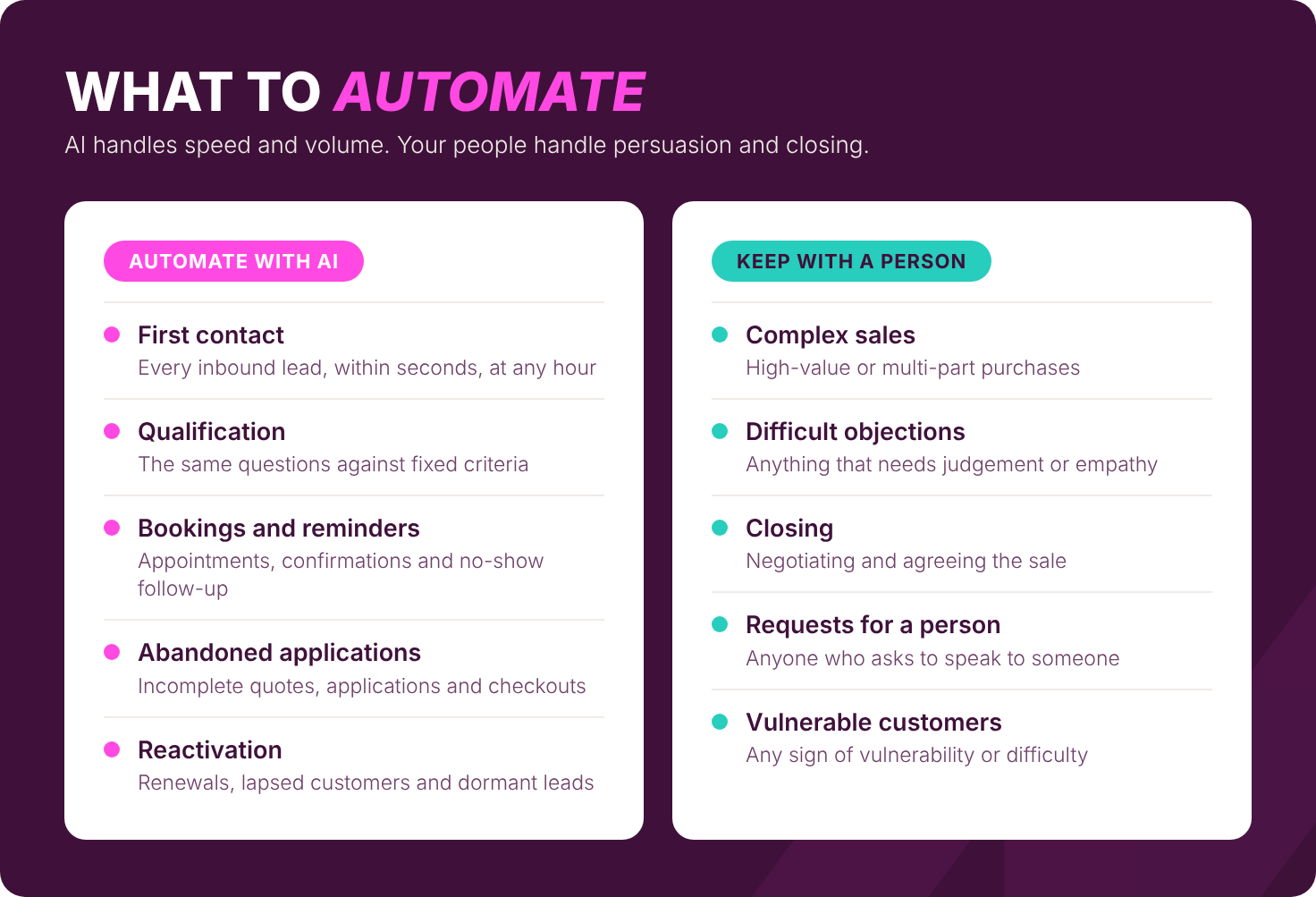
There is evidence for drawing the line here. A study by researchers at Yale and NBER found AI callers were substantially less effective than human callers at persuading people to take a costly action, in that case repaying a debt. AI is strong at speed, consistency and availability. Persuasion is still a human strength, so let AI get the right prospects to your people faster.
UK rules for AI sales calls
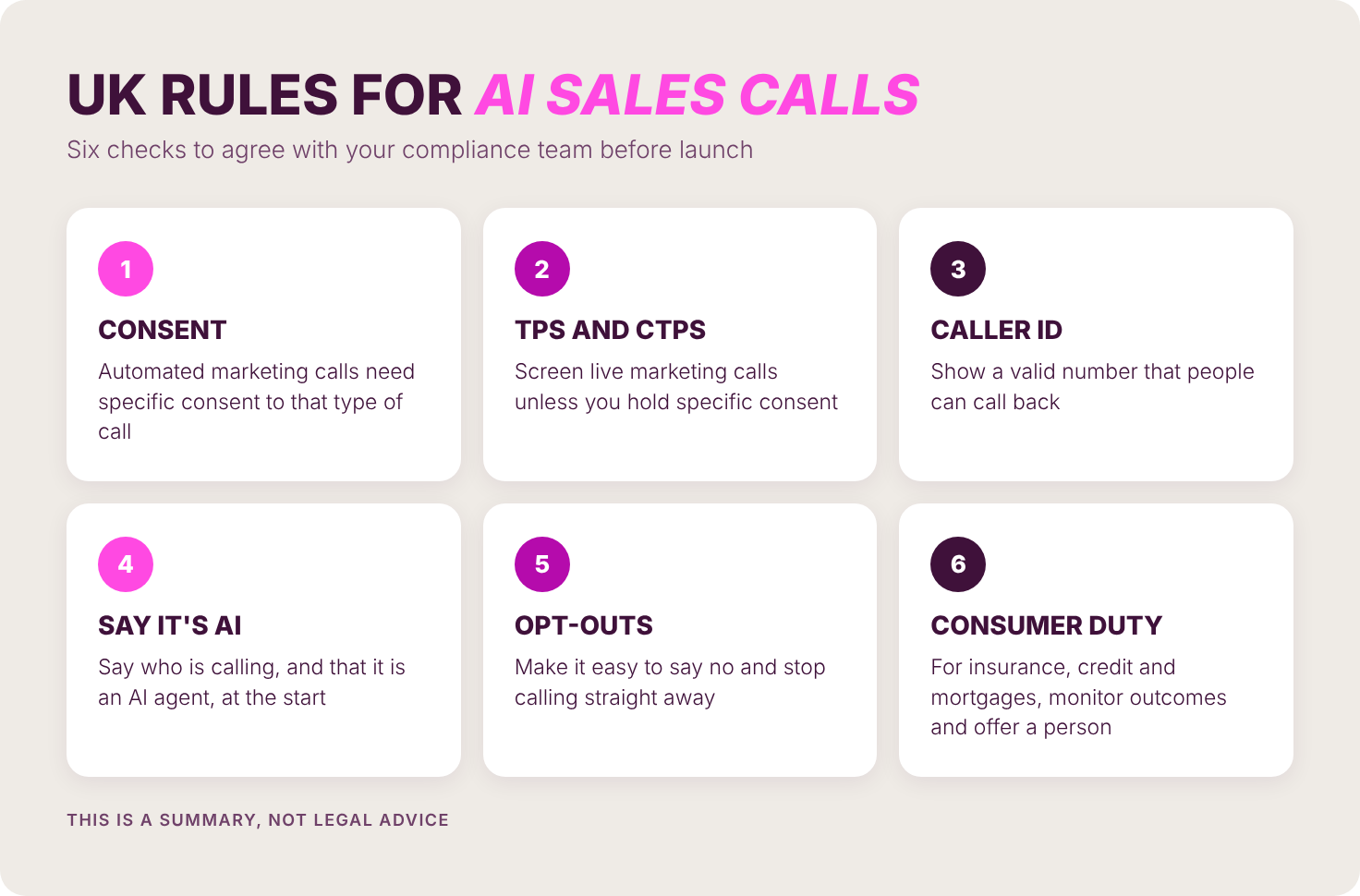
AI does not change the rules on sales calls, but it can repeat a mistake thousands of times in an hour. Agree your approach with your compliance team before you launch. The main areas are these:
- Consent for automated calls. Under the Privacy and Electronic Communications Regulations (PECR), automated marketing calls need the person's specific consent to that type of call. General marketing consent, or consent to live calls, is not enough. Check with your compliance and legal advisers how your AI agent's calls are classed. For unsolicited sales calls, the safest approach is to treat them as automated calls and only call people who have specifically agreed to them.
- Calls people asked for. When someone has asked you to call them about their quote or application, record that request and keep the call to what they asked about.
- TPS and CTPS screening. Screen live marketing calls against the Telephone Preference Service and Corporate Telephone Preference Service, unless you hold specific consent.
- Valid caller ID. Show a valid number that people can call back. See our guide to CLI compliance.
- Tell people it's AI. Say who is calling and that it is an AI agent at the start of the call. In MaxContact's Voice of the UK Consumer 2026 research, 88% of consumers said being told they are talking to AI matters to them.
- Opt-outs. Make it easy to say no, stop calling anyone who opts out, and update your records straight away.
- Regulated products. If you sell insurance, credit or mortgages, the FCA's Consumer Duty applies to AI conversations as well as human ones. Monitor outcomes and give vulnerable customers a route to a person.
For more detail, read our guide to Ofcom and PECR regulations.
How to set qualification criteria for an AI agent
1. Define a sales-ready lead
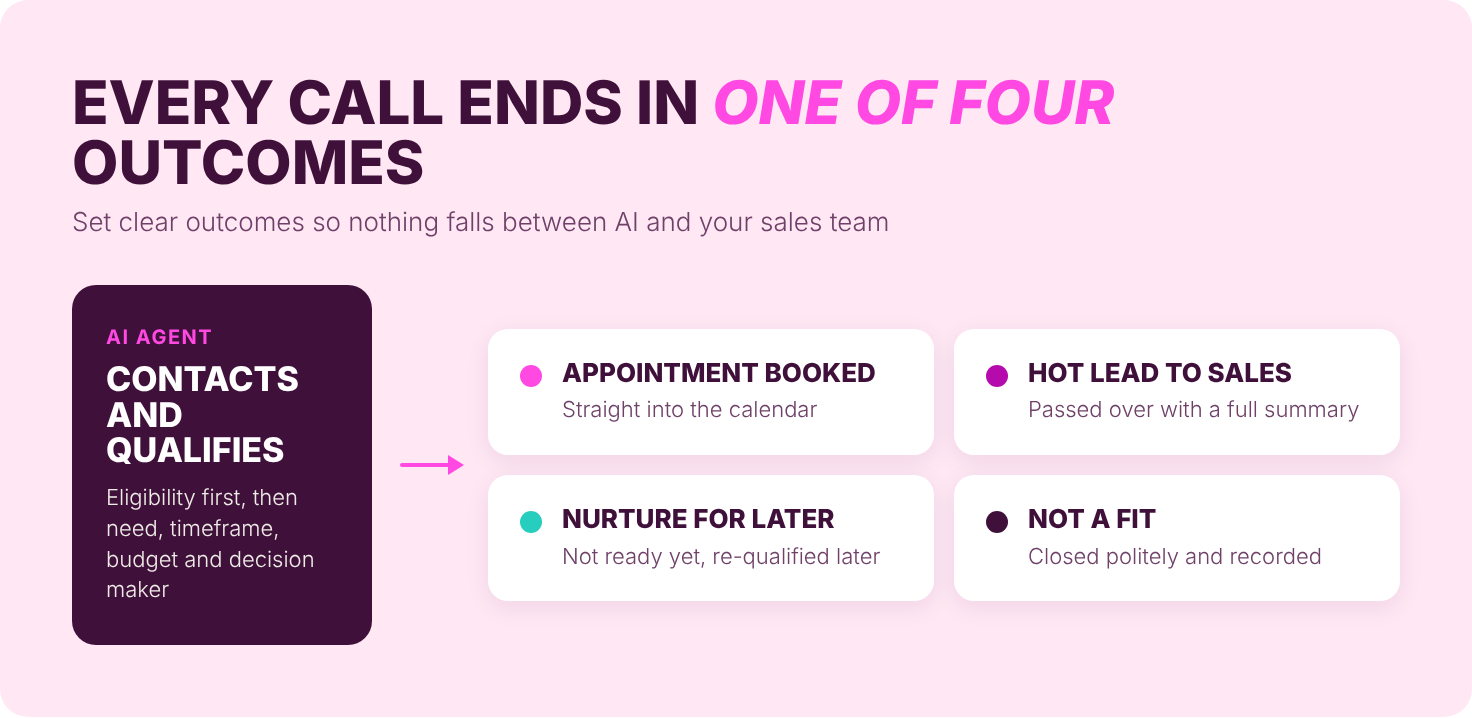
Agree with your sales team what has to be true before a lead is passed over. For example: a clear need, a timeframe, eligibility, a budget range and the person who makes the decision.
2. Put eligibility questions first
Keep the questions short and in a set order, with eligibility first, so unsuitable leads are identified quickly and politely.
3. Set clear outcomes
Every conversation should end in one of four outcomes: appointment booked, hot lead passed to sales, nurture for later, or not a fit.
4. Define the handover
When the AI passes a lead to a person, the handover should include what the customer said, what was agreed and the suggested next step, so your agent doesn't start from scratch.
5. Review calls every week
Check a sample of conversations, especially those that didn't qualify, and refine the questions and wording.
Connecting AI to your sales systems
An AI sales agent is only useful if its outcomes land where your team works. MaxContact's AI Sales & Lead Agent connects to CRMs including Salesforce, HubSpot and Zoho, to marketing automation tools including Marketo and Pardot, and to calendar systems, through APIs and pre-built connectors. Qualified leads, call summaries and bookings go straight into the records your team already uses.
How to measure results
- Speed to lead: time from enquiry to first contact.
- Contact rate and qualification rate: the share of leads reached, and the share of those that qualify.
- Booking and show rate: appointments booked, and how many go ahead.
- Conversion: how AI-qualified leads convert compared with your other lead sources.
- Cost per qualified lead.
- Compliance: opt-out handling, complaints and call audits.
Run a controlled pilot against a comparable lead source before you scale. You can estimate the potential impact with our AI Agents ROI calculator.
Frequently asked questions
What is an AI sales agent?
An AI sales agent is software that holds spoken conversations with leads, qualifies them against your criteria, books appointments and hands sales-ready prospects to your team.
Can an AI agent qualify leads and book appointments?
Yes. MaxContact's AI Sales & Lead Agent contacts leads, confirms their requirements and books appointments, or passes hot prospects to your sales team.
Is it legal to use AI for sales calls in the UK?
Yes, if you follow PECR and the rules that apply to your sector. Automated marketing calls need specific consent, live calls must be screened against the TPS, and callers must be identified. Agree your approach with your compliance team before launch.
Will customers know they are speaking to AI?
They should. Tell them at the start of the call and give them an easy way to reach a person.
Can it re-engage old leads and lapsed customers?
Yes, with the right consent. It can contact dormant leads and lapsed customers with renewal reminders, new offers and updated pricing, and re-qualify their interest.
Does an AI sales agent replace salespeople?
No. It handles first contact, qualification and booking, so your team spends its time on sales-ready customers and closing.
Which systems does it connect to?
CRMs including Salesforce, HubSpot and Zoho, marketing automation tools including Marketo and Pardot, and calendar systems.
See the AI Sales & Lead Agent in action
Find out how MaxContact's AI Sales & Lead Agent contacts and qualifies every lead, or book a demo.
AI Debt Collection How AI Voice Agents Work, What Is Compliant and What to Expect
AI voice agents can take on the routine, high-volume contact in collections while your people handle the complex and sensitive cases. Learn where to use AI, what UK compliance requires and how to measure results.
AI debt collection uses AI voice agents to handle the routine, high-volume conversations in a collections operation: first contact, payment reminders, payment arrangements and out-of-hours payments. Human agents keep the complex, sensitive and high-value cases. Used this way, AI lets you reach more customers without removing the human contact that regulated collections depend on.
This guide covers what an AI voice agent does in collections, where to use AI and where to use people, what UK compliance requires and how to measure results.
What an AI voice agent does in collections
An AI collections agent holds a spoken conversation with the customer, understands what they say and takes the next step in your systems. MaxContact's AI Collections Agent covers four main scenarios:
- First contact and account tracing. It makes the first call, confirms it is speaking to the right person, verifies account details and opens a payment conversation in line with treating customers fairly.
- Payment reminders. It calls with a reminder, explains the payment options, can send an SMS payment link and schedules follow-up based on the customer's response and history.
- 24/7 payments. It takes payments outside business hours, sets up payment arrangements and direct debits, and confirms payment straight away, with PCI-compliant payment handling.
- Handover to a person. It passes the call to a human agent when the situation needs judgement or empathy, with the full conversation history, so the customer does not have to repeat themselves.
Where to use AI and where to use people
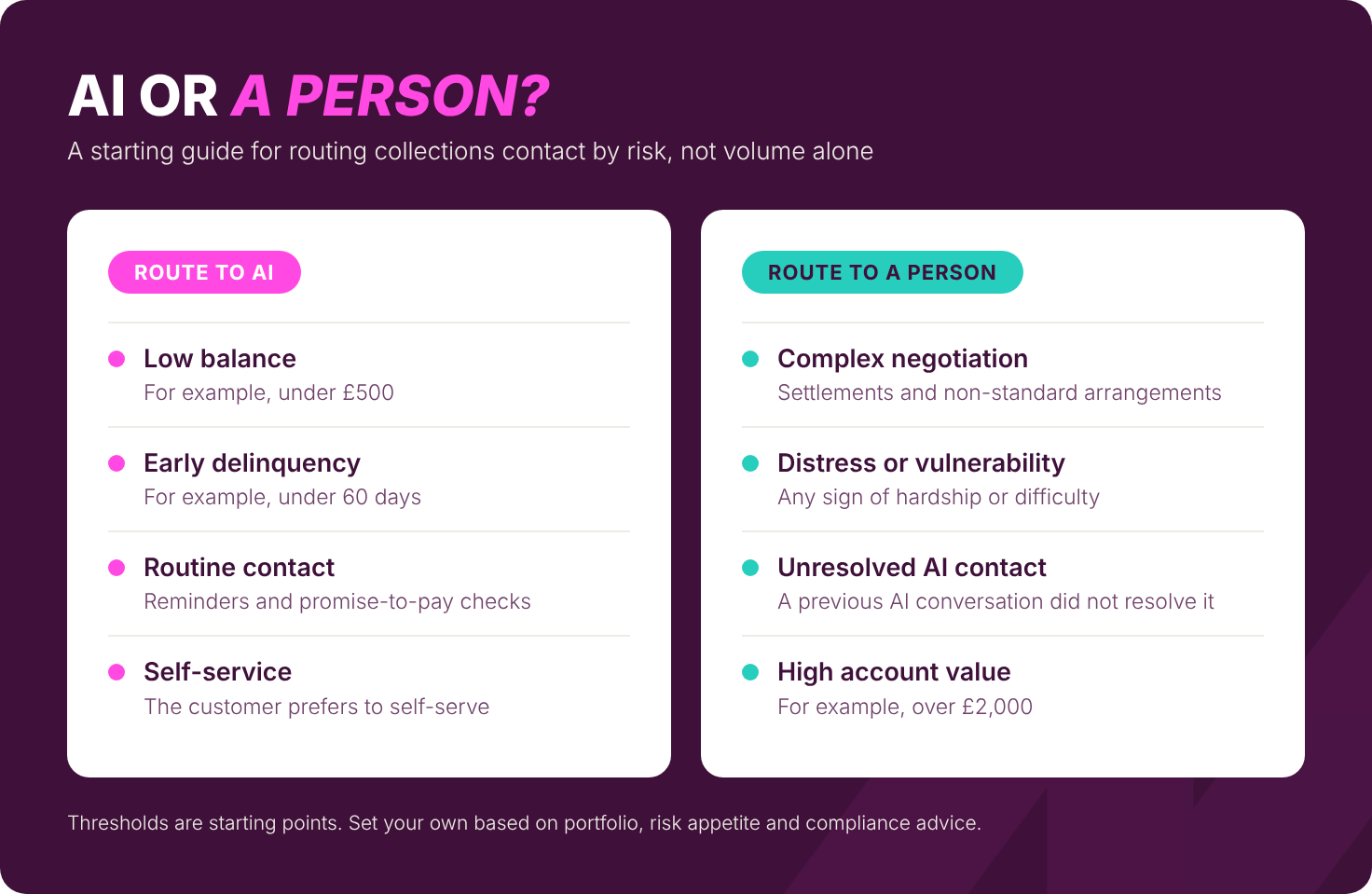
The strongest deployments split the work by risk, not by volume alone. Use this as a starting guide for routing:
| Route to AI when: | Route to a person when: |
|---|---|
|
|
These thresholds are starting points. Set your own based on your portfolio, risk appetite and compliance advice.
A phased approach to deployment
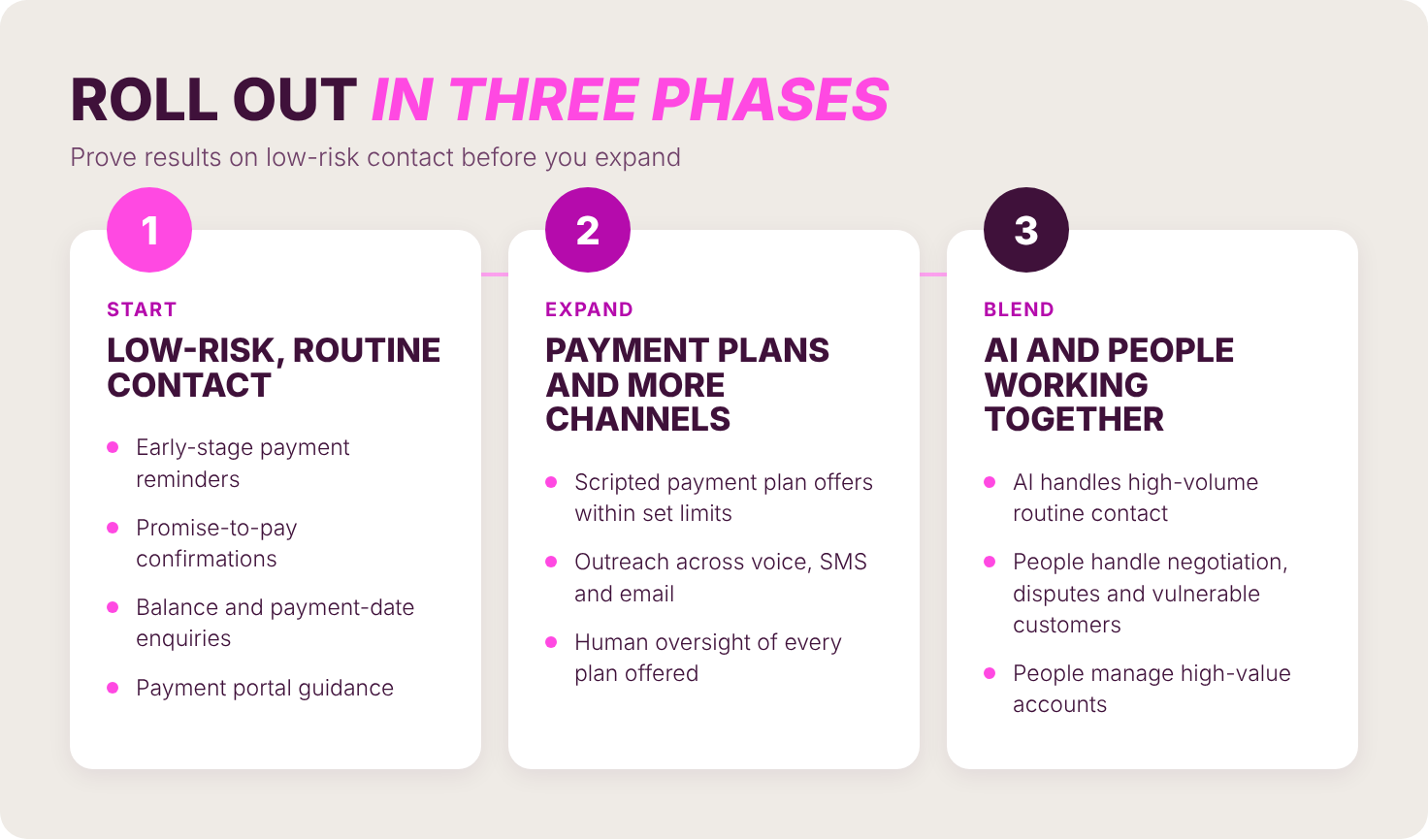
1. Start with low-risk, routine contact
Begin with early-stage payment reminders, promise-to-pay confirmations, simple balance and payment-date enquiries, and guidance on using your payment portal. These conversations pass on information rather than persuade, so a weak call is unlikely to damage your chances of collecting.
2. Expand into payment plans and more channels
Once the first phase has proved its results, add scripted payment plan offers within set limits, and coordinate outreach across voice, SMS and email. Keep human oversight of every payment plan the AI offers.
3. Move to a blended model
AI handles the high-volume, routine contact. Your people focus on complex negotiation, vulnerable customers, disputes and high-value accounts.
For the full deployment guide, read our playbook for deploying AI voice agents in debt collection.
What UK compliance requires
AI does not change your obligations under the FCA's Consumer Credit sourcebook (CONC 7) or the Consumer Duty. It means you need to evidence them for automated conversations as well as human ones.
- Consumer Duty and fair outcomes. Monitor outcomes for customers, not only operational efficiency, and check regularly that the AI treats all customer groups fairly.
- Vulnerability. The agent needs a reliable route to a person when it detects distress or signs of financial difficulty.
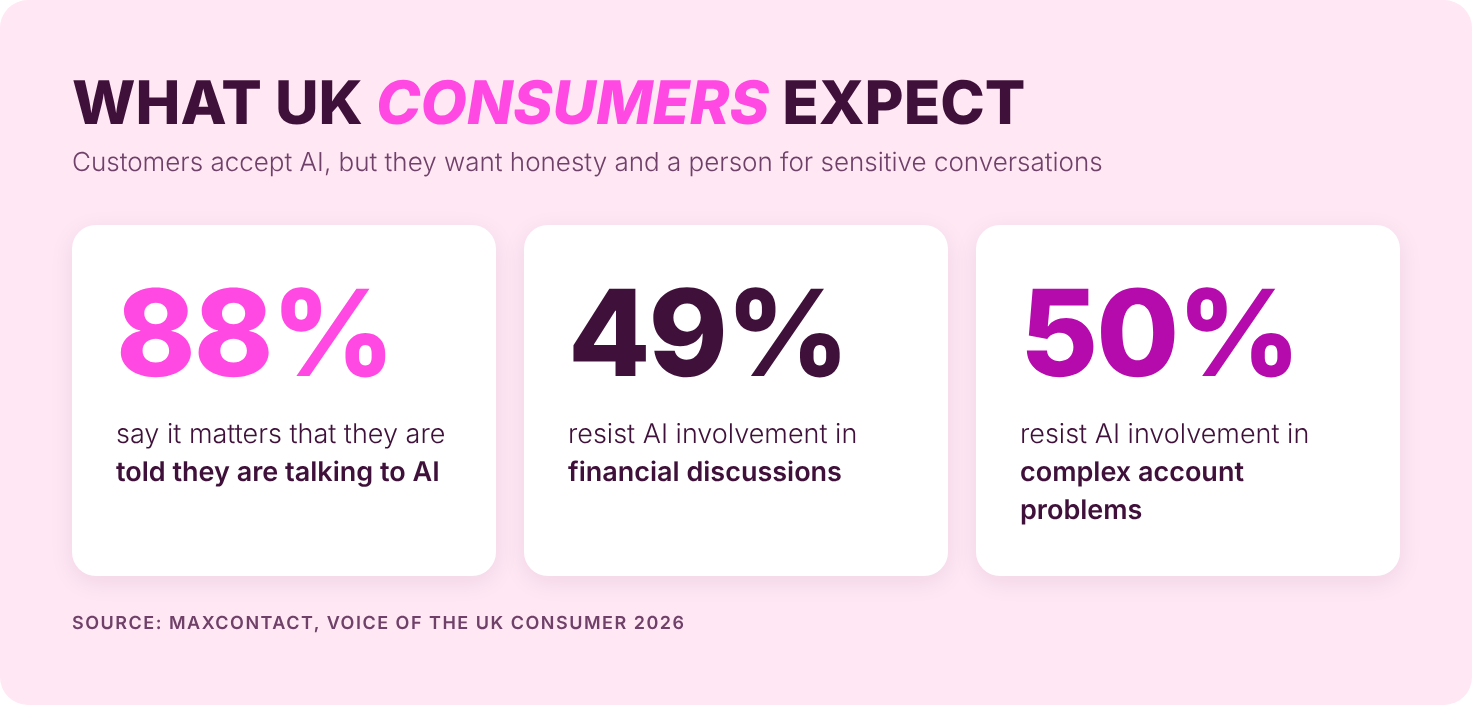
- Transparency. Tell customers at the start of the conversation that they are speaking to AI. In MaxContact's Voice of the UK Consumer 2026 research, 88% of consumers said being told they are talking to AI matters to them.
- Data protection. Establish a lawful basis for processing personal data, and support access and erasure requests.
- Payments. Take card details through PCI DSS-compliant processing so that card data does not reach agents.
- Audit trail. Keep call recordings and records of each conversation, so you can show how decisions were made if the FCA or a customer asks.
Customers also want a person available for sensitive situations. The same research found that 49% of consumers resist AI involvement in financial discussions, and 50% resist it for complex account problems. That is why the handover to a person is built into the design from the start.
What results to expect
Published figures vary widely and depend on the portfolio, the use case and how the agent is deployed, so treat headline numbers with care.
- Cost and recoveries. McKinsey reports that organisations using advanced generative AI in customer assistance and collections can reduce operating costs by up to 40% and improve recoveries by about 10%.
- The persuasion gap. A study by researchers at Yale and NBER found AI callers were substantially less effective than human callers at getting borrowers to repay. Switching to human callers six days into delinquency closed much of the gap, but borrowers first contacted by AI still repaid less a year later.
This is why routine contact comes first, why persuasive conversations stay with people, and why you should measure whether promises are kept, not only how many are made.
How to measure success
- Efficiency: cost per contact, cost per successful resolution and agent productivity.
- Effectiveness: promise-to-pay rate, promise fulfilment rate and long-term recovery rate.
- Quality and compliance: whether escalations happen at the right time, complaint rates, audit trail completeness and breaches found.
- Testing: run a controlled pilot with a large enough sample to be meaningful, and track repayment behaviour over 6 to 12 months before scaling.
You can model the potential impact on your operation with our AI Agents ROI calculator.
Frequently asked questions
What is AI debt collection?
AI debt collection uses AI voice agents and digital channels to carry out routine collections conversations, such as first contact, reminders and payment arrangements, and hands complex cases to human agents.
Can an AI voice agent take payments?
Yes. MaxContact's AI Collections Agent can take payments, set up payment arrangements and direct debits, and send SMS payment links, with PCI-compliant payment handling.
Is AI debt collection compliant in the UK?
It can be, if it is designed around the Consumer Duty, CONC 7, vulnerability handling, transparency, data protection and a full audit trail. Compliance remains the firm's responsibility, so involve your Risk and Compliance teams before launch.
Does the AI tell customers it is not a person?
It should. Customers should be told at the start of the conversation that they are speaking to AI.
What happens when a customer is vulnerable or distressed?
The AI agent hands the call to a human agent and passes on the full conversation history.
Will AI replace collections agents?
No. AI takes the repetitive, high-volume contact. People handle complex negotiation, vulnerable customers, disputes and high-value accounts.
Which accounts should I start with?
Start with early-stage delinquency, low balances and routine reminders, then expand as results are proven.
See the AI Collections Agent in action
Find out how MaxContact's AI Collections Agent handles routine collections contact and hands sensitive cases to your team, or book a demo.

13 Things a QA Scorecard Can Tell You Beyond Pass/Fail
Scorecards do more than compliance QA. Here are 13 ways to use one, from predicting churn to meeting FCA Consumer Duty to building your AI automation roadmap, plus how to set each one up in MaxContact.
Scorecards do more than quality assurance. The same mechanic, built as a rating, pass/fail, or observation question, can predict customer outcomes, meet UK regulatory requirements like FCA Consumer Duty, surface commercial opportunities, and build a data-backed case for where to introduce AI agents. This guide covers 13 ways to use one, plus how to build each use case in MaxContact.
In This Article
- How Scorecards Work
- Predicting Customer Outcomes
- Compliance and Regulatory Risk
- Commercial and Sales Performance
- Operational and Product Insights
- Getting Started
- FAQs
For years, the case for automated QA rested on one number: most contact centres only review 2-5% of their calls. That's no longer the gap. According to MaxContact's 2026 UK Conduct Risk Report, 46.7% of regulated contact centres now use AI to review every call, nearly matching the 49.5% still sampling manually. Coverage, in other words, is largely solved.
What isn't solved is what happens next. The same research found that 54% of contact centres had a compliance breach or harm issue surface outside their routine QA process, and 16.5% found more than one. Reviewing every call tells you what happened. It doesn't tell you what's about to happen. It won't flag who's about to churn, which calls should never have happened at all, or which agent needs help before their next review cycle.
That's the real opportunity in a scorecard. Not just scoring compliance after the fact, but turning every call into a signal you can act on, for coaching, for commercial performance, and for risk. Here are 13 ways to do it.
How Scorecards Work
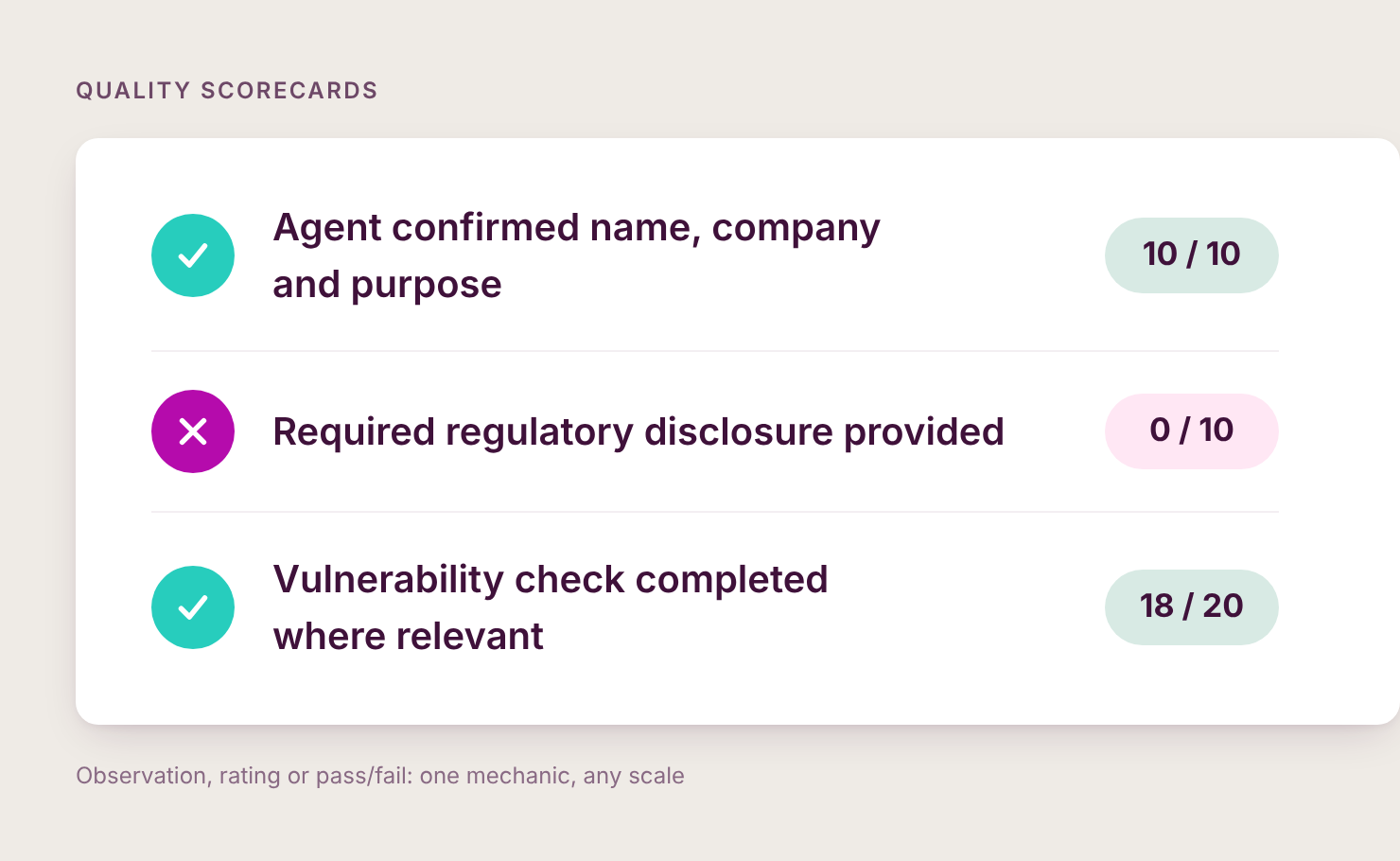
Before diving into the use cases, a quick note on mechanics. It's what makes all of this possible in MaxContact Conversation Analytics, rather than needing a different tool for every job.
A MaxContact scorecard question can be built as an observation (a few lines of AI commentary on what it found), a rating (a score on any scale you choose, such as 1 to 5, or a simple true/false), or a pass/fail. The same underlying mechanic, "based on this transcript, did X happen?", powers everything from a compliance check to a churn prediction.
Scorecards can also run two ways. An always-on schedule scores every new call as it lands, continuously. A one-time schedule runs against a historical sample instead, useful for testing a new use case against last quarter's calls before switching it on for good.
Results then roll up into question-level reporting, so you're not digging through individual calls to see which questions are failing, where, and for whom.
Predicting Customer Outcomes
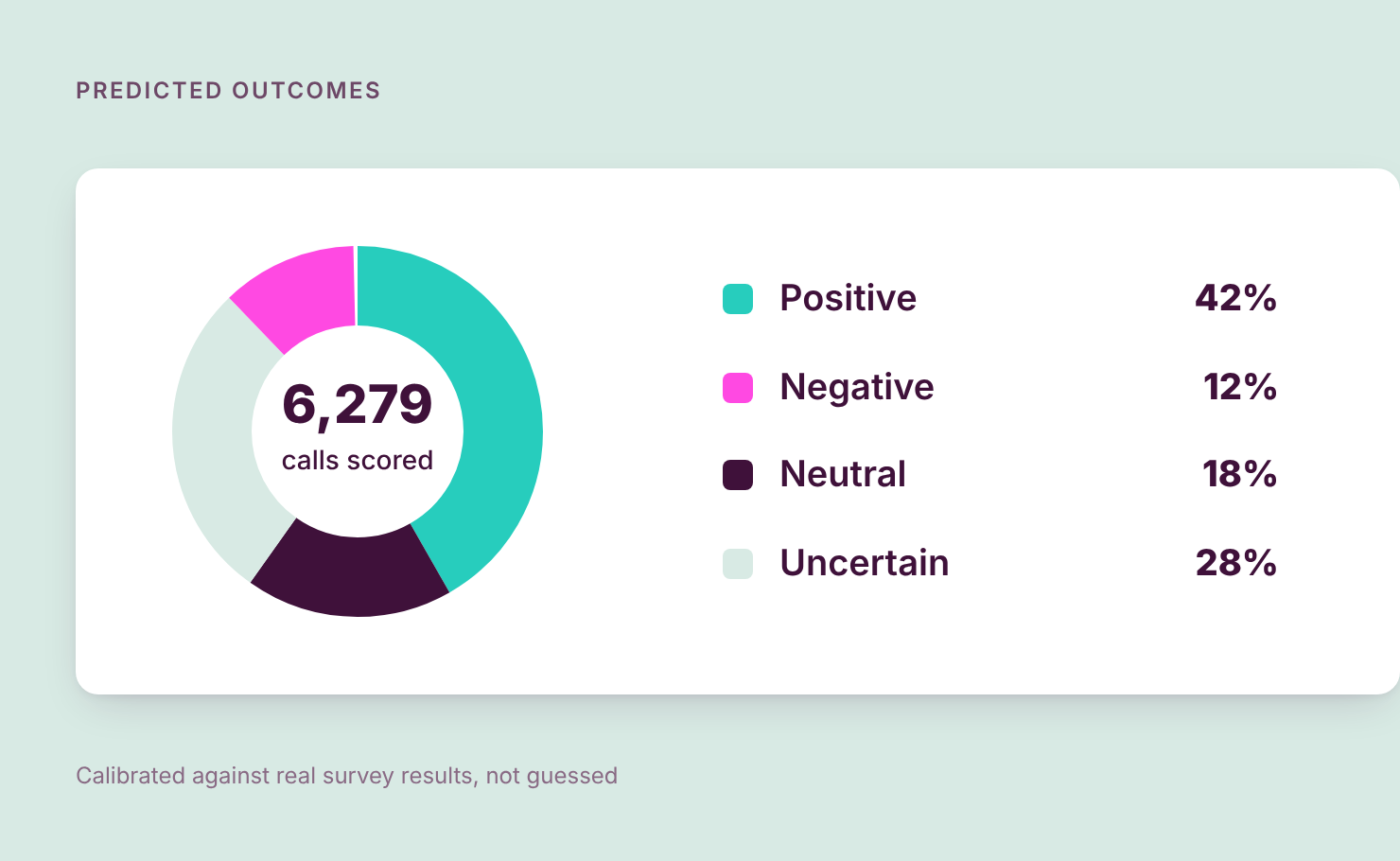
Predicted CSAT and NPS
A scorecard question can ask, in plain terms: based on this transcript, what would this customer's CSAT score likely be? Because it runs on every call, you get a sentiment read on 100% of conversations, not the 5% or so that respond to a post-call survey.
The catch: this is only credible once you calibrate it against your real survey results. Run the question alongside your existing survey data, check how closely the predictions track the real scores, and adjust until they're reliably close. Skip that step and all you've got is a sentiment score, not predicted CSAT. You have a sentiment score wearing a more exciting name. Once calibrated, the same logic extends to NPS.
Repeat Contact and FCR Likelihood
Was the issue actually resolved on this call, or is the customer about to ring back? A scorecard can score first-contact-resolution (FCR) likelihood directly from the transcript. Did the agent confirm the issue was fixed, or leave it open, vague, or dependent on another team?
This is arguably more actionable than CSAT, because failure demand has a direct, calculable cost. At roughly £5 per service call, every repeat contact doubles the cost of that interaction. That's before you've factored in agent time or the churn risk a frustrated second call brings with it.
Promise-to-Pay Likelihood
For collections teams, a scorecard can rate how firm a payment commitment was. Not just whether a promise to pay was logged, but whether the language was definite ("I'll pay Friday") or hedged ("I'll try to sort something"). The question can be scoped so it only applies when an arrangement-to-pay or promise-to-pay outcome has been set, rather than running on every call.
Because the strength of that commitment is directly tied to revenue collected, this gives collections leaders a leading indicator: a queue of weak promises worth a follow-up call, before the due date passes and it becomes a broken promise instead.
Customer Churn Intent
A scorecard question can rate whether a call shows real churn risk: cancellation language, competitor mentions, or complaints that keep repeating across contacts. Score it as a simple true/false, or as a numeric risk rating to see customers nudging from low to high risk before they act on it.
Either way, the output is the same: a retention queue built from what customers are saying, not from account age or a generic risk model.
Compliance and Regulatory Risk
Vulnerability Detection
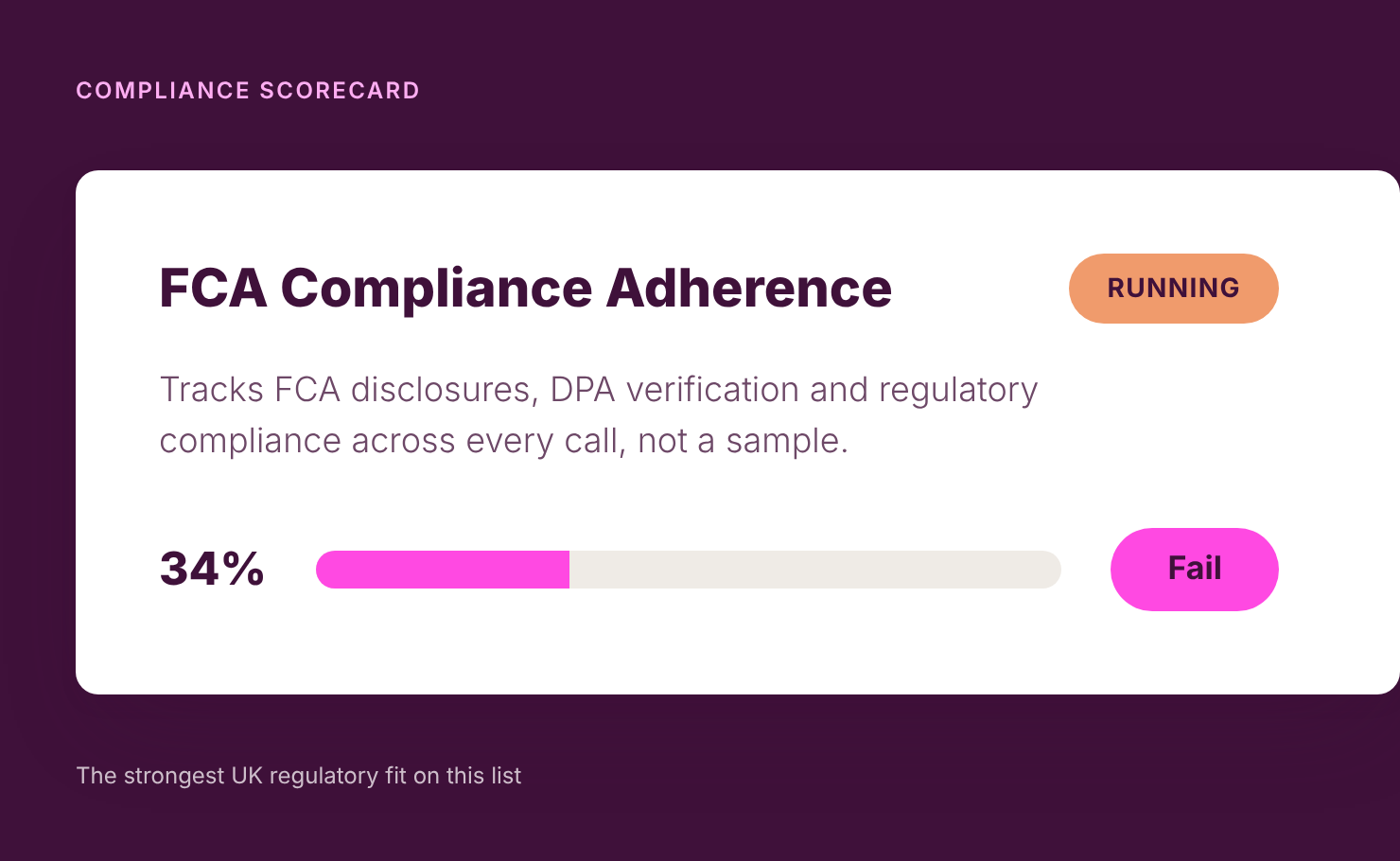
Under FCA (Financial Conduct Authority) Consumer Duty, firms have to identify and respond appropriately to vulnerable customers, and increasingly, prove they did. The FCA's own framework names four drivers of vulnerability: health, life events, resilience, and capability. A scorecard question can be built to listen for the language that signals each of these. It scores whether the agent picked up on it, and flags whether they fully acknowledged it, only partially addressed it, or missed it entirely.
This is the strongest UK regulatory fit on this list, for a simple reason: firms already know they struggle with it. Last year, the FCA reviewed 180 board reports and found the most common failure wasn't a lack of effort. It was an inability to evidence outcomes for vulnerable customers specifically. A scorecard that runs on every call, not a sample, is a direct answer to that evidence gap.
Complaint Detection
Under FCA rules, an expression of dissatisfaction counts as a complaint whether or not the customer ever uses the word "complaint." A scorecard can be built to catch that distinction, flagging calls where a customer expressed real dissatisfaction, even phrased as a passing comment, so they get logged and handled as complaints rather than closed out as routine queries.
This is a clear compliance win with a direct cost attached. MaxContact's 2026 UK Conduct Risk Report found the average regulatory fine paid by UK contact centres in the past 12 months was £81,000, across everyone surveyed, including businesses that paid nothing at all. Nearly a third paid £50,000 or more. Since February 2026, the stakes have risen further still. The Data Use and Access Act raised the maximum PECR (Privacy and Electronic Communications Regulations) fine from £500,000 to £17.5 million or 4% of global turnover, whichever is higher. For the first time, company directors can also be held personally liable, for up to £500,000 individually.
Fraud and Social Engineering Signals
A scorecard can be trained to listen for the patterns that indicate fraud risk on a call: pressure tactics, inconsistent answers to identity questions, or signs that a third party is coaching the caller in the background. Scored consistently across every call, a pattern that's easy to miss in a single conversation becomes visible at scale, and auditable after the fact.
Fines aren't the only cost at stake here either. The same research found non-compliant sales cost UK contact centres an average of £22,000 in lost revenue over the past year through refunds and cancellations. Just over half of respondents (50.2%) said they'd lost a sale, a contract, or a customer entirely over a compliance issue.
Commercial and Sales Performance
Missed Sales Opportunities
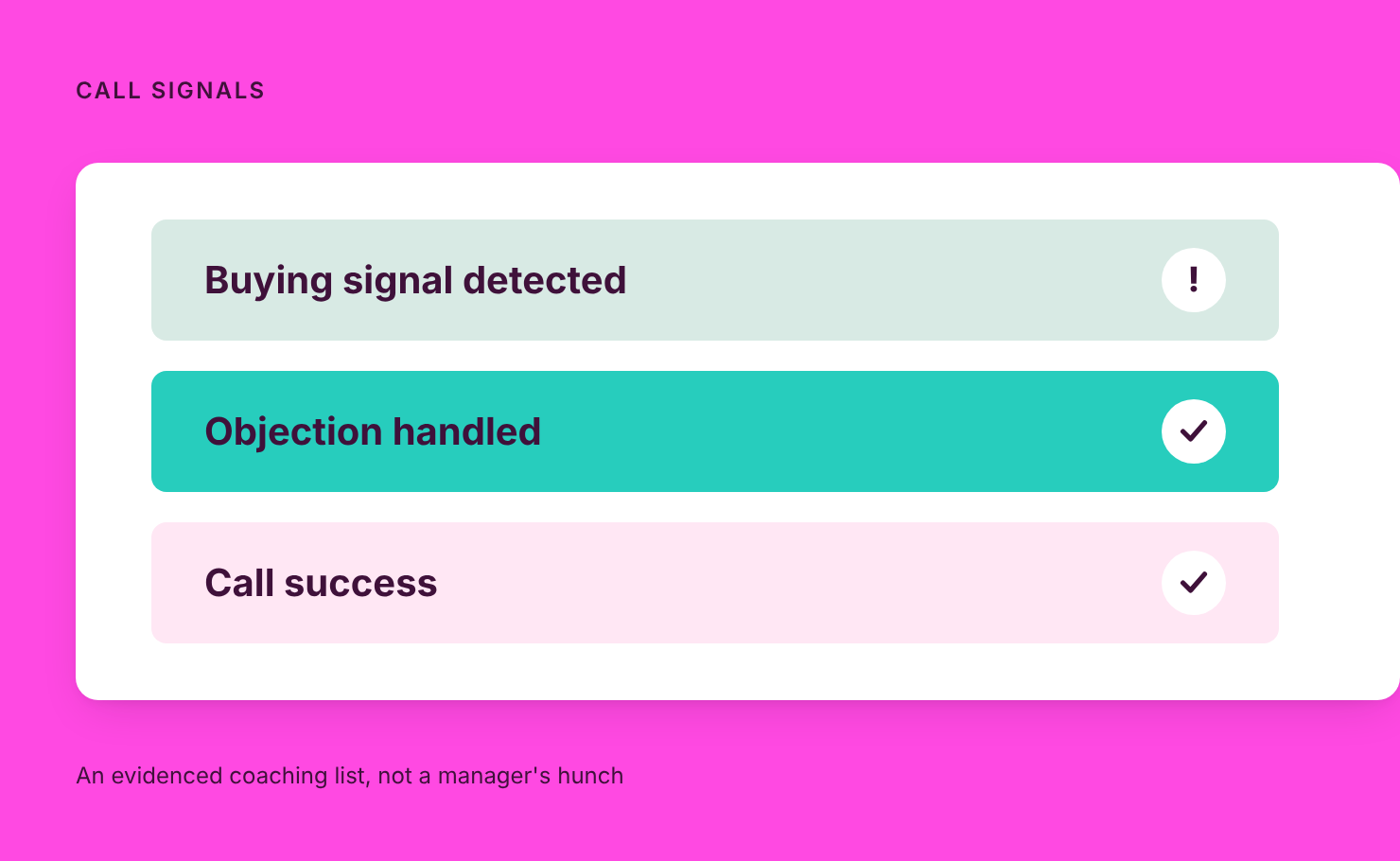
A scorecard question can flag buying signals an agent didn't act on: a customer who asked about an upgrade, mentioned a competitor's offer, or hinted at a bigger need the agent never followed up on. Run across every call, this builds a clear, evidenced coaching list, rather than a manager's hunch about who's leaving revenue on the table.
Sales Methodology Scorecards
A scorecard can also check whether an agent followed a specific sales methodology, not just whether they spotted an opportunity. A BANT scorecard, for example, scores a call against the four areas the framework is built on: Budget, Authority, Need, and Timeline. Each becomes its own rating question, usually scored on a 0-5 scale in this example (ratings can run on any range you choose), with a minimum score needed to pass (3 out of 5 was the bar in the original demo), plus an observation question at the end to pull the whole picture together.
The same approach works for any other sales methodology your teams are trained on, including FAB, AIDA, or SPIN. Because every call gets measured against the same criteria, you get a consistent read on how closely the team is actually following the methodology, not just whether revenue came in.
Script and Campaign Effectiveness
Because scorecards score consistently and at scale, they're a ready-made engine for A/B testing. Run the same scorecard against calls using different script versions or campaign approaches, and compare outcomes directly: which version holds objections better, which closes faster, which gets flagged for compliance issues less often. The scorecard becomes the measurement layer for commercial experiments you're already running, instead of a side project in a spreadsheet.
Operational and Product Insights
Automation Candidacy
This is where a scorecard stops being purely a QA tool and starts building your automation roadmap. Start with one scorecard and one pass/fail question: is this call type a good candidate for automation? Pair it with an observation question asking what, specifically, makes it one. Run it across your calls and your candidates start to emerge: complaints, vulnerability checks, simple status updates, whatever they are for your business.
From there, write a dedicated scorecard with one question per candidate type, each scored pass/fail. Run that as a one-time scorecard against a historical sample, and you get a hit rate per candidate: this type of call could have been automated 87% of the time, that one only 20%. That gives you a data-backed, evidenced pipeline for deciding what to automate first, not a guess about where AI Agents could help, but a ranked list built from your own call data.
Contact Reason and Failure Demand
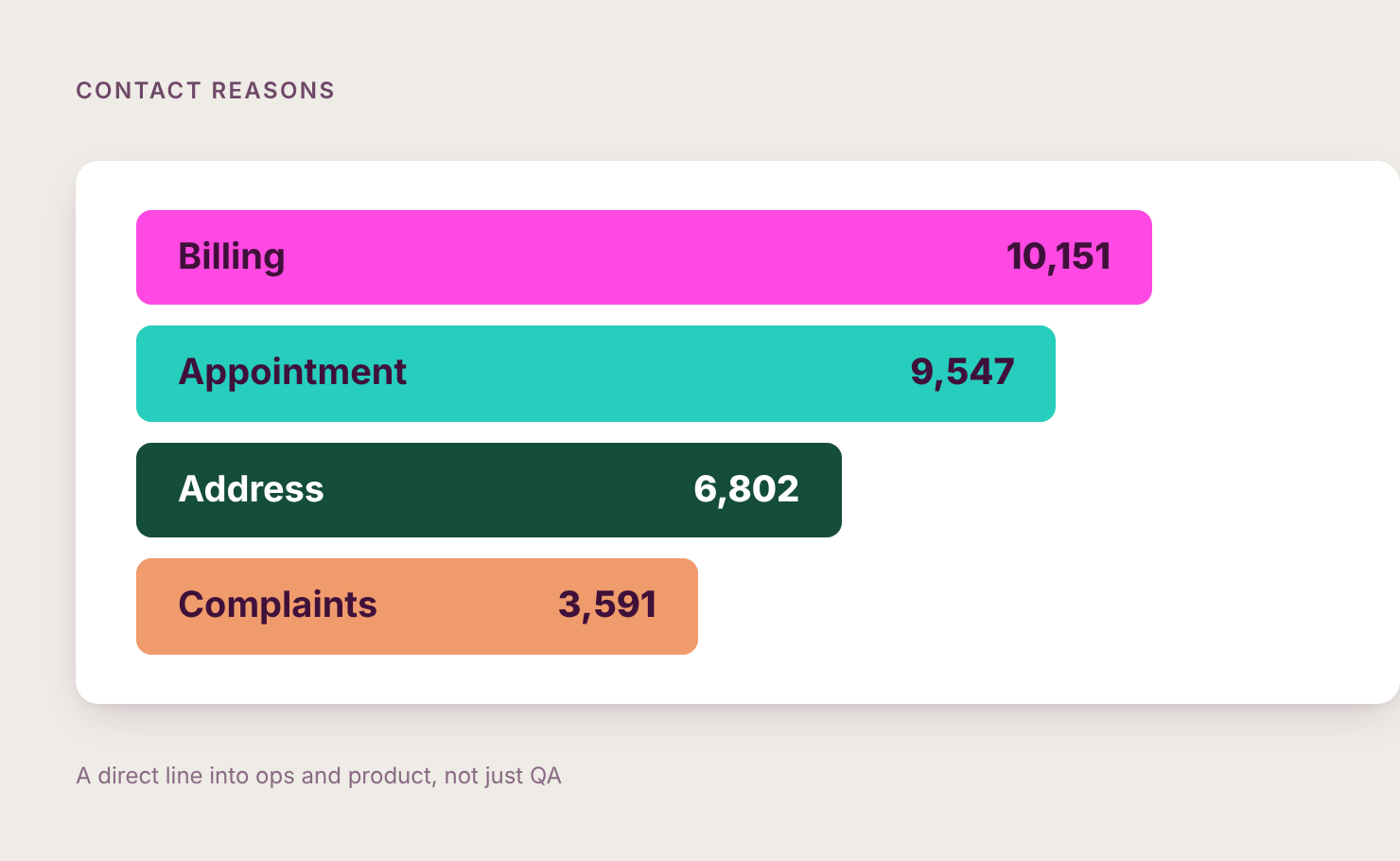
A scorecard can categorise why a customer called, and more usefully, flag which of those calls shouldn't have needed to happen at all. A customer chasing an order update because a text alert never arrived is failure demand: a problem created somewhere else in the business that lands on your contact centre's call volume. This is valuable well beyond QA. It's a direct line into your ops and product teams about where the underlying process is broken.
Knowledge Gaps
Agent uncertainty, excessive holds, and unnecessary transfers are all symptoms a scorecard can detect and score consistently. Rather than treating this as an individual performance issue, use it to point at the knowledge-base articles or training modules that need fixing. The same hesitation showing up across multiple agents on the same topic is a knowledge gap, not a coaching gap.
Getting Started
Here's how to turn any of these into a live scorecard in MaxContact.
1. Start with one use case, not all 13. Pick the one with the clearest payoff for your team right now. Vulnerability detection if Consumer Duty evidence is your biggest exposure, churn intent if retention is the priority.
2. Write or import the scorecard. Describe the question in plain English and let the scorecard builder turn it into evaluation criteria, or import an existing scorecard if a similar methodology already exists elsewhere in the business.
3. Choose your question type. Decide whether the use case needs an observation (a few lines of commentary), a rating (true/false, or any numeric scale, such as 1 - 5), or a straight pass/fail.
4. Scope it, if it needs scoping. Some questions only make sense in context. A promise-to-pay question, for example, should only fire when an arrangement-to-pay outcome has actually been logged on that call. Scorecards can be scoped to specific products, outcomes, or campaign types so you're not scoring irrelevant calls.
5. Test it against a historical sample first. Run it as a one-time scorecard against last month's or last quarter's calls before switching it on live. This matters most for anything predicting an outcome: CSAT, churn, automation candidacy. Check the results against what you already know before trusting it at scale.
6. Switch to an always-on schedule. Once you're confident in the results, move the scorecard to an always-on schedule so it scores every new call automatically, with no manual sampling involved.
7. Review through question-level reporting. Don't just watch an aggregate score. Use question-level reporting to see which specific questions are failing, for which agents, teams, or call types, so the next action is obvious rather than buried in an overall pass rate.
FAQs
Does this replace manual QA entirely? Not necessarily. Many regulated contact centres run scorecards alongside manual spot-checks, especially while a use case is new or being calibrated against real outcomes. What it replaces is reliance on a 2-5% sample as your only evidence base.
How accurate is predicted CSAT? It depends entirely on calibration. Run it alongside real survey data first, check how closely the predictions track actual scores, and adjust the scorecard question until they align. An uncalibrated predicted CSAT score is just a sentiment score with a different name.
Can I run a scorecard on calls that already happened? Yes. One-time scorecards can run against a historical sample, which is useful for testing a new use case or auditing a past period, rather than only scoring calls as they come in.
Do I need a different tool for each use case? No. Every use case on this list runs on the same scorecard mechanic: observation, rating, or pass/fail questions, inside Conversation Analytics. What changes is the question you ask, not the platform.
Does automation candidacy mean an AI agent takes over immediately? No. It identifies and ranks which call types are good candidates for automation based on real call data, giving you an evidenced starting point for deciding where to introduce AI Agents, rather than a guess.