.png)
We surveyed 1,000 UK adults who had interacted with a contact centre in the last 18 months. The findings reveal something that goes beyond wait times, channel preferences, and AI adoption. This year, the biggest barrier to customer contact isn't the interaction itself - it's getting consumers to engage in the first place.
The Numbers Don't Lie: Trust Is Now an Operational Problem
Before we get to what consumers want, we have to address what's getting in the way. Our research reveals a structural trust deficit playing out before a single agent picks up the phone.
- 69% of UK consumers always or often screen calls from unknown numbers
- 46% have ignored a message from a legitimate company because they assumed it was a scam
- Only 22% strongly agree they can tell when unexpected company contact is genuine
- 77% of those who ignored a legitimate call experienced a real consequence such as a missed appointment, an unresolved problem, a missed payment deadline
This is the Trust Gap: the growing distance between a company's confidence in its own outbound contact and what consumers actually believe when they see an unknown number. It affects every sector with outbound ambitions and it can't be fixed by dialling more.
Call Avoidance Varies Dramatically by Sector
Not all sectors face the same screening wall. Our data shows stark differences in call avoidance rates, and the gap between best and worst performing sectors is significant.
Loans, credit and debt management companies are the most avoided, with 37% of consumers saying they'd be least likely to answer a call from this sector. Insurance follows at 25%, with telecoms, technology, and retail/e-commerce close behind at 22–23%. Banks and building societies fare better at 16% avoidance, and notably, they also hold the highest sector trust score at 96%.
The lesson? Trust and answer rates move together. Sectors that have invested in consumer trust over time are reaping the operational benefits in their outbound performance. Those that haven't are paying the price at the identification gate.
"This data should make every contact centre leader pause," says Ben Booth, CEO of MaxContact. "Consumers broadly trust the sectors they deal with, but that trust doesn't translate into picking up the phone. If consumers can't tell the difference between a legitimate call and a scam, outbound strategies will struggle to deliver."
What Actually Makes Consumers Pick Up
The good news is that the Trust Gap is closable. When we asked consumers what would make them more likely to answer, two things stood out clearly:
- 82% say they would be more likely to answer if caller ID clearly identified the company name
- 80.5% say a pre-call text or email would make them more likely to pick up
These aren't aspirational preferences - they're operational levers. The problem isn't the dialler. It's the identification gate. Legitimate contact centres aren't losing the persuasion game. They're often not getting on the pitch.
Contact centres should prioritise:
- Branded caller ID and carrier number reputation management - so consumers can recognise your call before they decide whether to answer
- Pre-call communication - give consumers a reason to expect your call, especially in high-avoidance sectors
- Treating contact frequency as a trust variable -too-frequent contact doesn't just frustrate consumers; in regulated sectors, it carries compliance risk
AI Is Here — But Transparency Is Non-Negotiable
UK consumers have been interacting with AI in contact centres for some time. The problem is, many didn't know it.
87% of consumers believe they've interacted with AI or automation in a recent company contact. Of those, 22% were sure or fairly sure they'd been talking to AI — but weren't aware of it at the time. That's more than one in five consumers who discovered, after the fact, that part of their experience was automated.
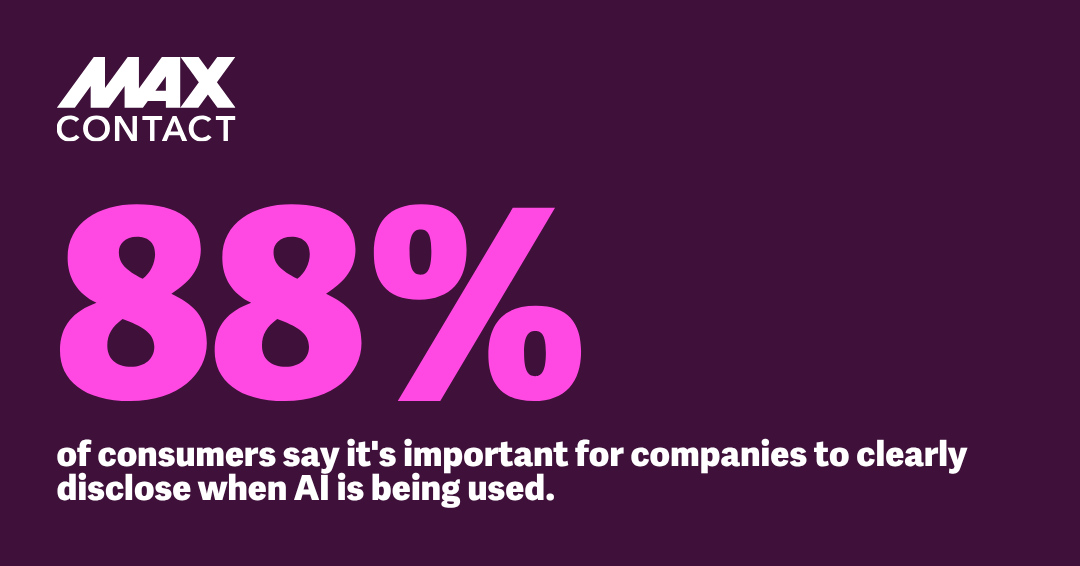
Nearly 9 in 10 (88%) consumers say it's important for companies to clearly disclose when AI is being used. Half say it's very important.
"The reputational risk of undisclosed AI is real and avoidable," says Ben Booth. "Consumers aren't opposed to AI - they're opposed to being kept in the dark about it. Deploying AI without disclosure doesn't just frustrate customers; it reinforces the same uncertainty that's causing them to screen your calls."
AI Adoption: Where It Works and Where It Doesn't
Consumer opinion on AI is nuanced. Where AI genuinely adds value, consumers are broadly willing to accept it:
- Answering FAQs: 36%
- Routing to the right department: 35%
- Account updates and billing information: 26%
But the picture reverses sharply when it comes to high-stakes interactions. Over half (54%) say they don't want AI involved in emergency situations. Significant numbers also object to AI involvement in complex account problems (50%), financial discussions (49%) and when negotiating terms (46%).
Crucially, 71% of consumers say they'd be comfortable with AI helping resolve an issue faster — as long as a human agent was available throughout. The acceptance of AI is conditional on a clear, accessible escalation path.
Humans Still Matter Where It Counts
Despite the growth of AI and automation, consumers are clear about when they need a person:
- Emergency situations - 41% want a human agent
- Complex account queries - 33%
- Financial discussions — 29%
- Explaining a sensitive or personal matter - 26%
- Making a complaint - 23%
These aren't edge cases. An AI that handles a billing query well creates modest goodwill. An AI that mishandles a bereavement disclosure or an emergency can permanently damage a customer relationship.
When things go wrong and complaints happen, consumers care most about: a clear explanation of the outcome (39%), being kept updated throughout (37%), appropriate compensation when the company is at fault (33%), and only having to explain the issue once (31%).
What Builds and Breaks Consumer Trust
Our research shows consistent patterns in what drives contact experience, positively and negatively.
What puts consumers off before they even try:
- Long wait times: 36%
- Being transferred multiple times: 34%
- Difficulty reaching a human: 29%
- Having to repeat themselves: 28%
What good looks like:
- Quick resolution -36%
- Easy access to a human when needed - 35%
- Knowledgeable agents - 34%
- Clear communication throughout - 32%
On channel trust, email remains the most trusted channel for company contact (51%), followed by phone calls (30%) and letters (27%). For outbound communications that don't need an immediate response, email is still the most credible messenger.
Five Focus Areas for Contact Centre Leaders in 2026
Based on our findings, these are the areas that will have the most impact:
- Fix the identification gate: Deploy branded caller ID, carrier number reputation management and pre-call communication. The recoverable opportunity isn't every screened call; it's the willing contacts who are filtering themselves out because they fear scams.
- Make AI disclosure the default: Clearly disclose AI use at the start of every AI-assisted interaction. In regulated sectors, it's a compliance requirement. Everywhere else, the reputational risk is reason enough.
- Protect the human escalation path : Across every question about AI in this study, the most-cited condition for consumer acceptance was the same: a human must be available and clearly signposted. Design the escalation as carefully as you design the AI.
- Treat 'only explain once' as an infrastructure target: CRM integration, context-passing between channels, and warm handoffs are the operational response to the number one complaint driver.
- Audit complaint journeys against what consumers actually need : A clear outcome explanation, ongoing updates, appropriate compensation, not having to repeat themselves, and a human presence. These five things determine whether a resolved complaint becomes a trust-builder or a churn trigger.
Want the full picture? The Voice of the UK Consumer 2026 report includes sector-by-sector breakdowns across utilities, telecoms, finance/debt, and insurance — with data on vulnerability handling, AI comfort, complaint experience, and regulatory risk. Download the full report here.
.png)
