knowledge hub:
resources & insights
Get the knowledge and tools you need to improve contact centre performance, deliver better customer experiences and grow your business.
the latest
downloads

The Assisted Agent Playbook
A practical guide to AI-enabled agent assistance for contact centre leaders. Covers the before, during, and after of every call - with the ROI case, a real-world scenario, and three actions you can take this week.
- 42% of UK consumers have already switched provider due to poor contact centre experience - Voice of the UK Consumer 2026
- 69% rate AI worse than humans for understanding their issue - the gap isn't the technology, it's the context being lost between calls
- £175,000 - illustrative annual saving potential for a 50-agent team from a 50% reduction in wrap time alone, without reducing headcount
- 50% wrap time reduction - what Agent Wrap Up Summary delivers, returning hours of capacity back to productive contact time every shift
- 100% call coverage - from QA sampling to full-call insight, without adding resource
The Voice of the UK Consumer 2026: The Trust Gap
UK consumers are screening calls, ignoring messages, and filtering out legitimate contact because they can no longer tell what's real. MaxContact's 2026 Voice of the Consumer report covers how businesses can adapt.
Over two thirds of UK consumers always or often screen calls from numbers they don't recognise. Half have ignored a message from a legitimate company because they assumed it was a scam or fraud. This isn't a fringe behaviour — it's the default. And it means legitimate contact centres are losing customers before a single conversation starts.
When consumers screen out genuine contact, the consequences are real:
- 37% had to contact the company later to resolve a problem that got worse
- 31% missed important service information
- 21% missed an appointment or a payment deadline.
The UK Contact Centre Regulatory Guide 2025–2027
A practical, regulation-by-regulation guide for compliance and risk managers in UK contact centres. Covers 10 regulatory areas, with action checklists, deadline summaries, and links to every primary source.
- £17.5 million — the new maximum fine for PECR breaches, up from £500,000. A thirty-five-fold increase that changes the risk calculation for every outbound operation.
- £500,000 personal liability - company directors can now be held individually liable for serious data protection breaches under the Data (Use and Access) Act 2025.
- 2 August 2026 - the date EU AI Act transparency obligations take effect, including chatbot disclosure and human escalation requirements for any UK contact centre serving EU customers.
- 4 cross-cutting FCA reviews running through 2026, examining whether firms can prove - with evidence, not policy documents - that customers are getting good outcomes.
This isn’t a future risk. It’s happening now. The guide breaks down each regulation, explains what’s new, and gives you a clear action list.
.png)
the latest
webinars and events
.png)
Partner webinar - Selling AI in the contact centre Tuesday 30th June
We'll show you what the data says about the biggest barrier to AI adoption in the contact centre right now - and demonstrate exactly what businesses that are getting it right are doing differently.
.png)
AI-Enabled Agent Assistance: What the Data Says and What to Do About It
Your agents are navigating 4+ screens on every call, and its costing you time and money. Here's what the research says about enabling agents with AI.
Afterwork with MaxContact: Is AI Making Brands More Or Less Trustworthy?
Join us at The Den, Kimpton Clocktower on 13 May 2026 from 6-8:30pm for an evening of honest conversation, good food, and the kind of debate that doesn't happen in a webinar.
the latest
videos

Building Successful Sales Campaigns
Build outbound sales campaigns that convert. This short demo shows you exactly how easy it is to get started and highlights the features our customers rely on every day to boost productivity and hit their targets.
Outbound Customer Engagement Software
Outbound customer engagement that cuts through the noise, see MaxContact's customer engagement platform in action.
Omnichannel Customer Engagement Software
Meet your customers where they are; on Email, SMS, WhatsApp, Web Chat and more. See MaxContact's platform in action.
the latest
client stories

Protector Insurance: Better Visibility, Stronger Performance
Find out how Protector Insurance used MaxContact to improve reporting, monitoring and service levels — achieving 99% of calls answered within 20 seconds.
Protector is a growing insurance organisation operating across three core lines: liability, property, and motor fleet. With more than 200 UK-based employees and continued monthly onboarding, the business is expanding steadily across the UK and Europe, with offices in Manchester, London, Birmingham, the Nordic countries, and Paris.
Its UK phone operations is centred around claims handling teams based primarily in Manchester, where the teams manage large volumes of inbound and outbound calls each day. Team leaders support claim handlers through coaching, performance management, and service level oversight.
As the business grew, Protector needed a customer engagement solution that offered greater flexibility, stronger reporting, and more usable functionality than its previous provider. MaxContact now supports that operation with improved data access, real-time dashboards, and emerging AI adoption that are helping shape the next stage of development.
.png)
Smarter Calls, Faster Bookings - Sureserve’s Success with Firstcom Europe
Our partnership with Sureserve shows how the right outbound technology and hands-on support can transform operations. With MaxContact from Firstcom Europe, a pre-call process that once took 10 people all day now takes just three people less than two hours, while expanded SMS functionality has also improved customer engagement.
Sureserve operates as a Smart Meter Operator, responsible for installing smart meters on behalf of energy suppliers. A core part of their operation involves making high‑volume outbound calls to customers to book smart meter installation appointments - making efficiency, accuracy, and scale critical to success.
To support this, Sureserve required a reliable dialler solution capable of handling outbound calling at scale while reducing manual effort. As the business grew, there was also a need to improve customer engagement channels and streamline pre‑call processes.
One challenge that emerged over time was knowledge continuity. While the system was already in place when the current team joined, training knowledge had been retained by previous staff and was lost during role transitions. This limited full visibility of the platform’s capabilities, even as usage expanded across the business.

InDebted: 30% Productivity Gain with MaxContact
Our partnership with InDebted is an example of AI working hand-in-hand with humans, a combination we will see more of in the future. Since their AI Agent joined the team, InDebted’s contact centre productivity grew by 30% and resolution rate by 12%.
Our partnership with InDebted is an example of AI working hand-in-hand with humans, a combination we will see more of in the future. Since their AI Agent joined the team, InDebted’s contact centre productivity grew by 30% and resolution rate by 12%.
Creating space for humans to focus their time and efforts where it’s most needed is one of the greatest values AI can bring to contact centres.
InDebted is a fintech startup revolutionising debt collection by helping customers boost their financial fitness. Their product uses empathetic digital messaging and offers self-serve options which makes it easy for customers to resolve their accounts. Since its launch in 2016, InDebted has helped over 250,000 customers with a 98% customer satisfaction.
When COVID-19 hit, InDebted saw a spike in the need for debt repayment support. When reaching out to customers, the team realised they were spending most of their time guiding customers on tasks that were fully enabled through self-serve. InDebted was looking for a way to continue supporting customers to self-serve their enquiries and payments while creating the space for their call centre team to help with the trickier enquiries. They wanted a solution that was smarter than an Interactive Voice Response (IVR), could provide great customer experience and deliver on their call deflection goals.
the latest
articles and insights
After-call work isn’t an efficiency problem- it’s a trust problem.
After-call work isn't just a time drain - it's a trust problem. Discover how inconsistent CRM records erode customer loyalty, and how AI-generated call summaries close the loop.
Ask a contact centre leader about after-call work and they'll usually frame it as a time problem. Wrap time is too long. Agents aren't “going available” quickly enough. AHT is inflating. The fix, in most conversations, is operational: better templates, tighter ACW targets, more monitoring.
That framing is not wrong, but it is incomplete. After-call work is not just a time problem. It’s a quality problem, one which has a direct customer-facing cost that most operations are not measuring.
What actually happens when the call ends
The call ends. The agent is under pressure to “go ready” and be available for the next call in the queue. They have notes to write, a CRM record to update, a disposition to log. Often with multiple systems to update. They have approximately two minutes to do all of that before the queue moves. So, they write what they can. A sentence, maybe two. A shorthand that makes sense to them right now but will mean nothing to the agent who picks up next week's call. Sometimes nothing at all, and a disposition code carries the entire context of a complex interaction. Now multiply that across your team. Ten agents handling the same call type will leave ten different records. Some thorough, some minimal. Some missing the most important detail entirely - what was promised, what was escalated, what the customer was told to expect next. This is the quality problem, and it compounds quietly.
The customer pays for it twice
The first cost is visible: longer calls, higher AHT, agents unavailable for longer than they should be. This is what gets measured. The second cost is less visible but more damaging. The customer calls back. A different agent picks up. They open the record - and it tells them almost nothing useful. So, they ask the customer to explain themselves again. That moment - the repetition, the sense that the company was not paying attention - is where trust erodes. It’s not dramatic. It does not show up immediately in CSAT. But it accumulates, and eventually it becomes the reason a customer switches.
Our Voice of the UK Consumer 2026 research found that 42% of UK consumers have already switched provider due to poor contact centre experience. The word ‘already’ matters. These are not consumers who are at risk of switching – they’ve already left. The post-call gap is not just an internal inefficiency. It's a retention risk dressed up as an admin problem.
Why training cannot fix this
The instinct, when notes are inconsistent, is to retrain. Set clearer standards. Remind agents what a good record looks like. Monitor more closely. This rarely works. Not because agents do not want to do it well, but because the system is not set up to support consistency at pace. An agent writing notes under queue pressure, with no template and no structure, will produce exactly what the conditions allow. Varying quality, varying detail, varying usefulness. The problem is not discipline or intent. It is that the task is being done manually in the least forgiving conditions possible.
What changes when AI writes the notes
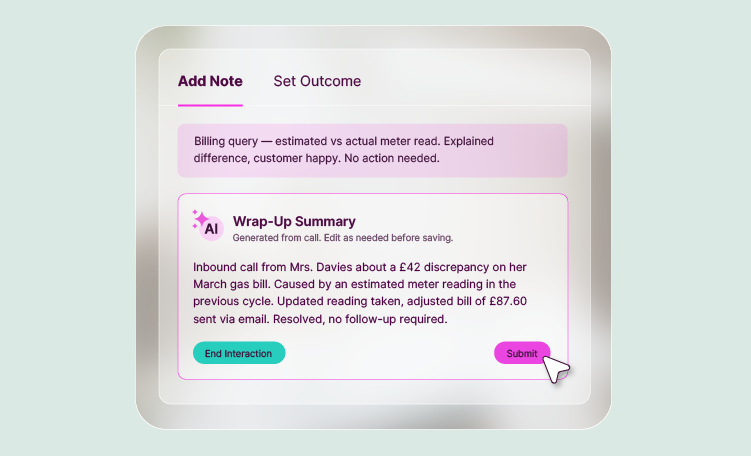
Agent Wrap Up Summary generates a structured call record automatically the moment the call ends; drawing on the conversation to produce a consistent summary of what was discussed, what was agreed, and what happens next. Every call. Every agent. Every time.
Consistency is the point. Not just the time saving, though that is real: wrap time typically accounts for 15–20% of an agent's working day, and a 50% reduction returns meaningful capacity to productive contact time. For a 50-agent team, that translates to an illustrative annual saving of £175,000: based on 50 agents, 50 calls per day, a 50% reduction in wrap time, and an average fully loaded agent cost of £25,000 per year.
The more significant change is downstream. When every call produces a reliable, structured record, that record becomes the foundation for what the next agent sees before their call begins. Customer History in Contact Hub surfaces that context automatically - so the agent who picks up next week is starting the call informed.
This is how personalisation at scale works. Not by asking agents to memorise histories or search through fragmented notes. By generating a complete record on every call, so context accumulates and becomes genuinely useful over time.
The record is where the loop closes
Agent Wrap Up Summary is the start of a feedback loop, not the end of one. The structured data it generates - consistent, covering 100% of calls - feeds everything downstream.
Conversation Analytics can analyse that data at scale, identifying coaching opportunities, surfacing compliance drift, and enabling AI Call Scoring that cuts QA review time from 30 minutes to approximately 5 minutes per call. Real Time Agent QA (available in Beta Q4 2026), uses it to guide agents in the moment, surfacing compliance prompts, flagging sentiment shifts, and steering conversations towards the outcomes that best records show actually work.
Better calls produce better records. Better records enable better coaching. Better coaching produces better calls. The loop only works when it is closed. And it closes after the call ends.
Start with the audit
You do not need a platform overhaul to find out where you stand. Pull a sample of CRM records from last week. Read them. Ask a simple question: if the next agent had only this record to go on, what would they know? The answer will tell you more about the state of your post-call process than any metric can.
Want to see how Agent Wrap Up Summary works in practice? Download The Assisted Agent - our practical guide to AI-enabled agent assistance across the full call lifecycle. Or if you'd rather see it live: book a demo with the MaxContact team.
Your Contact Centre Has Four Problems. AI Is Already Solving Them.
Most contact centre teams are sitting on the same four challenges. Here's what the data says — and what good looks like.
If you run a contact centre, the chances are you're managing rising call times, inconsistent quality reviews, repeat contacts that erode margin, and a personalisation gap that's hard to close without the right data infrastructure underneath it.
None of these are new problems. But the distance between where most operations are today and what's now achievable is narrowing fast - and the teams pulling ahead aren't waiting for a full platform overhaul to make it happen.
At MaxContact's recent webinar, hosted by Marketing Director Kayleigh Tait and Principal Product Manager Conor Bowler, we worked through four specific challenges that are costing contact centres time and money right now - and showed, live, how AI is solving each one. Here's what we covered.
Challenge 1: Call length is rising, and post-call admin is a big reason why
Average service call duration in the UK is now 422 seconds - seven minutes per call - according to Contact Babel. That's the highest figure recorded in 20 years of data collection, and it's been climbing steadily since 2004. There's no sign it comes down on its own.
A large part of the reason is fragmentation. 96% of agents are still navigating multiple systems on every single call. Only 4% of UK contact centres operate from a single unified desktop. 40% of agents are juggling more than four applications at once - doing real-time system-surfing while simultaneously trying to solve a customer's problem or make a sale.
Then there's wrap time. 18% of every call is post-call admin: writing up notes, updating records, triggering next steps. That's queue time growing while your agents do data entry.
The commercial impact is significant. For a 50-agent contact centre making 50 calls a day, a 50% reduction in wrap time is worth over £175,000 a year - based on MaxContact's own ROI modelling.
What good looks like:
An agent wrap-up summary that generates automatically within seconds of a call ending, built from a live stereo transcript that's already separated the agent's voice from the customer's. The agent reviews it, makes any edits, and submits. No blank page. No three to five minutes of typing between every call.
MaxContact's Agent Wrap-Up Summary feature — currently in alpha testing and moving to beta in mid-June — does exactly this. Prompts are fully configurable via Prompt Studio, so the output format, structure, and language match your operation's context, whether that's a collections agency, a sales team, or a customer service function.
Challenge 2: Repeat contacts are eroding margin and driving churn
42% of UK consumers have already switched provider because of a poor contact centre experience - not because of a product issue, but because of the experience itself. A further 38% have seriously considered it. MaxContact's consumer research, shared at the After Work with MaxContact event, makes clear this isn't an edge-case risk.
First contact resolution is what Contact Babel calls the "miracle metric." It's consistently cited as one of the top two KPIs most influential on customer satisfaction. Every repeat call is a direct hit on that number - and at roughly £5 per service call, a repeat contact doubles your cost before you've factored in agent time and churn risk.
The AI angle here is often misunderstood. 69% of customers rate AI worse than humans for understanding their issue - but the problem usually isn't the AI itself. It's where it's introduced in the customer journey. AI deployed in an emotionally charged or complex situation will struggle. The bigger failure point is the handover: when a customer escalates from an AI interaction to a human agent and has to repeat everything from scratch. That's where trust breaks.
What good looks like:
Context continuity. When a human agent picks up - regardless of whether the previous interaction was with an AI agent, a chatbot, or a colleague - they start with the full picture. Customer history, intent, what happened last time, what was agreed. Not a blank screen.
That requires clean data flowing across your channels and a single interface for agents to work from. It's a foundational requirement, not an aspirational one.
Challenge 3: QA based on a sample of 1–2 calls per week isn't good enough
The average contact centre reviews one to two calls per agent per week. Contact Babel's most recent guide describes this explicitly as "neither fair nor valid as a performance measurement tool." That's not a MaxContact opinion - it's the industry's own assessment of its standard practice.
The consequence is that coaching decisions, script adjustments, and performance reviews are all made on a handful of conversations selected at random. Objection handling failures, compliance drift, and the moments where an agent is genuinely struggling can remain completely invisible until the problem is already embedded.
What good looks like:
100% call coverage. Scorecards built on every conversation, not a sample. AI that makes that achievable without overwhelming your QA team.
MaxContact's AI call scoring — now generally available to all Conversation Analytics customers — reduces QA review time per call from 30 minutes to 5 minutes. That's approximately four days of analyst capacity returned to the team every month. Capacity that can go into actual coaching, script development, and performance improvement.
Scorecards are fully configurable: yes/no questions, rating scales, observation notes, auto-fail criteria. Business context can be set per scorecard so the AI understands your products, processes, and compliance requirements before it starts scoring. Scheduled auto-QA at scale — allowing always-on scoring as calls come in, or one-off compliance campaigns across historical data — is moving to beta on 6 July, with general availability planned for early August.
Challenge 4: Personalisation requires the right building blocks first
76% of consumers say personalised communications influence their brand choice, according to Salesforce's State of the Connected Customer. Personalisation at conversation level isn't a luxury - it's a commercial lever.
But it doesn't start with AI. It starts with having the right infrastructure in place:
- Customer history and intent available before the conversation starts
- In-call sentiment detection so agents know when someone is frustrated or at risk
- Consistent context across channels - what happened on the last call, the last chat, the last AI interaction
- Next-best-action guidance that surfaces what your best agents do in key moments, and replicates it across the team in real time
Once those building blocks are in place, personalisation stops being an aspiration. It becomes the logical next step, because you already have everything you need.
The bigger picture: it's not about solving one problem in isolation
The demo Conor ran at the webinar wasn't designed to show five separate features. It was designed to show how they connect.
A single agent interface. An automated wrap-up that feeds clean data into the next interaction. Real-time transcription with stereo accuracy that improves everything built on top of it. AI scoring across 100% of conversations. Context that follows the customer, not the channel.
The teams that are getting this right aren't deploying AI as a standalone fix for one metric. They're building a connected system where each piece makes the next one work better.
That's the direction of travel. And a lot of it is available right now.
Watch the full webinar and explore the resources
▶ Watch the full replay on YouTube → https://youtu.be/C2ED-KwbKns
📄 Download the Contact Babel UK Contact Centre Decision-Makers' Guide → https://www.contactbabel.com/
📅 Book a demo or speak to your account manager → https://www.maxcontact.com/book-a-demo

Call Centre Quality Monitoring: Why Sampling Isn't Enough
Quality assurance is one of the most compliance-critical functions in any contact centre, and one of the most under-resourced. For most operations, the gap between what QA teams can review and what regulators now expect to see evidenced has never been wider.
Most contact centres review a small fraction of their calls. A QA analyst picks a handful, scores them, flags what went wrong, and then moves on. It feels like it ticks the box for quality assurance. But for Ofcom-regulated telecoms operations and FCA-regulated financial services firms, it’s not enough, and the consequences of getting it wrong have never been higher.
This article explains why call sampling creates compliance exposure, what always-on monitoring looks like in practice, and what to look for when evaluating your current approach.
What is call quality monitoring?
Call quality monitoring is the process of reviewing agent-customer interactions to assess whether they meet your quality, compliance, and performance standards.
It typically covers:
- What was said and how the agent handled the conversation
- Whether compliance scripts and protocols were followed
- How vulnerable customers were identified and managed
- Whether the outcome was appropriate for the customer
- How performance compares against your scoring framework
When call quality monitoring is done consistently, it gives you a documented evidence-base across every call type, agent, and campaign. But when it’s done poorly or too infrequently, it leaves gaps that regulators are increasingly likely to find before you do.
How do most contact centres currently monitor calls?
Sampling is the typical approach many call centres take to monitoring calls. A QA reviewer listens to a set number of calls per agent per month, scores them against a framework, and feeds the results back into coaching. It is time-consuming work, so let’s break down the numbers.
Example:
- A single reviewer handles 50 calls a month at 30 minutes per call.
- This amounts to 25 hours of review time.
- And it is still only a fraction of the total call volume reviewed.
The problem here is not the effort; it's the coverage. On average, contact centres manually evaluate 5% of calls per week, meaning many QA operations are leaving the majority of interactions unreviewed. This means:
- You don’t know whether your agents are consistently identifying vulnerable customers.
- You don’t know whether compliance scripts are being followed on the calls you did not pick.
- You are not building an evidence bse, only a small sample.

FCA Consumer Duty: you need evidence across every interaction, not a snapshot
For debt collection, insurance, and other FCA-regulated contact centres, the stakes are different but the problem is the same. Consumer Duty requires firms to demonstrate they are delivering good outcomes for retail customers, not just on the calls they reviewed, but consistently and measurably across their entire operation.
The FCA has shifted decisively from implementation to enforcement. Regulators are no longer asking whether you have a quality monitoring process. They are asking whether you can prove, with documented evidence, that your agents are handling vulnerable customers correctly, following compliant scripts, and not causing foreseeable consumer harm. And that’s for every call, not just the ones you checked.
A sampling approach does not produce that evidence. It produces a snapshot.
For more on what the FCA now expects from contact centres in financial services and debt collection, see our Consumer Duty guide.
The problem with call sampling: A Summary
- Sampling typically covers around 5% of calls per week, leaving the 95% of interactions unreviewed and unverifiable
- Compliance drift happens slowly. By the time sampling catches a behaviour, it is already established and harder to coach out
- Poor agent behaviour on outbound calls can go undetected long enough to trigger carrier blocking or an FCA flag
- Vulnerable customers may not be identified correctly on calls you never reviewed
- Good performance goes unrecognised as you cannot replicate what you cannot see
- A sample tells you what happened on the calls you chose to review. It does not tell you what is happening in your operation
From sampling to monitoring: what's actually required
Moving from sampling to consistent call monitoring is not simply a matter of reviewing more calls. It requires the right infrastructure in place, and historically, that infrastructure was either too expensive, too time-consuming, or both.
At a minimum, always-on monitoring requires:
- Call recording across all interactions, not just selected campaigns or call types
- Transcription that converts voice to text accurately enough to be reviewed and searched at scale
- A platform that connects recording, transcription, scoring, and reporting in one place rather than across multiple disconnected tools
Without all three, monitoring at scale either falls back on human reviewers (which is where the 25-hours-per-50-calls problem comes back in) or produces data too inconsistent to be useful as a compliance evidence base.
MaxContact's Conversation Analytics brings all of this together in a single platform. Call recording, real-time transcription, and reporting sit alongside each other. This gives your QA team a single place to monitor, review, and evidence what is happening across every interaction, without stitching together multiple tools or managing separate systems.
The reason most contact centres have defaulted to sampling is not because they did not want better coverage. It is because the operational cost of achieving it manually was prohibitive. A team large enough to review every call would cost more than most mid-market operations can justify. But that has changed.
How Conversation Analytics makes always-on monitoring feasible
Conversation Analytics is the platform that makes consistent, always-on call monitoring operationally viable for mid-market contact centres.
Rather than relying on a QA team to manually select, listen to, and score calls, Conversation Analytics connects call recording, transcription, scoring, and reporting in a single platform – automating quality assurance. Every interaction is captured, transcribed, and made reviewable, giving your QA team complete visibility across all call types, all agents, and all campaigns without the resourcing overhead of manual review at scale.
The cost comparison is significant. Replicating meaningful call coverage with human reviewers alone would cost an estimated £14,000 per month in analyst time for a mid-sized contact centre. Conversation Analytics delivers that coverage at a fraction of the cost, freeing your QA team to focus on coaching, calibration, and the complex calls that genuinely need a human eye.
How AI call monitoring surfaces insights faster
AI is what makes the insights from always-on call monitoring actionable rather than overwhelming.
Without AI, full call coverage creates a different problem; more data than a QA team can meaningfully review and act on. AI-powered call monitoring solves that by doing the heavy lifting on routine scoring, so your team's attention goes where it matters most.
| Benefit | What it means for your operation |
|---|---|
| Structured scorecards answered automatically | Every scorecard question is answered using transcript evidence; no manual listening, no reviewer subjectivity. |
| Transcript-linked evidence | Every score links back to the exact exchange that informed it, giving you a defensible audit trail. |
| Faster review cycles | Review time drops from 30 minutes to 5 minutes per call, recovering around 4 days of analyst time every month. |
| Consistent scoring across your entire operation | The same criteria, applied the same way, across every agent, call type, and campaign every time. |
| Human oversight built in | Your QA team reviews outputs, calibrates scoring, and focuses on complex calls. AI handles the routine. Governance stays with your team. |
The result is not just faster QA. It is a more reliable, more defensible evidence base built on every call, not a sample of them.
What to look for in your call quality monitoring approach
Is your evidence transcript-linked? Generic summaries are not a defensible evidence base. Scoring decisions need to be traceable back to what was actually said.
Is your scoring consistent? If different reviewers score the same call differently, your evidence has a credibility problem. Consistent scoring logic applied across all interactions removes that subjectivity.
Does your QA sit within your analytics platform? If scoring, feedback, and reporting live in separate tools, you create friction and risk. Everything should be in the same place.
Is human oversight built in? Your QA team should be able to review, challenge, and calibrate outputs. Always-on monitoring supports human-led governance, it does not replace it.
Are you scoring the right calls? Configurable triggers and criteria by call type, queue, campaign, or outcome, mean your monitoring effort goes where the compliance risk is highest.
The question is not whether you can afford to monitor every call
It is whether you can afford not to.
Ofcom and the FCA have both made clear that evidence of compliance needs to be consistent, documented, and demonstrable. A sampling process may satisfy an internal audit. It is unlikely to satisfy a regulator asking for proof of good outcomes across your entire customer base.
Always-on call quality monitoring closes that gap. It gives your QA team better data, gives your compliance function defensible evidence, and gives your operation a consistent view of what is actually happening on the phones across all calls, rather than just the ones you happened to pick.