Ask a contact centre leader about after-call work and they'll usually frame it as a time problem. Wrap time is too long. Agents aren't “going available” quickly enough. AHT is inflating. The fix, in most conversations, is operational: better templates, tighter ACW targets, more monitoring.
That framing is not wrong, but it is incomplete. After-call work is not just a time problem. It’s a quality problem, one which has a direct customer-facing cost that most operations are not measuring.
What actually happens when the call ends
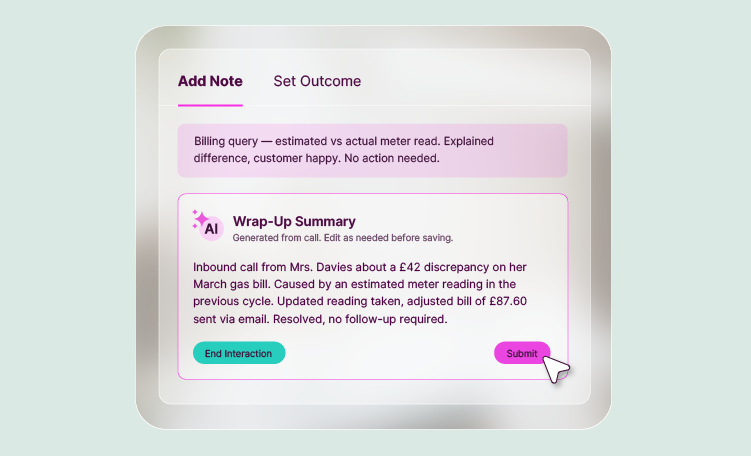
The call ends. The agent is under pressure to “go ready” and be available for the next call in the queue. They have notes to write, a CRM record to update, a disposition to log. Often with multiple systems to update. They have approximately two minutes to do all of that before the queue moves. So, they write what they can. A sentence, maybe two. A shorthand that makes sense to them right now but will mean nothing to the agent who picks up next week's call. Sometimes nothing at all, and a disposition code carries the entire context of a complex interaction. Now multiply that across your team. Ten agents handling the same call type will leave ten different records. Some thorough, some minimal. Some missing the most important detail entirely - what was promised, what was escalated, what the customer was told to expect next. This is the quality problem, and it compounds quietly.
The customer pays for it twice
The first cost is visible: longer calls, higher AHT, agents unavailable for longer than they should be. This is what gets measured. The second cost is less visible but more damaging. The customer calls back. A different agent picks up. They open the record - and it tells them almost nothing useful. So, they ask the customer to explain themselves again. That moment - the repetition, the sense that the company was not paying attention - is where trust erodes. It’s not dramatic. It does not show up immediately in CSAT. But it accumulates, and eventually it becomes the reason a customer switches.
Our Voice of the UK Consumer 2026 research found that 42% of UK consumers have already switched provider due to poor contact centre experience. The word ‘already’ matters. These are not consumers who are at risk of switching – they’ve already left. The post-call gap is not just an internal inefficiency. It's a retention risk dressed up as an admin problem.
Why training cannot fix this
The instinct, when notes are inconsistent, is to retrain. Set clearer standards. Remind agents what a good record looks like. Monitor more closely. This rarely works. Not because agents do not want to do it well, but because the system is not set up to support consistency at pace. An agent writing notes under queue pressure, with no template and no structure, will produce exactly what the conditions allow. Varying quality, varying detail, varying usefulness. The problem is not discipline or intent. It is that the task is being done manually in the least forgiving conditions possible.
What changes when AI writes the notes
Agent Wrap Up Summary generates a structured call record automatically the moment the call ends; drawing on the conversation to produce a consistent summary of what was discussed, what was agreed, and what happens next. Every call. Every agent. Every time.
Consistency is the point. Not just the time saving, though that is real: wrap time typically accounts for 15–20% of an agent's working day, and a 50% reduction returns meaningful capacity to productive contact time. For a 50-agent team, that translates to an illustrative annual saving of £175,000: based on 50 agents, 50 calls per day, a 50% reduction in wrap time, and an average fully loaded agent cost of £25,000 per year.
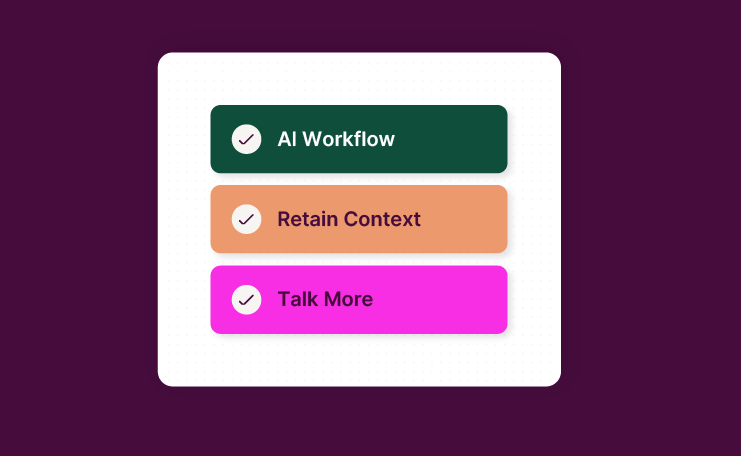
The more significant change is downstream. When every call produces a reliable, structured record, that record becomes the foundation for what the next agent sees before their call begins. Customer History in Contact Hub surfaces that context automatically - so the agent who picks up next week is starting the call informed.
This is how personalisation at scale works. Not by asking agents to memorise histories or search through fragmented notes. By generating a complete record on every call, so context accumulates and becomes genuinely useful over time.
The record is where the loop closes
Agent Wrap Up Summary is the start of a feedback loop, not the end of one. The structured data it generates - consistent, covering 100% of calls - feeds everything downstream.
Conversation Analytics can analyse that data at scale, identifying coaching opportunities, surfacing compliance drift, and enabling AI Call Scoring that cuts QA review time from 30 minutes to approximately 5 minutes per call. Real Time Agent QA (available in Beta Q4 2026), uses it to guide agents in the moment, surfacing compliance prompts, flagging sentiment shifts, and steering conversations towards the outcomes that best records show actually work.
Better calls produce better records. Better records enable better coaching. Better coaching produces better calls. The loop only works when it is closed. And it closes after the call ends.
Start with the audit
You do not need a platform overhaul to find out where you stand. Pull a sample of CRM records from last week. Read them. Ask a simple question: if the next agent had only this record to go on, what would they know? The answer will tell you more about the state of your post-call process than any metric can.
Want to see how Agent Wrap Up Summary works in practice? Download The Assisted Agent - our practical guide to AI-enabled agent assistance across the full call lifecycle. Or if you'd rather see it live: book a demo with the MaxContact team.

.png)
