knowledge hub:
resources & insights
Get the knowledge and tools you need to improve contact centre performance, deliver better customer experiences and grow your business.
the latest
downloads
The UK Contact Centre Regulatory Guide 2025–2027
A practical, regulation-by-regulation guide for compliance and risk managers in UK contact centres. Covers 10 regulatory areas, with action checklists, deadline summaries, and links to every primary source.
- £17.5 million — the new maximum fine for PECR breaches, up from £500,000. A thirty-five-fold increase that changes the risk calculation for every outbound operation.
- £500,000 personal liability - company directors can now be held individually liable for serious data protection breaches under the Data (Use and Access) Act 2025.
- 2 August 2026 - the date EU AI Act transparency obligations take effect, including chatbot disclosure and human escalation requirements for any UK contact centre serving EU customers.
- 4 cross-cutting FCA reviews running through 2026, examining whether firms can prove - with evidence, not policy documents - that customers are getting good outcomes.
This isn’t a future risk. It’s happening now. The guide breaks down each regulation, explains what’s new, and gives you a clear action list.
.png)

Security & Compliance Brochure
Enterprise-level security and compliance, built into every layer of the MaxContact platform.
The Always-On Contact Centre Scorecard
A strategic guide to AI solutions and automation.
Customers increasingly expect to access support at any time of day, across voice and digital channels. But increasing headcount to cover 24/7 expectations isn't a sustainable model for most contact centres operating on tight margins.
However, an “always-on” contact centre doesn’t mean staffing agents around the clock.
It’s about using AI and automation to absorb predictable demand across inbound and outbound without the need for a live agent. This allows human agents to step away from repetitive tasks and focus on complex, high-judgment conversations where they bring the most value.
the latest
webinars and events
.png)
AI-Enabled Agent Assistance: What the Data Says and What to Do About It
Your agents are navigating 4+ screens on every call, and its costing you time and money. Here's what the research says about enabling agents with AI.
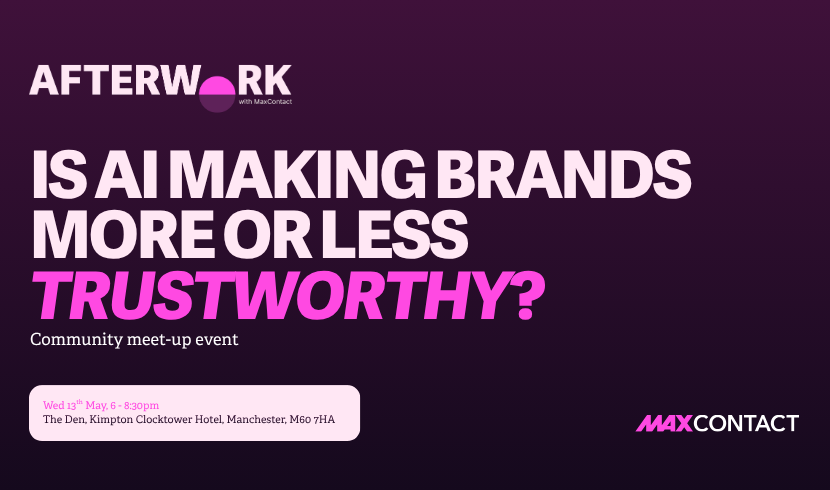
Afterwork with MaxContact: Is AI Making Brands More Or Less Trustworthy?
Join us at The Den, Kimpton Clocktower on 13 May 2026 from 6-8:30pm for an evening of honest conversation, good food, and the kind of debate that doesn't happen in a webinar.
.png)
Contact Centre Reality Check: Are Your KPIs Still Fit For Purpose?
How do you know if your KPI targets are still right for the environment you're actually operating in?
the latest
videos

Building Successful Sales Campaigns
Build outbound sales campaigns that convert. This short demo shows you exactly how easy it is to get started and highlights the features our customers rely on every day to boost productivity and hit their targets.
Outbound Customer Engagement Software
Outbound customer engagement that cuts through the noise, see MaxContact's customer engagement platform in action.
Omnichannel Customer Engagement Software
Meet your customers where they are; on Email, SMS, WhatsApp, Web Chat and more. See MaxContact's platform in action.
the latest
client stories

Protector Insurance: Better Visibility, Stronger Performance
Find out how Protector Insurance used MaxContact to improve reporting, monitoring and service levels — achieving 99% of calls answered within 20 seconds.
Protector is a growing insurance organisation operating across three core lines: liability, property, and motor fleet. With more than 200 UK-based employees and continued monthly onboarding, the business is expanding steadily across the UK and Europe, with offices in Manchester, London, Birmingham, the Nordic countries, and Paris.
Its UK phone operations is centred around claims handling teams based primarily in Manchester, where the teams manage large volumes of inbound and outbound calls each day. Team leaders support claim handlers through coaching, performance management, and service level oversight.
As the business grew, Protector needed a customer engagement solution that offered greater flexibility, stronger reporting, and more usable functionality than its previous provider. MaxContact now supports that operation with improved data access, real-time dashboards, and emerging AI adoption that are helping shape the next stage of development.
.png)
Smarter Calls, Faster Bookings - Sureserve’s Success with Firstcom Europe
Our partnership with Sureserve shows how the right outbound technology and hands-on support can transform operations. With MaxContact from Firstcom Europe, a pre-call process that once took 10 people all day now takes just three people less than two hours, while expanded SMS functionality has also improved customer engagement.
Sureserve operates as a Smart Meter Operator, responsible for installing smart meters on behalf of energy suppliers. A core part of their operation involves making high‑volume outbound calls to customers to book smart meter installation appointments - making efficiency, accuracy, and scale critical to success.
To support this, Sureserve required a reliable dialler solution capable of handling outbound calling at scale while reducing manual effort. As the business grew, there was also a need to improve customer engagement channels and streamline pre‑call processes.
One challenge that emerged over time was knowledge continuity. While the system was already in place when the current team joined, training knowledge had been retained by previous staff and was lost during role transitions. This limited full visibility of the platform’s capabilities, even as usage expanded across the business.

InDebted: 30% Productivity Gain with MaxContact
Our partnership with InDebted is an example of AI working hand-in-hand with humans, a combination we will see more of in the future. Since their AI Agent joined the team, InDebted’s contact centre productivity grew by 30% and resolution rate by 12%.
Our partnership with InDebted is an example of AI working hand-in-hand with humans, a combination we will see more of in the future. Since their AI Agent joined the team, InDebted’s contact centre productivity grew by 30% and resolution rate by 12%.
Creating space for humans to focus their time and efforts where it’s most needed is one of the greatest values AI can bring to contact centres.
InDebted is a fintech startup revolutionising debt collection by helping customers boost their financial fitness. Their product uses empathetic digital messaging and offers self-serve options which makes it easy for customers to resolve their accounts. Since its launch in 2016, InDebted has helped over 250,000 customers with a 98% customer satisfaction.
When COVID-19 hit, InDebted saw a spike in the need for debt repayment support. When reaching out to customers, the team realised they were spending most of their time guiding customers on tasks that were fully enabled through self-serve. InDebted was looking for a way to continue supporting customers to self-serve their enquiries and payments while creating the space for their call centre team to help with the trickier enquiries. They wanted a solution that was smarter than an Interactive Voice Response (IVR), could provide great customer experience and deliver on their call deflection goals.
the latest
articles and insights

Make Call Reviews Faster, Fairer, and Evidence Backed.
Introducing AI Call Scoring — now included within Conversation Analytics at no additional cost.
Here’s a number worth sitting with: 30 minutes.
That's how long it takes to manually score one call. Listen back, fill in the scorecard, write up the notes, log the result. Do that 50 times a month and you've lost on average 4 days per reviewer to scoring alone.
Most QA teams know this. They're not slow or inefficient - the maths just doesn't work. One reviewer for every 25 agents, 30 minutes a call, finite hours in the week. Something must give, and that’s coverage. The industry average sits at around 5% of calls reviewed, which means 95% of what happens on your contact centre floor stays invisible.
Not just to your QA team. To your compliance records. To your coaching programme. To the agents who deserve consistent, fair feedback on every call they handle.
That's the problem AI Call Scoring is built to fix.
Your standards applied to every call you wish to score.
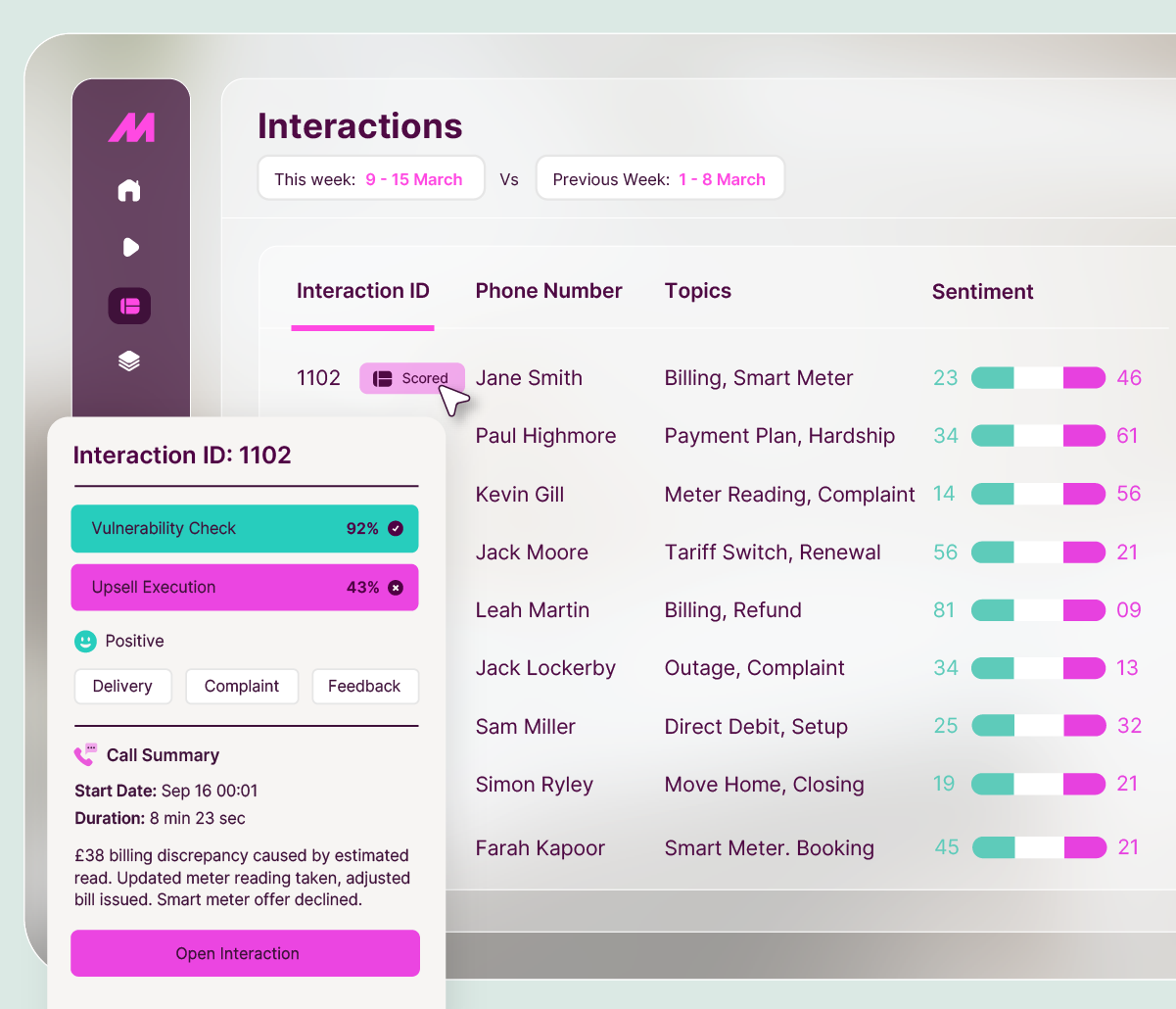
The way it works is straightforward. You define your existing QA standards - built around your business rules, your compliance requirements, your definition of what a good call looks like. AI Call Scoring applies them to your selected calls, scoring each one against your criteria using evidence taken directly from the transcript.
No algorithm deciding what good looks like on your behalf. You set the standard.
.png)
What this means for your QA team day to day
One of the things that doesn't get talked about enough in QA is how demoralising inconsistency is. Two reviewers score the same call differently. An agent pushes back. The process loses credibility. And meanwhile, the team is so buried in manual scoring that the actual coaching - the conversations that change behaviour -never happen.
AI Call Scoring brings review time down from around 30 minutes to about 5 minutes per call. Your QA team stop being a scoring machine and start doing what they're good at - calibrating standards, making judgment calls, and coaching agents to improve.
For a reviewer handling 50 calls a month, that's roughly four days back every month. That's a lot of coaching time that wasn't there before.
It's not just for big teams
This is worth saying clearly because it matters: AI Call Scoring isn't just a tool for large operations with dedicated QA departments.
For teams of 50 or more agents, the time savings are significant - around 133 days per year across four QA staff, worth approximately £15k in team time. But beyond the hours, scoring more calls consistently means you start seeing the patterns that a small sample will never show you.
For smaller teams of 10 to 30 agents, it's even more of a shift. Structured QA without dedicated headcount. Team leaders reviewing scored calls in minutes. Compliance coverage that doesn't require a compliance team. And a framework that grows with the business.
When compliance is non-negotiable
For contact centres operating in regulated sectors, the stakes have risen. Consumer Duty, now actively enforced by the FCA, places a direct obligation on organisations to evidence that customers are receiving good outcomes.
When a complaint lands, you can't point to a sample. You need evidence that the specific interaction was handled correctly. AI Call Scoring gives you an auditable record of every scored call, with auto-fail rules that catch compliance breaches - a missed disclosure, an incomplete ID check - regardless of how the rest of the call went. Every call you score is evidenced, auditable and defensible.
Your team stays in control
We want to be clear about this: AI Call Scoring is there to support your QA team, not sideline them. Every scored result can be reviewed, edited, challenged or discarded. Your people stay in the loop. The AI does the volume work - your team does the thinking.
It all lives inside Conversation Analytics — scored calls, common objections, objection handling effectiveness, top performers and saved compliance views, together in one place.
Already on Conversation Analytics? It's yours.
AI Call Scoring is included within Conversation Analytics at no extra cost. If you're already using the suite, it's available to you now.
This is also just the start. Automated QA at Scale is coming later this year - fully automated scoring across campaigns at volume. More on that soon.
If you're not yet using Conversation Analytics and want to see what AI Call Scoring could do for your team, come and talk to us. Book a demo and we’ll show you what it looks like in your environment.
Outbound still pays - your customers just need a smarter approach
High-volume cold calling is losing ground. Here's what a high-performing, data-led outbound strategy looks like - and how to sell it to your customers.
High-volume cold calling based on limited data is no longer a cost-effective outbound strategy and in the B2C world can be non-compliant.
With both sales and debt collection, the public has grown wary of unsolicited calls and generic conversations. But that doesn’t mean outbound dialling is over as a revenue engine.
It means it has to be smarter, multi-channel and data-led. Based on real-time information and a refined dialling strategy. Often personalised in tone, timing and approach.
So, if you’re reselling UCaaS today, there’s a strong chance your customers’ outbound results are being held back by the platform they’re on. When revenues stagnate, contact rates fall or conversions get harder to close, the problem usually isn’t effort - it’s strategy, data and tooling. This blog sets out what a high-performing outbound operation looks like, so you can have that conversation with confidence.
The outbound metrics your customers should be measuring
The foundation of any smart outbound strategy is good information. Help your customers understand that without the right data, they can’t tell whether calls are reaching the right people, whether agents are performing, or whether their scripts are working. Measurement isn’t a nice-to-have - it’s where improvement starts.
Outbound KPIs to share with your customers:
• Connect rates: are calls being connected to a real person?
• Contact rate: how often are agents reaching the right decision-maker?
• Data penetration rate: is their data being used effectively - are they making the most of high-value leads?
• Conversion rate: the percentage of contacts that result in a positive outcome
• Calls to success rate: the number of calls needed per successful result
Take conversion rate as a case in point. It tells your customers two things at once: the quality of their contact data, and the effectiveness of their team.
Better data means a higher likelihood of reaching the right person. Skills-based routing - matching the right agent to the right call- increases that further. And stronger training, combined with more refined scripts, means more of those conversations end the way they should.
Qualitative insight matters as much as the numbers
Quantitative KPIs don’t tell the full story.Improving contact rates will generate more conversations - but without the right skills in place to handle them, conversion rates won’t follow.
Encourage your customers to combine the numbers with qualitative insight: what objections are coming up most, what their customers are saying about competitors, and where conversations are breaking down.Helping them bring both lenses together is one of the most valuable things you can do as a partner - and it’s a conversation most resellers never have.
Industry-specific KPIs worth knowing
The metrics above apply broadly, but it’s worth helping your customers zone in on numbers that are specific to their sector.
In debt collection, promise to pay (PTP - the percentage of calls resulting in a commitment to pay) and percentage of debt collected are key indicators. In sales, first-call close rates and average revenue per call say a lot about campaign effectiveness.
MaxContact’s KPI Benchmark Report gives a detailed breakdown of what good looks like across sectors. It’s a useful resource to share with customers who want to know how their numbers stack up.
Benchmarking: what good looks like
Once your customers know what to measure, the next step is helping them understand what the numbers mean.
MaxContact’s own research found that the largest proportion of respondents - 34%, across both sales and debt collection - reported conversion rates of between 10% and 19%. Cold outbound sales calls typically convert at 1–3%; warmer, more targeted calls can reach as high as25%.
Broad benchmark ranges for common outbound KPIs:
• Average handling time: 4–12 minutes
• Contact rate(cold calls): 5–15%
• First call resolution: 10–40%
These are broad ranges and will vary significantly by sector and product complexity. The more important thing for your customers is to track their own numbers consistently over time - and to understand what’s driving movement in either direction.
What your customers can do to improve outbound performance
Once your customers are tracking the right metrics,the focus shifts to moving them. Here are the levers most likely to make a meaningful difference - and the conversations worth having:
• Team training and coaching - conversation analytics can surface objection patterns, benchmark individual and campaign performance, and show exactly where coaching will have the biggest effect.
• Smarter dialling strategy - when are their contacts most likely to answer? Are they prioritising by lead value? Are they using the right dialler mode for the campaign? These are practical questions you can help them think through.
• Omnichannel engagement - how does combining SMS, email and calls affect contact and conversion rates? Could AI agents handle routine calls while human agents focus on more complex or sensitive interactions?
The performance advantage you can offer your customers
Helping your customers understand and act on their outbound performance data is a powerful way to open the door to a bigger conversation. Standard UCaaS platforms can’t offer the range of insight and capability that a specialist customer engagement solution like MaxContact provides - and once customers seethe gap, the case for change makes itself.
Think conversation analytics, AI chatbots, workforce management, intelligent outbound dialling and sophisticated contact strategies - capabilities that standard UCaaS systems simply can’t match, and that enterprise-grade platforms price out of reach for most teams.
MaxContact delivers measurable results - from 200–300% increases in contact rates to doubling sales teams’ conversion rates. Benchmark Insights Report.
That’s because its intelligent, intuitive platform lets teams build smarter outbound strategies and tailor them for every campaign.
Talk to the MaxContact partner team about adding a specialist customer engagement solution to your portfolio. Book a call
.png)
Are You Ready for AI In Your Contact Centre?
Learn what AI readiness really looks like - and download the scorecard to assess yours.
AI doesn’t fix contact centres. It scales them. If your journeys are joined up, automation can reduce the pressure your team is facing. However, if they’re fragmented, AI amplifies the friction - faster transfers, repetition and customer effort. That’s why the most useful question contact centre leaders can ask themselves isn’t “What can AI do?” - it’s, "Are we actually ready for it?".
Whether you’re running sales and retention in telecoms, payment collections with vulnerability considerations in finance, customer support in utilities, or managing multiple client programmes in a BPO, the readiness question is the same - do we have the foundations to automate without increasing customer effort or operational risk?
“Always-on” support is an operating model, not a staffing one. It's built to remove avoidable demand, protecting your team's time for high-judgement conversations, and making escalation safe when risk or complexity arises.
Always-On Service Starts with Resolution, Not Headcount.
Consumers are increasingly expecting help at any time of day, across voice and digital channels. But increasing headcount to meet 24/7 customer support expectations isn’t sustainable for most contact centres operating on tight margins.
An always-on contact centre doesn’t mean agents working around the clock. It means using AI and automation to absorb predictable demand across inbound and outbound – from service updates and appointment changes to sales follow-ups and renewals, to payment reminders and self-serve arrangements - without needing an agent for every interaction.
The trap many leaders fall into is assuming that automation alone creates always-on. It doesn’t. Always-on is the result of clear journeys, consistent rules, and controlled escalation.
The Real Readiness Problem: Avoidable Demand
Most contact centres don’t struggle because customers contact them. They struggle because customers are contacting them more than once.
A lot of volume is created by operational gaps:
- Unresolved issues driving repeat contact
- Too many transfers caused by poor routing
- Long handle times driven by missing context
- Channels operating as seperate service silos
This is the stuff that quietly drains performance. It also explains why some AI programmes stall: they automate interactions on top of broken flows, then wonder why customer effort doesn’t fall, and agent workload doesn’t change.
If you want a pragmatic AI strategy, start by identifying where the operation is generating demand it shouldn’t have to handle.
A Practical Readiness Lens: Demand, Continuity, Control
To make readiness tangible, use this simple lens. If any one of these is weak, automation outcomes will be capped - or worse, you’ll scale the wrong things.
1) Demand: Do You Know What Should Be Automated?
AI delivers value when it absorbs predictable, repeatable demand - the structured interactions that don’t require human judgement. If you can’t clearly separate predictable from complex demand, you’ll either automate the wrong things and frustrate your customers or keep too much with agents and miss the efficiency gains.
A pragmatic starting point is mapping the top drivers and asking: which ones are genuinely structured, and which are only “simple” because we’re not seeing the full context?
2) Continuity: Does Context Move with The Customer?
Customers think in outcomes, not channels. Readiness means your operation can maintain continuity when a conversation starts in chat and moves to voice, or when an outbound reminder triggers an inbound response, or when a customer returns with a follow-up and expects you to remember what happened last time.
If context doesn’t travel, automation becomes a reset button, and resets are where handle time, repeat contact, and frustration grow.
3) Control: Can You Escalate Safely and Measure Outcomes?
Automation should never be a dead end. When complexity rises, or when there’s vulnerability, a complaint, payment risk, or compliance exposure, you need controlled escalation to a human agent with the full context carried across.
If you can’t define escalation rules and success measures beyond containment” you’re not ready to scale. You’re ready to pilot.
Where AI Fits When You’re Ready: Layers, Not Channels
A common mistake is deploying AI as separate tools by channel - a chatbot here, an AI agent there - and expecting it to add up to an always on operation. It simply adds more mini contact centres to the one you already have.
A more practical approach is to treat AI as layers across the operating model:
- Decision layer (AI Agents): Interprets intent, resolves structured interactions, and prevents outbound activity from automatically creating inbound pressure through unmanaged follow-up
- Asynchronous layer (chatbots and messaging): Allows customers to complete routine tasks without joining a queue, while keeping journeys connected across voice and digital
- Visibility Layer (Conversation Analytics): Shows where demand originates, where conversations stall, and what drives repeat contact so you can improve routing, coaching, and automation design based on evidence rather than instinct
When these layers support end-to-end workflows, AI stops being a bolt-on and becomes a genuine performance lever.
A Quick Readiness Check: The Questions Most Teams Skip
If you’re planning AI-enabled automation this quarter, these questions are worth answering before you commit time and budget:
- What proportion of our demand is truly predictable and repeatable?
- Where do customers repeat themselves, get transferred, or drop out?
- What's creating repeat contact and how will we remove it?
- What are our escalation triggers for risk, vulnerability or complexity and do we trust them?
- How will we measure success beyond containment - effort, quality, outcomes, stability?
- Do inbound and outbound journeys reinforce each other, or create extra pressure?
If those answers aren’t clear yet, that’s not a blocker, it's your roadmap.
Pressure-Test Your Readiness With The Scorecard
If you want a structured way to benchmark readiness across the foundations that matter - demand, continuity, escalation, and operational fit - our scorecard is designed for exactly that. Use it to create alignment internally, prioritise improvements, and shape an automation roadmap that holds up under real-world volume, not just pilot conditions. Download the Always-On Contact Centre Readiness Scorecard here.