Vague objectives mean QA scorecards and reporting tend to focus on superficial metrics rather than what moves the needle. Even a well-configured platform struggles to prove ROI if nobody has defined what "working" looks like in the first place.
This article covers what a good setup looks like, where implementations tend to go wrong, and what results contact centres can expect. Whether you're evaluating speech analytics software or about to switch one on, this is the practical detail worth knowing before you commit.
How Conversation Analytics powers effective quality assurance
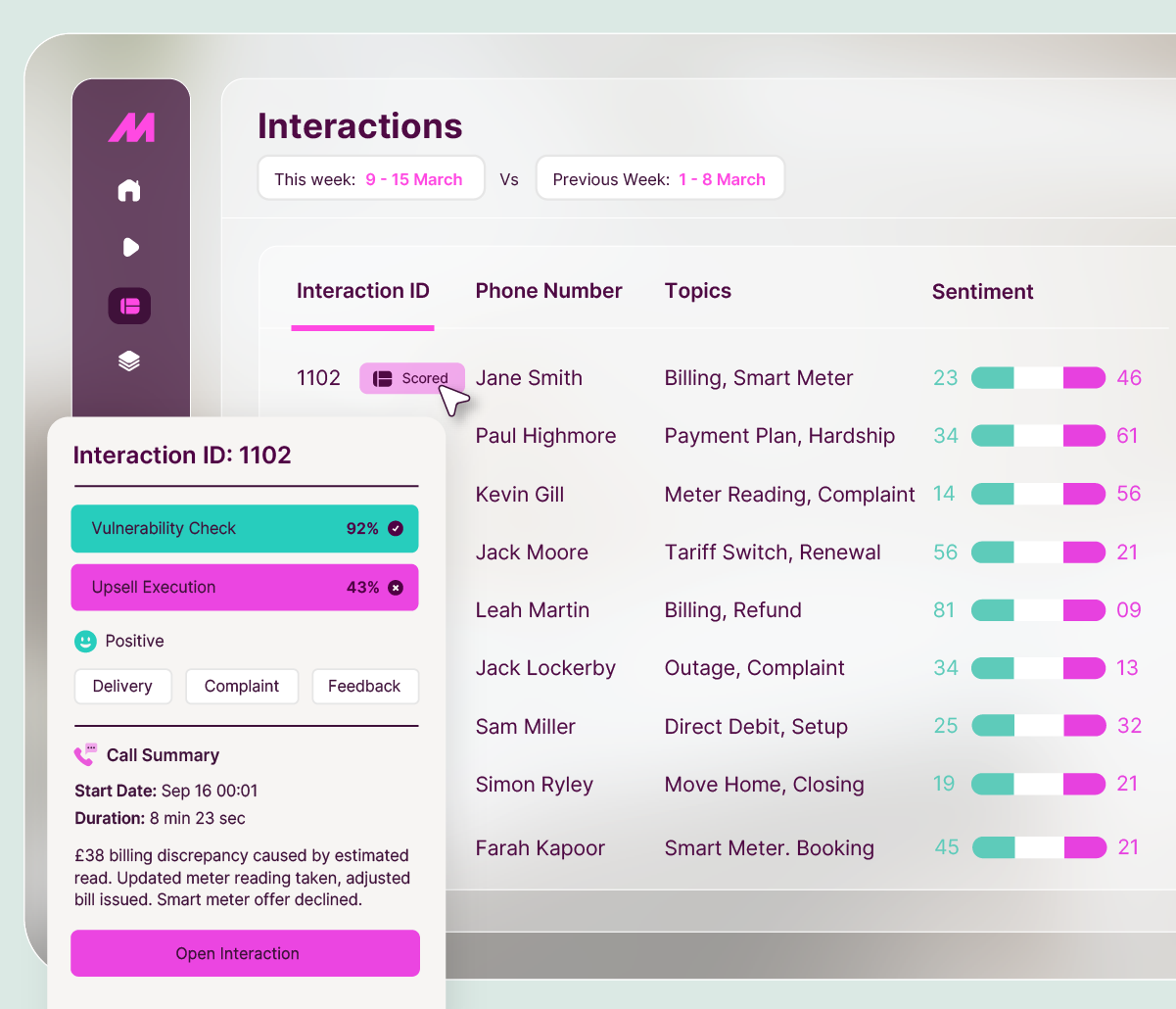
Conversation Analytics is MaxContact's speech analytics platform. It transcribes every call, identifies patterns in topics and phrases, and surfaces sentiment across the full call population rather than a sample.
Two capabilities sit on top of that data, and they solve different problems. AI Call Scoring lets your QA team select which calls to score against your existing scorecard. Using transcript evidence, a traditional thirty-minute review becomes a five-minute one. Auto QA at scale goes further: every eligible interaction is scored automatically as soon as the transcript is available, with no selection step at all.
There's also AI Assist, which works alongside the scorecard. Once a call is transcribed and scored, you can ask it open questions a fixed scorecard was never built to answer, such as how could this agent have shifted the sentiment of that call, or where was the actual turning point in the conversation. It's closer to having a coaching conversation about a specific call than reading a score with supporting evidence.
Scoring quality will always depend on what data feeds it. Accurate transcription, well-categorised topics, and clearly defined criteria all come out of Conversation Analytics itself, which is why the setup sequence is a critical part of implementation.
Start with outcomes, not configuration
When clients implement our Conversation Analytics and Auto QA capabilities, we don't rush into configuration. Instead, we start with one question: what does success look like for your contact centre environment?
Success for a financial services contact centre managing FCA Consumer Duty obligations looks much different compared to success for a BPO needing to reduce QA workload. Which looks different again from a sales team trying to understand what separates their best converting calls from average ones. Conversation Analytics and Auto QA can serve all of those outcomes. But they can't define them for you.
The contact centres that get the most from the platform do this work before implementation begins. "Better quality assurance" is not a useful benchmark. A clear definition means specifying what you're trying to improve, how you'll measure it, and what meaningful progress looks like at 30, 60, and 90 days.
That definition shapes everything that follows: which scorecards you build, which call types you prioritise, how you configure Auto QA, and how you report results internally.
Why the setup sequence matters
Each stage of implementation exists to reduce risk in the one after it. Skip or rush the discovery stage and it is much harder to prove ROI later on.
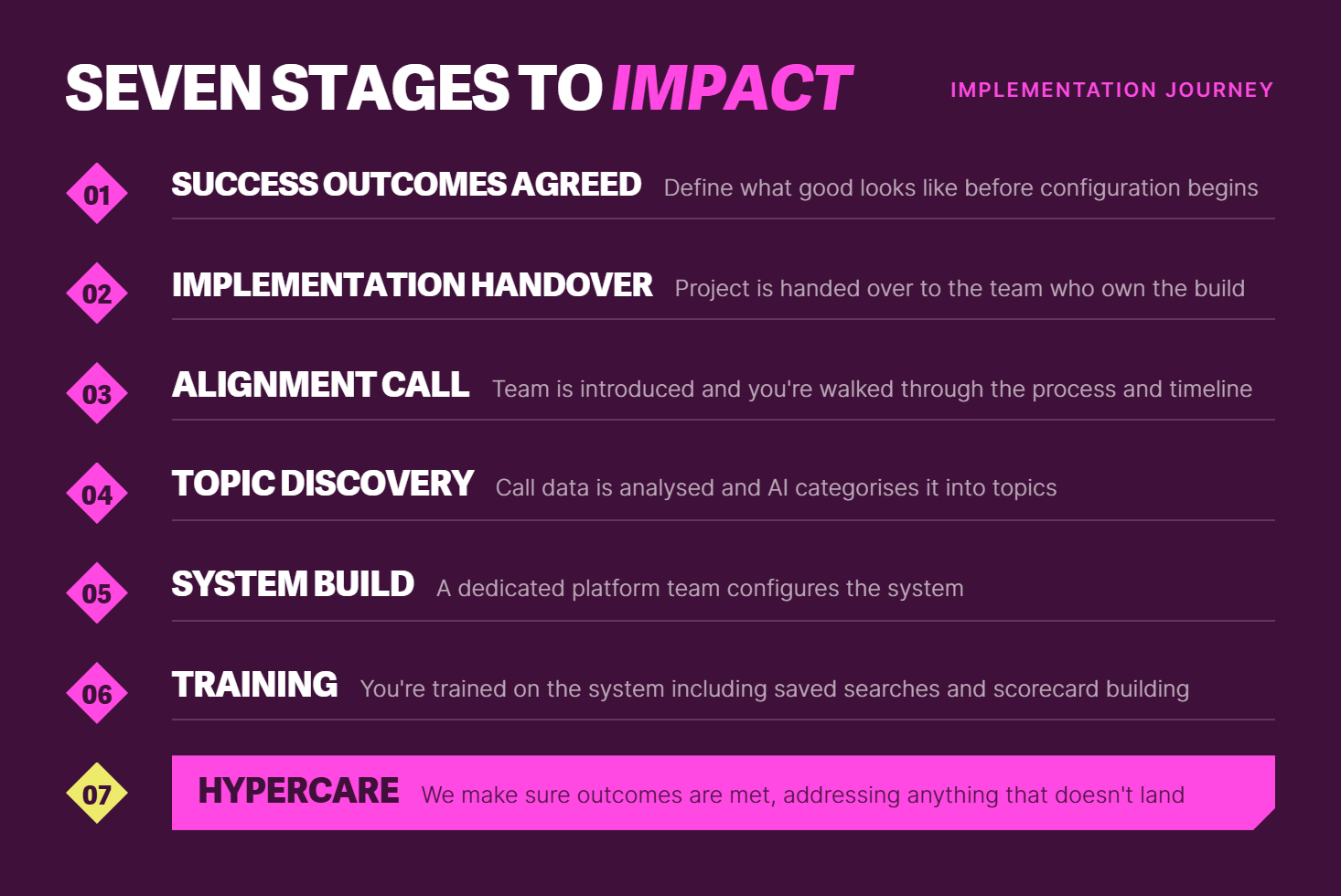
Why Topic Discovery changes everything
Topic Discovery is the step most implementations underestimate.
Before any scorecard gets built, Conversation Analytics analyses existing call data and categorises what's being discussed; the topics, phrases, and patterns from actual interactions, rather than what a team assumes is happening based on memory or anecdote. Scorecard criteria built on that foundation reflects the calls you're actually having, which shows up directly in how reliable the Auto QA scoring ends up being.
Conversation Analytics: Realistic results and timelines
One question most people ask is how quickly you'll see a return. Efficiency improvements are different from quality improvements, and the two don't follow the same timeline.
Efficiency gains are immediate
Review time drops from day one. This part is structural rather than something that builds up gradually. As soon as scoring is live, review time falls from around 30 minutes per call to somewhere in the 2-5 minute range, depending on call complexity.
The results across our customer base are consistent:
- An automotive contact centre reduced QA review time from 30 minutes to approximately two minutes per call, seeing a 93% reduction
- An education provider reduced call review time from 30 minutes to three minutes, a 90% reduction
- A BPO running Auto QA across 45 client scorecards confirmed 83-84% of QA tasks as automatable
Broader QA improvement takes longer.
Broader improvements, such as compliance rates shifting or call quality lifting across the board, take longer to show up, and the exact timeline varies by customer size and sector. Based on what we've seen so far, a window of roughly 4-6 weeks is a reasonable starting expectation, though this depends on how much call volume you're scoring and how quickly coaching conversations are acted on. The platform creates visibility; but what your team does with it determines the pace.
ICX moved from time-intensive manual call reviews to surfacing compliance issues as they happened, and then used that visibility to build a smarter coaching programme. Read the ICX Conversation Analytics case study.
What mature Auto QA looks like in practice
Most operations start with the efficiency win; faster reviews, full call coverage, and that's the right place to start. The difference in mature operations is what happens to the output after scoring, not the scoring itself.
In regulated environments such as financial services, insurance and debt collection, that means treating Auto QA output as compliance evidence rather than a coaching tool that happens to also help with audits. Every scored call becomes part of a documented trail covering the whole call population, which is a different proposition to a QA reviewer's sample.
For sales and collections teams, the same principle plays out differently: Conversation Analytics surfaces objection handling patterns and sentiment shifts through a call, showing which phrases and approaches tend to show up in calls that convert.
In both cases, the output only earns its value once someone's acting on it. Scoring feeds regular coaching conversations, compliance drift gets caught before it embeds itself, and team leads use the platform directly rather than waiting on a report from someone else. That level of adoption tends to build during training, as teams get more comfortable acting on what the data's telling them.
What to look for when evaluating a Conversation Analytics platform
Not all conversation analytics and quality assurance software works the same way. The differences that matter most aren't always visible in a demo. These are the questions worth asking before you commit.
Is scoring evidence-backed or black-box?
Some tools return an AI-generated score without showing what produced it. That's a problem the moment you need to defend a QA decision in a coaching conversation, a compliance audit, or to a regulator directly. A score should link back to the exact transcript exchange behind it.
Can you build scorecards without technical configuration?
Defining scorecard criteria in plain English, rather than through keyword rules or technical logic, determines how quickly your QA team can build, test, and refine scoring frameworks without depending on vendor support. It also determines how well scoring reflects the nuance of real conversations.
Does the platform distinguish between selective scoring and always-on coverage?
As covered above with AI Call Scoring and Auto QA at Scale, this isn't just semantics. For regulated contact centres, the distinction has direct compliance implications, and it's worth confirming which one you're actually being sold.
Is human oversight built in?
Auto QA should support your QA team. Reviewers need to be able to question outputs, challenge scores, and recalibrate criteria as things change. The governance stays with the people who understand the operation.
What does implementation actually look like?
How success outcomes are defined, how Topic Discovery informs scorecard build, what training and hypercare look like; these are worth asking of any vendor you're evaluating. Implementation is where the gap between a platform that delivers and one that doesn't usually opens up.
Ready to see it in action?
The difference between a speech analytics rollout that delivers and one that disappoints rarely comes down to the technology itself; it usually comes down to how it's implemented, how success gets measured, and how quickly a team turns what it's shown into something it acts on.
MaxContact combines Conversation Analytics, AI Call Scoring, Auto QA at Scale, Topic Discovery, training, and ongoing Customer Success support in a structured implementation process built around that. Whatever you're trying to fix, whether it’s QA workload, call coverage, compliance monitoring, or getting more out of the conversations you're already having, we'll work with you to define what success looks like and build toward it.
Book a demo to see how Conversation Analytics and Auto QA work in practice.



.png)
