Quality assurance in a call centre is the process of monitoring, evaluating, and improving agent interactions to ensure consistent customer experience and performance standards. All contact centres have a QA process. But most struggle to drive change from the data it provides.
For years, manual QA was the only option, and for many contact centres it still is. Supervisors sample a handful of calls, score them against a checklist and then file the results. Roughly 5% of interactions get reviewed on average. And then any feedback is given to agents days later (if at all).
It was never a great system. But as interaction volumes rise, agent workloads increase, and 42% of customers say they'll switch providers after a single poor experience, the cost of that insight-to-action gap is getting harder to absorb.
This guide covers how to make the shift from using QA as a monitoring exercise to using it as a driver of performance with AI-powered QA software.
You're monitoring quality. But are you actually improving it?
Knowing how to improve quality assurance in a call centre starts with an honest question: is your QA process actually producing change, or just producing data?
Traditional QA has a lag problem built in. A call happens and a supervisor reviews it days later. Feedback reaches the agent at a point where they've had dozens of conversations since the one that’s been reviewed. The connection between the behaviour and the coaching is weak, and the window for meaningful learning has already closed.
There's also the sampling issue. Manual QA typically covers around 5% of interactions.
“Leaders want answers, but those answers sit behind small QA samples, anecdotal feedback, and performance dashboards that only tell part of the story.” Connor Bowler, Principal Product Manager at MaxContact
The result is stark: manual QA gives you a story about some of your calls while an AI-powered platform gives you the truth about all of them.
Stop treating QA as an audit. Start treating it as a coaching tool.
Improving quality assurance starts with how you think about the QA function. It’s not an audit, but rather a coaching engine.
Approach QA with an audit mindset, and you’ll get reports. Approach QA with a coaching mindset, and you’ll get improvement. Contact centres that use QA to drive real behaviour change tend to do three things differently:
As AI handles monitoring and scoring at scale, QA teams move away from manual call reviews and closer to coaching, analysis, and performance design; a more valuable role, and a more sustainable one.
It's a shift some organisations are already making.
The ICX Use Case
ICX, a customer engagement provider for brands including Nissan, Suzuki, and Stellantis, replaced manual call reviews with MaxContact's Conversation Analytics platform. Quality assessors moved from repeated audio replays to transcript-based reviews, with AI-powered search surfacing compliance issues, objection patterns, and coaching opportunities across every interaction. Training is now built directly from sentiment and objection data, feeding into one-to-ones and agent development.
Call centre quality assurance metrics: What they're actually telling you
Once you've made the shift from audit to coaching mindset, the next question is: what is your QA data actually telling you?
The most common scorecard measures script adherence, handling time, first call resolution, CSAT, and compliance markers. All of these are valid, but they can mislead if you're drawing conclusions from a 5% sample. The same metrics applied across 100% of interactions tell a very different story.
A few principles that make QA data more actionable:
1. Work out whether you've got a data problem or a coaching problem.
An agent who consistently mis-dispositions calls might not need coaching, they might need better data or a clearer process. An agent whose sentiment scores drop in the last hour of every shift has a different problem entirely. QA data is most valuable when it helps you tell the difference.
2. Don't look at scores in isolation. Connect them to outcomes instead.
A call that scores well on process but ends in a complaint tells you the agent followed the script and still got it wrong. Map your QA scores against CSAT, NPS, or complaint rates to find out which quality indicators actually predict good outcomes and which ones are just measuring process-following.
3. Track how quickly agents improve after coaching.
The rate of improvement following a coaching session is more useful than the score itself. If coaching isn't producing measurable change within a defined window, perhaps it’s the approach that needs to change, not just the agent's behaviour.
4. Use sentiment data to find what scores can't show you.
Scores tell you what happened procedurally. Sentiment analysis tells you how the customer felt at the start of the call, at the point of objection, and at sign-off. The gap between a high compliance score and a negative end sentiment is often where the most valuable coaching insight sits.
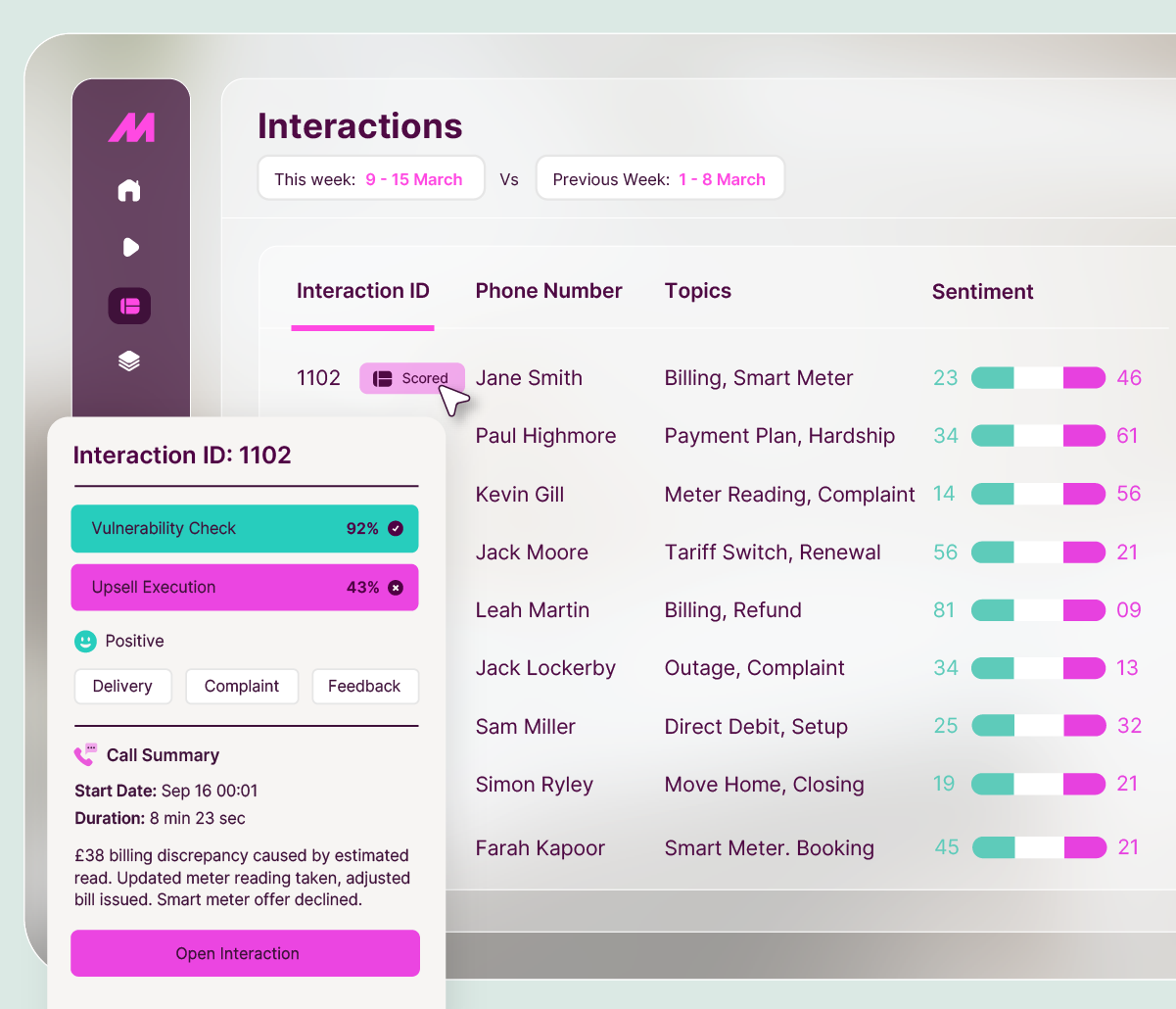
MaxContact's Auto QA applies customisable scorecards consistently across every selected interaction, including auto-fail criteria for non-negotiable standards, and surfaces sentiment alongside compliance scoring in a single view. QA managers spend less time manually reviewing calls and more time acting on what the data reveals.
The difference between feedback that lands and feedback that doesn't
Call centre quality monitoring best practices all point to the same conclusion: data doesn't change behaviour. Coaching does.
Specific beats general, every time. "You need to listen more actively" isn't actionable. "On this call at 2:34, the customer mentioned they'd been waiting three weeks and you moved on without acknowledging it. Here's what it sounds like when it's handled well" is constructive, actionable feedback. .
Frequency matters more than depth. Regular short coaching sessions (ten minutes a week focused on one call or one skill) tend to produce better outcomes than monthly deep-dives. Behaviour change is cumulative.
Self-review builds ownership. Agents who listen back to their own calls and score themselves before a coaching session arrive with more self-awareness and more investment in the gaps. The manager is coaching, not judging.
Use your best calls as teaching tools. Sharing anonymised examples of top-performing interactions gives the whole team a concrete standard to aim for. Not a number. A behaviour.
Data from MaxContact's Conversation Analytics platform drawn from over 700,000 objections across a six-month period, shows agents successfully overcome just 39% of objections, while 61% remain unresolved. The most challenging category is need objections ("not interested", "no immediate need"), which represent 46% of all objections but carry the lowest conversion rate. That's a pattern, and it needs a pattern-level response.
For BPOs like ICX, managing quality assurance across multiple client accounts at scale, running separate manual processes for each campaign simply isn't viable. "Anything that helps us connect to more of the conversations, especially given the volume we handle, is incredibly valuable. The team does a fantastic job, but no one can review everything manually. With Conversation Analytics, we can proactively support our agents and maintain complete oversight, so we never miss a critical moment or insight," said Sarah Franks, Call Centre Manager at ICX.
The hidden reason your QA findings never make it to the coaching conversation
There's a practical barrier between QA insight and coaching action that doesn't get talked about enough: post-call admin.
After every interaction, agents log outcomes, complete call notes, update CRM records, and prepare for the next contact. In high-volume environments, where over 52% of contact centre leaders report agent workloads have increased year-on-year, that wrap-up time absorbs the space that could go into engaging with coaching materials or reviewing their own performance data.
When agents are constantly catching up on admin, QA becomes something that happens to them in scheduled sessions, not something they engage with actively. The feedback loop gets longer. The shift from "QA as audit" to "QA as improvement" stalls.
Agent Wrap-Up Summary changes this directly. By automatically capturing call summaries, key outcomes, sentiment, topics, and follow-up actions at the point of wrap, it creates a consistent record for every interaction without adding work for the agent. That frees up the time and headspace to engage with performance data in real time.
What better QA actually means for your bottom line
For contact centre leaders asking how to improve quality scores in their call centre, the answer comes down to this: quality improvement has to show up in numbers the business cares about.
For BPOs, that means client retention. Clients expect their customers to be handled to a defined standard; when quality slips, renewals are at risk. With agent attrition running at 31% across the industry, AI-powered QA becomes even more valuable. New agents can be held to the same standard from day one, without relying on institutional knowledge that walks out the door.
For financial services and insurance contact centres, the case is just as direct. Agents who handle complaints well, identify vulnerability accurately, and resolve queries first time produce better CSAT, fewer escalations, and stronger retention. With first call resolution rates dropping from 43% to 37% year-on-year, the contact centres that reverse that trend through better coaching protect both customer relationships and commercial performance.
Either way, QA only delivers value if it produces measurable change, closing the loop between monitoring, coaching, and results, consistently and at pace.
How to make all of this work when you're dealing with real call volumes
The barrier has always been operational: the volume of calls, the limits of manual review, and the admin overhead that eats into coaching time.
The contact centres that improve quality consistently aren't doing something fundamentally different. They've just stopped treating QA as something that happens after the call and started building it into how the operation runs; faster feedback, visible data, coaching that's based on patterns rather than incidents.
At the volumes most contact centres are dealing with, that only works if the infrastructure supports it. AI-powered QA removes the manual overhead that makes it impractical, covering every interaction, surfacing what matters, and giving agents and managers the time to actually act on what the data shows.
If your QA process is still generating reports instead of results, it's time to change how it works. See how MaxContact's Auto QA and Agent Wrap-Up Summary turn insight into action.

.png)
