What UK Customers Really Want from Contact Centres in 2025
We’ve recently launched our “Voice of the Consumer” research at MaxContact, and the results offer clear insights into what UK customers actually want when they interact with contact centres in 2025.
// VIMEO VIDEO PLAYER
$("[js-vimeo-element='component']").each(function (index) {
let componentEl = $(this),
iframeEl = $(this).find("iframe"),
coverEl = $(this).find("[js-vimeo-element='cover']");
// create player
let player = new Vimeo.Player(iframeEl[0]);
// when video starts playing
player.on("play", function () {
// pause previously playing component before playing new one
let playingCover = $("[js-vimeo-element='component'].is-playing").not(componentEl).find("[js-vimeo-element='cover']");
if (playingCover.length) playingCover[0].click();
// add class of is-playing to this component
componentEl.addClass("is-playing");
// ✅ add a permanent class after first play
if (!componentEl.hasClass("has-played")) {
componentEl.addClass("has-played");
}
});
// when video pauses or ends
player.on("pause", function () {
componentEl.removeClass("is-playing");
});
// when user clicks on our cover
coverEl.on("click", function () {
if (componentEl.hasClass("is-playing")) {
player.pause();
} else {
player.play();
}
});
});
We’ve recently launched our “Voice of the Consumer” research at MaxContact, and the results offer clear insights into what UK customers actually want when they interact with contact centres in 2025. We surveyed over 1,000 UK consumers in February 2025 who had interacted with contact centres in the last 18 months, and their responses paint a vivid picture of current expectations.
The Numbers Don’t Lie: Customer Experience Matters
Our research uncovered some eye-opening statistics that should make every contact centre leader take notice:
42% of consumers have already switched providers because of poor contact centre experiences, and another 38% have seriously considered it
More than half (55%) abandon calls when wait times get too long
70% still want to talk to a real person when explaining specific situations
Young adults (25-34) embrace AI at more than double the rate of those over 55
These numbers show the direct link between contact centre performance and customer retention. Every abandoned call represents potential lost revenue.
AI Adoption: A Clear Generation Gap
Our survey shows 45% of consumers feel comfortable with AI chatbots and virtual assistants, while 36% remain uncomfortable. But dig deeper and you’ll find significant demographic differences:
65% of 25-34 year olds feel comfortable with AI tools
Only 27% of over-55s share that comfort level
Men show higher AI acceptance than women (48% vs. 41%)
Urban consumers adapt to AI more readily than rural customers
“Contact centres need to recognise these demographic differences when implementing AI solutions,” says Ben Booth, CEO at MaxContact. “Your customer base should directly influence your technology deployment strategy.”
The data suggests contact centres should:
Use AI for what it does best – handling routine enquiries, gathering initial information, and routing conversations
Create clear pathways to human agents when customers need them
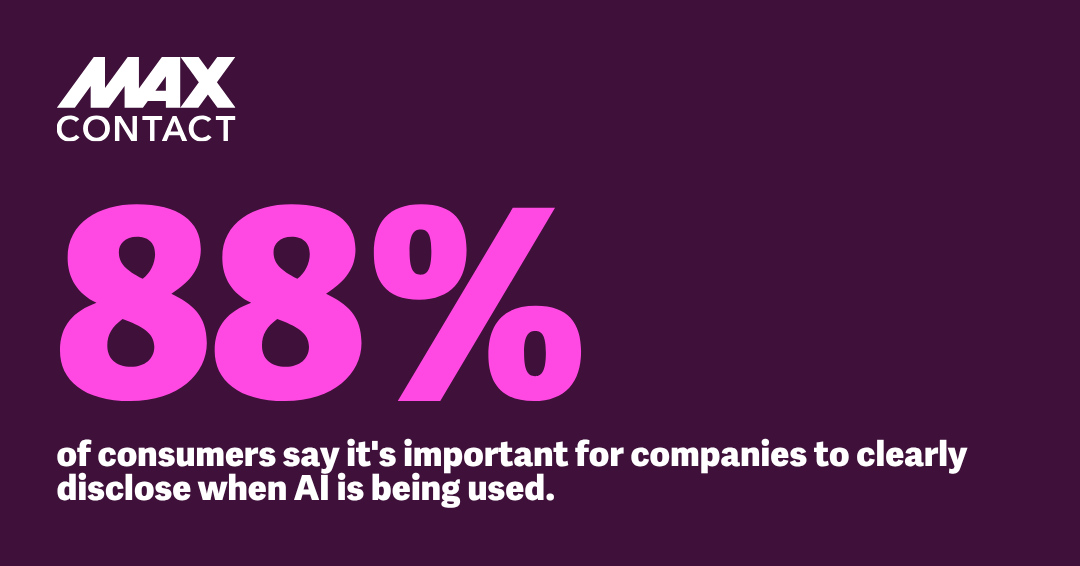
Be upfront about when customers are talking to AI systems
Consider using AI behind the scenes to support agents rather than focusing solely on customer-facing bots, especially with older demographics
Humans Still Win Where It Matters Most
Despite advances in AI and automation, customers overwhelmingly want human agents for certain situations:
70% prefer humans when explaining unique situations
67% want a person during emergencies
65% choose humans for complex account questions
61% want real people when making complaints
Interestingly, fewer consumers (47%) insist on human interaction for payment arrangements, and only 41% prefer humans when discussing financial difficulties.
“Your agents remain your most valuable resource,” notes Ben Booth, CEO at MaxContact. “The key is deploying them where they add the most value while automating routine transactions that don’t require human judgement or empathy.”
Channel Selection: Right Tool for the Right Job
Consumers have clear preferences about how they want to be contacted:
Phone calls dominate for urgent matters (67% prefer this channel)
Email is the top choice for initial outbound contact (53%)
For account updates, email (39%) outperforms phone calls (26%)
Phone remains the fastest resolution channel (60%)
What’s surprising? WhatsApp and social media ranked low across all scenarios, suggesting these channels work better as supplements rather than primary contact methods in most industries.
For contact centre workforce management, these findings highlight the need for skilled phone agents supported by robust email response systems, with chat and social media as secondary channels.
Customer Loyalty Hangs in the Balance
The data on customer switching behavior is particularly concerning:
42% have switched providers after poor contact centre experiences
17% have switched multiple times
Among 25-34 year olds, 60% have switched providers
“Contact centre quality directly impacts your bottom line,” explains Ben Booth, CEO at MaxContact. “When customers switch providers, they take their lifetime value with them.”
What Builds Customer Trust?
Consumers identified several key factors that establish trust:
Agents who truly understand their needs (49%)
Clear identification and purpose (42%)
Professional communication style (42%)
Agents empowered to make decisions (35%)
Technical reliability emerged as another crucial factor, with 27% of respondents reporting frequent disconnections during calls. Your CCaaS platform needs rock-solid uptime and call quality metrics to avoid this common frustration.
Five Focus Areas for Contact Centre Leaders
Based on our research, we recommend contact centres prioritise:
Smart technology allocation – Deploy IVR, chatbots and self-service portals for routine transactions while reserving agent time for complex issues
Queue management – Use callback options, accurate wait time estimates, and workforce management tools to minimise hold times
Channel strategy – Align communication channels with message type and demographic preferences
Agent enablement – Equip your team with knowledge bases, CRM integration, and decision-making authority
Want more insights? The complete “Voice of the Consumer” report includes detailed breakdowns by age, gender, and region, along with practical recommendations for contact centre operations. Access your free copy here.
About MaxContact
MaxContact’s cloud contact centre platform helps you manage more conversations, improve customer experience, and make data-driven decisions. Our platform seamlessly blends outbound, inbound and omnichannel functionality, providing AI-enhanced insights that help you deliver the efficient, personalised interactions customers expect in 2025.
For more information, speak to one of our experts.
(() => {
const rich = document.querySelector('#rich-text');
const toc = document.querySelector('#toc');
if (!rich || !toc) return;
// Only H2s inside the Rich Text
const headings = [...rich.querySelectorAll('h2')];
if (!headings.length) { toc.style.display = 'none'; return; }
// Slugify + ensure unique IDs (handles accents like šđčćž)
const slugCounts = {};
const slugify = (str) => {
const base = (str || '')
.trim()
.toLowerCase()
.normalize('NFD').replace(/[\u0300-\u036f]/g, '') // remove diacritics
.replace(/[^a-z0-9\s-]/g, '')
.replace(/\s+/g, '-')
.replace(/-+/g, '-');
const n = (slugCounts[base] = (slugCounts[base] || 0) + 1);
return n > 1 ? `${base}-${n}` : base || `section-${n}`;
};
// Build anchors directly inside #toc
toc.innerHTML = '';
headings.forEach((h, idx) => {
if (!h.id) h.id = slugify(h.textContent || `section-${idx+1}`);
const a = document.createElement('a');
a.href = `#${h.id}`;
a.classList.add('content_link', 'is-secondary');
a.dataset.target = h.id;
a.setAttribute('aria-label', h.textContent || `Section ${idx+1}`);
const p = document.createElement('p');
p.className = 'text-size-small';
p.textContent = h.textContent || `Section ${idx+1}`;
a.appendChild(p);
toc.appendChild(a);
});
// Offset for fixed navs - with extra spacing for visibility
const getOffset = () => {
const nav = document.querySelector('.navbar, .w-nav, [data-nav]');
const navHeight = nav ? nav.getBoundingClientRect().height : 0;
// Add 30px buffer to ensure heading is clearly visible below fixed navbar
return navHeight + 30;
};
toc.addEventListener('click', (e) => {
const link = e.target.closest('a.content_link[href^="#"]');
if (!link) return;
e.preventDefault();
e.stopPropagation(); // Stop other event listeners
const id = link.getAttribute('href').slice(1);
const target = document.getElementById(id);
if (!target) return;
const targetTop = target.getBoundingClientRect().top + window.scrollY;
const finalY = targetTop - 150;
// Use only smooth scroll
window.scrollTo({ top: finalY, behavior: 'smooth' });
history.replaceState(null, '', `#${id}`);
});
})();
related articles
you might also like
Our articles and industry insights give you expert perspectives, practical strategies, and the latest trends to help your business connect smarter and perform better.
(() => {
const WORDS_PER_MINUTE = 200;
const MULTIPLIER = 1; // your choice
const estimateMinutes = (el) => {
if (!el) return null;
const text = (el.innerText || el.textContent || "").trim();
if (!text) return 1;
const words = (text.match(/\S+/g) || []).length;
const baseMinutes = Math.max(1, Math.ceil(words / WORDS_PER_MINUTE));
return Math.max(1, Math.ceil(baseMinutes * MULTIPLIER));
};
const findNearestTargetInItem = (itemRoot, rt) => {
if (!itemRoot) return null;
return itemRoot.querySelector('.is-text');
};
const applyWithin = (root) => {
// More forgiving selector: attribute present or equals "true"
root.querySelectorAll('[data-rich-text], [data-rich-text="true"]').forEach((rt) => {
const itemRoot =
rt.closest('[role="listitem"]') ||
rt.closest('.w-dyn-item') ||
rt.parentElement ||
root;
const target = findNearestTargetInItem(itemRoot, rt);
if (!target) return;
const mins = estimateMinutes(rt);
if (mins != null) target.textContent = `${mins} MIN READ`;
});
};
const init = () => {
applyWithin(document);
// Re-apply on dynamic changes (pagination/filters)
const mo = new MutationObserver((mutations) => {
for (const m of mutations) {
for (const n of m.addedNodes) {
if (!(n instanceof Element)) continue;
if (
n.matches('[data-rich-text], [data-rich-text="true"], [role="list"], .w-dyn-items, .w-dyn-item') ||
n.querySelector?.('[data-rich-text], [data-rich-text="true"]')
) {
applyWithin(n);
}
}
}
});
mo.observe(document.body, { childList: true, subtree: true });
};
// Robust bootstrapping
if (window.Webflow && Array.isArray(window.Webflow)) {
window.Webflow.push(init);
} else if (document.readyState === 'loading') {
document.addEventListener('DOMContentLoaded', init, { once: true });
} else {
// DOM is already ready; run now
init();
}
})();
As we close out 2025, it's time to reflect on the predictions we made at the start of the year and examine how the contact centre industry actually evolved. While some trends played out largely as anticipated, others took different paths, and the year brought valuable lessons about the pace of technological adoption and the realities of AI implementation.
Let's look back at what we predicted for 2025 and how it measured up against reality.
AI Enters the Value Creation Phase: Prediction Validated
We predicted that 2025 would be the year AI moved from deployment to proving its worth, with organisations becoming more pragmatic about ROI and accepting realistic efficiency gains of around 25% rather than the marketed 70-80%. This proved to be one of our most accurate predictions.
The shift happened – and not just among buyers. AI vendors themselves fundamentally changed their positioning throughout the year, moving away from revolutionary promises toward demonstrable value delivery. The industry experienced a collective reality check, with both clients and vendors acknowledging that AI's current capabilities, while valuable, require focused implementation and realistic expectations.
The buyer sophistication we anticipated materialised as predicted. Organisations approached AI investments with the same caution they learned from the early SaaS era, demanding proof of value before committing resources. This pragmatic approach has actually accelerated successful implementations, as companies focused on achievable wins rather than transformational moonshots.
The adoption patterns we're seeing reflect this pragmatic approach. Our recent benchmark data shows that chatbots (57%), virtual or AI agents (56%), and fraud detection (46%) lead AI adoption – a mix of customer-facing and operational applications that demonstrates organisations are deploying AI across diverse use cases rather than betting everything on a single transformational solution.
This diversified approach demonstrates that organisations have learned a crucial lesson: AI value comes from multiple focused applications working together, not from a single revolutionary solution. Rather than seeking the one AI tool to transform everything, successful contact centres are building an ecosystem of AI capabilities, each solving specific problems and delivering measurable returns.
Looking to 2026, this value-focused approach will intensify. The stakes have never been higher for demonstrating real return on AI investment.
Agent Role Evolution: Still a Work in Progress
Our prediction about enhanced focus on emotional intelligence and complex problem-solving, driven by agents juggling 5-10 applications, proved partially accurate – but the evolution happened more slowly than anticipated.
The fundamental problem we identified, cognitive load from application switching, still exists. When agents need to hunt for information across multiple systems, that friction hasn't been solved at scale. However, there's a crucial development: vendors are now actively prioritising this challenge for the next 12-18 months in a way they weren't before.
The reality is that other AI use cases – digital deflection and efficiency improvements – showed faster, more measurable results and therefore attracted more immediate attention. Agent-focused solutions, which require more complex integrations and change management, naturally took longer to implement.
What's changed is the industry's recognition that solving the agent experience is the next frontier. The easy wins have been captured; now the focus is shifting to the harder problem of reducing cognitive load and empowering agents to focus on high-value interactions. The agent role evolution we predicted is happening – it's just unfolding across a longer timeline than a single year.
Personalisation Meets Privacy: Not Yet
This was one of our predictions that didn't materialise as expected. We highlighted that while 76% of consumers say personalised communications are a key factor in considering a brand, 80% are concerned about how their data is being used – a tension we believed would define how contact centres approached personalisation in 2025. In reality, this particular dynamic didn't become the defining issue we thought it would.
Personalisation absolutely grew, but not in the data-driven, privacy-challenging ways we envisioned. Instead, we saw incremental improvements that enhanced customer experience without crossing privacy boundaries. Conversational IVR systems that recognise customers and speak naturally. Auto-summarisation that gives agents context about previous interactions. Proactive outreach based on known customer journeys.
These are all forms of "respectful personalisation" – but the anticipated tension with privacy regulations didn't materialise because those regulations themselves haven't fully arrived yet. The comprehensive AI-specific data protection frameworks we expected are still pending, creating a situation that's both liberating and potentially dangerous.
The privacy conversation is coming – regulation always lags behind technology. But 2025 taught us that personalisation can advance through improvements in how we interact with customers, not just through deeper data mining. The human touch in personalisation is key, making interactions feel more conversational and contextual.
Economic Pressures Drive Innovation: Absolutely Accurate
This prediction proved devastatingly accurate. The economic pressures we highlighted – minimum wage increases to £12.21 per hour and National Insurance changes – drove exactly the responses we anticipated, and then some.
The most significant development was the dramatic acceleration of offshoring. Organisations didn't just explore offshore and nearshore options; many made wholesale moves, relocating entire operations because even with 20-30% AI-driven productivity improvements, the cost savings of offshore operations (often halving expenses) proved more immediately impactful.
This created an interesting dynamic: AI and offshoring aren't competing strategies, they're complementary ones. Organisations are doing both. The combination delivers the cost reductions that economic pressures demand, while AI provides the efficiency gains needed to maintain service quality in distributed operations.
For UK-based contact centres, this created an urgent imperative: AI implementation is no longer optional for competing at scale. The economics are stark – without AI-driven efficiency improvements, domestic operations struggle to justify their cost premium against offshore alternatives.
The year also validated our prediction about investment focusing on technology with clear cost benefits. Organisations moved past experimentation to demand concrete ROI demonstrations before committing to new platforms. First-contact resolution gained renewed focusas a direct cost-reduction strategy, and workforce management sophistication increased as organisations sought to maximise resource efficiency.
Economic pressure didn't just drive innovation – it fundamentally reshaped operational strategies across the industry.
Hybrid Working 2.0: Matured and Settled
Our prediction about hybrid working evolving beyond basic remote capabilities proved largely accurate. With over 60% of contact centres incorporating home working [Source: MaxContact 2024 KPI Benchmarking Report], 2025 was the year hybrid models matured from experimentation to established practice.
The persistent challenges we identified – training, culture, team cohesion, and the 10% higher attrition in remote teams – didn't disappear, but organisations developed more sophisticated approaches to managing them. The industry moved from asking "does hybrid work?" to "how do we make hybrid work better?"
That said, the journey isn't complete. Hybrid working remains an ongoing optimisation challenge rather than a solved problem. Organisations continue refining their approaches to onboarding, knowledge management, and cultural cohesion in distributed environments. The difference is that these are now recognised as manageable challenges within an accepted working model, rather than existential questions about hybrid working's viability.
What 2025 demonstrated is that hybrid working in contact centres has settled into a mature, sustainable model. It's not perfect, and it requires ongoing attention, but it's no longer experimental. Organisations know what works, what doesn't, and what trade-offs they're making.
We predicted 2025 would see contact centres move beyond scratching the surface toward sophisticated analytics and better cross-channel insights. What actually happened was more nuanced: awareness arrived, but implementation is still catching up.
The year's defining lesson about data came from AI implementations: data quality and integration determine success or failure. Organisations attempting AI projects quickly discovered that siloed, fragmented data blocks effective AI deployment. This painful lesson elevated data strategy from a nice-to-have to a fundamental requirement.
As a result, conversations about new technology implementations now start with data. Where is it? How timely is it? How well integrated across systems? This represents genuine progress – the industry now understands that data foundations must come before AI applications.
However, understanding the problem and solving it are different challenges. Data consolidation and integration remain complex, expensive projects that don't happen overnight. Many organisations spent 2025 realising the depth of their data challenges rather than solving them.
Interestingly, we also learned that AI tools themselves are creating more data. Speech analytics transcribing 100% of calls, conversation analytics tracking interaction quality, AI agents generating workflow data – the volume of available information is exploding. The new challenge isn't just integrating existing data sources, but making the tsunami of new data accessible and actionable for frontline decision-makers.
The data-driven future we predicted is coming, but 2025 was the year of recognition rather than transformation. The real work lies ahead in 2026.
Regulatory Compliance and Security: The Waiting Game
Our prediction about new AI-specific regulations joining existing frameworks like Consumer Duty didn't materialise in 2025 – though the reality is more nuanced than a simple absence of regulation.
While dedicated AI legislation hasn't arrived, existing regulatory frameworks continue to apply robustly to AI implementations. The FCA'stechnology-agnostic, outcomes-focused approach means that contact centres using AI remain fully accountable under Consumer Duty requirements – including obligations to act in good faith, avoid foreseeable harm, and deliver good outcomes for customers. This principles-based approach has proven flexible enough to address AI-related risks without requiring entirely new regulatory structures.
What we're seeing is that leading organisations aren't waiting for AI-specific regulations to establish best practices. Forward-thinking contact centres and vendors are proactively embedding responsible AI principles into their implementations – focusing on data protection, algorithmic transparency, fairness, and customer consent. These organisations recognise that existing regulatory requirements around consumer protection, operational resilience, and data governance already provide a comprehensive framework for responsible AI deployment.
This proactive approach positions organisations well regardless of future regulatory developments. By building AI systems that align with existing regulatory principles and industry best practices, they're creating implementations that are inherently compliance-ready. When AI-specific guidance does arrive – and regulators continue to monitor the space closely – organisations that have already embedded responsible practices will adapt seamlessly rather than facing disruptive retrofitting.
Security incidents throughout the year kept data protection at board-level attention, reinforcing the importance of robust governance around AI implementations. The industry's focus on operational resilience, secure outsourcing arrangements, and clear accountability structures demonstrates mature risk management even in the absence of AI-specific mandates.
The regulatory landscape for 2026 remains one to watch closely. While comprehensive AI-specific frameworks may still be developing, the application of existing regulations to AI use cases continues to evolve through regulatory guidance and industry practice. Organisations taking a principles-based, outcomes-focused approach to AI implementation – prioritising customer outcomes, transparency, and accountability – are positioning themselves as industry leaders in responsible innovation.
Looking Back: What We Learned
Perhaps the most important insight from 2025 is that AI is delivering real value, but in focused applications rather than wholesale revolution. Hybrid working has matured into standard practice, but the human challenges persist. Economic pressures accelerated strategic shifts that might have taken years in different circumstances.
The year validated our core message from the start of 2025: success comes from realistic expectations, focused implementations, and keeping sight of what matters – delivering excellent customer service in sustainable ways for both businesses and employees.
What surprised us least was how little surprised us. As an industry voice advocating for realistic AI expectations while others promised transformation, we saw our predictions largely validated. The technology evolution we anticipated happened; it just happened at the measured pace we expected rather than the revolutionary speed others marketed.
2025 Trends in Brief: What Actually Happened
AI Value Creation: Vendors and clients shifted focus to ROI and measurable value delivery. Chatbots (57%), virtual/AI agents (56%), and fraud detection (46%) lead AI adoption, with organisations taking a diversified approach rather than betting on single transformational solutions.
Agent Role Evolution: The cognitive load problem persists, but vendors are now prioritising agent experience as the next frontier after capturing easier AI wins in digital deflection.
Personalisation vs Privacy: Personalisation grew through conversational IVR, auto-summarisation, and proactive outreach, but the anticipated privacy tensions didn't materialise as AI-specific regulations remain pending.
Economic Pressures: Offshoring accelerateddramatically as the combination of minimum wage increases and National Insurance changes made offshore operations (often halving costs) more impactful than AI's 20-30% efficiency gains alone.
Hybrid Working: Matured from experimentation to established practice, with over 60% of contact centres incorporating home working and developing sophisticated approaches to managing persistent challenges.
Data-Driven Operations: Awareness arrived as AI implementations proved that data quality determines success or failure, but many organisations spent the year realising the depth of their data challenges rather than solving them.
Regulatory Landscape: AI-specific regulations didn't materialise, but existing frameworks like Consumer Duty continue to apply robustly. Leading organisations are proactively embedding responsible AI principles aligned with existing regulatory requirements.
As we move into 2026, these lessons will guide the next phase of contact centre evolution. The industry has learned to balance innovation with pragmatism, efficiency with experience, and automation with human expertise. The challenges ahead are significant, but 2025 proved the sector's ability to adapt thoughtfully rather than reactively – and that may be the most important trend of all.
Blog
5 min read
How to Remove Guesswork from Contact Strategies with Conversation Analytics
(() => {
const WORDS_PER_MINUTE = 200;
const MULTIPLIER = 1; // your choice
const estimateMinutes = (el) => {
if (!el) return null;
const text = (el.innerText || el.textContent || "").trim();
if (!text) return 1;
const words = (text.match(/\S+/g) || []).length;
const baseMinutes = Math.max(1, Math.ceil(words / WORDS_PER_MINUTE));
return Math.max(1, Math.ceil(baseMinutes * MULTIPLIER));
};
const findNearestTargetInItem = (itemRoot, rt) => {
if (!itemRoot) return null;
return itemRoot.querySelector('.is-text');
};
const applyWithin = (root) => {
// More forgiving selector: attribute present or equals "true"
root.querySelectorAll('[data-rich-text], [data-rich-text="true"]').forEach((rt) => {
const itemRoot =
rt.closest('[role="listitem"]') ||
rt.closest('.w-dyn-item') ||
rt.parentElement ||
root;
const target = findNearestTargetInItem(itemRoot, rt);
if (!target) return;
const mins = estimateMinutes(rt);
if (mins != null) target.textContent = `${mins} MIN READ`;
});
};
const init = () => {
applyWithin(document);
// Re-apply on dynamic changes (pagination/filters)
const mo = new MutationObserver((mutations) => {
for (const m of mutations) {
for (const n of m.addedNodes) {
if (!(n instanceof Element)) continue;
if (
n.matches('[data-rich-text], [data-rich-text="true"], [role="list"], .w-dyn-items, .w-dyn-item') ||
n.querySelector?.('[data-rich-text], [data-rich-text="true"]')
) {
applyWithin(n);
}
}
}
});
mo.observe(document.body, { childList: true, subtree: true });
};
// Robust bootstrapping
if (window.Webflow && Array.isArray(window.Webflow)) {
window.Webflow.push(init);
} else if (document.readyState === 'loading') {
document.addEventListener('DOMContentLoaded', init, { once: true });
} else {
// DOM is already ready; run now
init();
}
})();
Contact centres are under pressure. Rising costs, increased competition, and shifting customer expectations mean teams are being asked to do more with less. The challenge? Making decisions based on incomplete data or small samples that don't represent the full picture.
In our recent webinar, we explored how conversation analytics helps contact centres move beyond guesswork and make data-driven decisions that improve performance, reduce costs, and deliver better customer experiences.
Four Forces Reshaping Contact Strategies
Contact centres face a perfect storm of challenges:
Rising costs and increasing competition The barrier to entry has lowered across most sectors, meaning competition can move with agility and quickly challenge established players. Every interaction is getting more expensive, whilst high attrition rates mean teams are working harder just to stand still.
Stagnating effectiveness Sales conversions and first call resolutions are trending downwards for many businesses. Conversations are becoming more complex and harder to resolve on the first attempt.
Growing commercial risk of poor CX Customers switch providers faster when service falls short. There's no loyalty in those first few minutes of an interaction. Many organisations struggle to route customers accurately, creating inconsistency and avoidable friction for both consumers and agents.
Shifting consumer behaviour AI call screening, digital buying journeys, and social search are making people harder to reach and changing where and how they want to engage with organisations.
t's not just one challenge – it's the combination of these forces that means traditional contact strategies need to evolve.
52% of contact centres report increased agent workloads this year – a 10-point rise since last year
Average agent churn rate sits at 31% – a costly cycle of recruitment and retraining
Agents are handling more conversations with more complexity and pressure than before
This level of attrition creates both financial costs and operational challenges, impacting team performance and customer experience.
The Sampling Problem
Many contact centres still rely on sampling to understand what's happening in their conversations. The traditional approach might involve listening to 2-3 calls per agent per month – a tiny fraction of overall activity.
When you're handling thousands or tens of thousands of conversations, sampling simply doesn't give you the full picture. You might miss critical trends, coaching opportunities, or compliance issues that only become visible when you analyse conversations at scale.
How Conversation Analytics Works
MaxContact's conversation analytics platform uses AI to analyse 100% of your conversations, not just a sample. Here's what that makes possible:
AI-powered call summaries Every conversation is automatically summarised, capturing key points, outcomes, and next steps. This saves hours of manual note-taking and makes it easy to understand what happened on any call at a glance.
Sentiment analysis Track customer and agent sentiment throughout conversations. Identify where interactions go well and where frustration builds, helping you understand the emotional journey of your customers.
Objection tracking Automatically identify common objections across all conversations. See which objections come up most frequently, how often they're successfully handled, and spot patterns that point to process improvements or product issues.
Custom saved views Create filtered views that surface the conversations that matter most to your team. Whether you're looking for calls with specific outcomes, objections, sentiment patterns, or compliance markers, saved views let you quickly find what you need without manually searching through thousands of recordings.
AI assistant prompts Ask questions of your conversation data in natural language. For example, "Show me calls where customers mentioned pricing concerns" or "Find conversations where agents successfully overcame objections." The AI assistant helps you explore your data and uncover insights without needing technical skills.
Real-World Use Cases
Coaching and development Identify specific coaching opportunities by finding conversations where agents struggle with particular objections or where sentiment deteriorates. Move from generic training to targeted coaching based on actual performance data.
Process improvements When you see patterns across hundreds of conversations – repeated objections, common confusion points, or friction in specific processes – you have clear evidence to drive process changes and improvements.
Compliance monitoring Analyse 100% of calls for compliance markers, not just a small sample. Identify potential issues quickly and address them before they become serious problems.
Understanding what drives success Compare conversations that result in positive outcomes with those that don't. What do successful agents do differently? What patterns emerge in conversations that lead to sales, resolved issues, or satisfied customers?
From Reactive to Proactive
The shift from sampling to comprehensive analysis changes how contact centres operate. Instead of reacting to issues after they've escalated or basing decisions on limited data, conversation analytics gives you:
Complete visibility into what's happening across all conversations
Early warning signals when trends start to emerge
Evidence-based decisions supported by comprehensive data
Measurable improvements that you can track over time
Getting Started with Conversation Analytics
Implementation includes working with MaxContact's product team to define success criteria and create custom views that align with your specific goals. Many organisations start with core use cases – coaching, compliance, objection handling – and then expand as they see the value and discover new applications for the platform.
The platform includes templates to get started quickly, but the real power comes from tailoring the analysis to your specific needs and challenges.
The Bottom Line
Contact centres can't afford to make decisions based on guesswork or small samples. When you're handling thousands of conversations, you need to understand what's happening at scale.
Conversation analytics removes the guesswork, giving you the insights you need to improve coaching, enhance processes, ensure compliance, and ultimately deliver better outcomes for both your team and your customers.
The 2025 UK Budget brings a series of labour-market, tax and business-rate shifts that directly affect contact centres - a sector powered by people and tight margins. Rising wage floors, frozen employer NIC thresholds, and new skills programmes will reshape workforce planning. Meanwhile, changes to business rates and investment incentives could reduce cost pressures for some operators.
(() => {
const WORDS_PER_MINUTE = 200;
const MULTIPLIER = 1; // your choice
const estimateMinutes = (el) => {
if (!el) return null;
const text = (el.innerText || el.textContent || "").trim();
if (!text) return 1;
const words = (text.match(/\S+/g) || []).length;
const baseMinutes = Math.max(1, Math.ceil(words / WORDS_PER_MINUTE));
return Math.max(1, Math.ceil(baseMinutes * MULTIPLIER));
};
const findNearestTargetInItem = (itemRoot, rt) => {
if (!itemRoot) return null;
return itemRoot.querySelector('.is-text');
};
const applyWithin = (root) => {
// More forgiving selector: attribute present or equals "true"
root.querySelectorAll('[data-rich-text], [data-rich-text="true"]').forEach((rt) => {
const itemRoot =
rt.closest('[role="listitem"]') ||
rt.closest('.w-dyn-item') ||
rt.parentElement ||
root;
const target = findNearestTargetInItem(itemRoot, rt);
if (!target) return;
const mins = estimateMinutes(rt);
if (mins != null) target.textContent = `${mins} MIN READ`;
});
};
const init = () => {
applyWithin(document);
// Re-apply on dynamic changes (pagination/filters)
const mo = new MutationObserver((mutations) => {
for (const m of mutations) {
for (const n of m.addedNodes) {
if (!(n instanceof Element)) continue;
if (
n.matches('[data-rich-text], [data-rich-text="true"], [role="list"], .w-dyn-items, .w-dyn-item') ||
n.querySelector?.('[data-rich-text], [data-rich-text="true"]')
) {
applyWithin(n);
}
}
}
});
mo.observe(document.body, { childList: true, subtree: true });
};
// Robust bootstrapping
if (window.Webflow && Array.isArray(window.Webflow)) {
window.Webflow.push(init);
} else if (document.readyState === 'loading') {
document.addEventListener('DOMContentLoaded', init, { once: true });
} else {
// DOM is already ready; run now
init();
}
})();
Budget 2025 - What Contact Centres Need to Know
The 2025 UK Budget brings a series of labour-market, tax and business-rate shifts that directly affect contact centres - a sector powered by people and tight margins. Rising wage floors, frozen employer NIC thresholds, and new skills programmes will reshape workforce planning.
Meanwhile, changes to business rates and investment incentives could reduce cost pressures for some operators.
For contact centres, the challenge is clear: absorb higher employment costs while accelerating efficiency, automation and employee development.
MaxContact’s view? This Budget reinforces what we already know - the most resilient contact centres will be those that invest in workforce experience, smarter technology, and data-led decision-making.
What the Budget Means for Contact Centres
If contact centres feel like they’re being asked to do more with less, Budget 2025 cements that reality. While many measures aim to ‘make work pay’, several place direct cost pressure on people-intensive industries - including ours. But with the right technology and operating model, these shifts can be turned into opportunities.
1. Wage Costs Are Rising - Again
From 1 April 2026, the National Living Wage (NLW) increases 4.1% to £12.71/hour (Budget clause - 4.22).
Minimum wage bands for younger workers rise even faster.
For contact centres - where large portions of the frontline workforce sit on or near the NLW - this is the single biggest cost impact.
What this means
Expect a higher annual wage bill, particularly for large multi-site operations.
Increased wage competition could make talent attraction harder.
Inefficient processes will become more expensive every year.
What to do
Use workforce optimisation and automation to reduce low-value tasks.
Improve agent experience to protect retention (reducing recruitment cost spikes).
Reforecast now - 2026 isn’t far away in budgeting terms.
2. Employer NIC Freeze = Higher Costs Hidden in Plain Sight
One detail in this year’s Budget that doesn’t make headlines - but really matters - is the freeze on the Employer National Insurance threshold until 2031 (Budget clause - 4.112)
Here’s what that means in simple terms:
The point at which employers start paying NIC for their staff will not increase for six years.
But wages will increase - especially with the higher National Living Wage coming in 2026.
So even though the NIC rate isn’t changing, employers will still pay more NIC each year as more of each salary is pushed above the frozen threshold.
For people-intensive sectors like contact centres, that’s a direct and unavoidable cost increase built into the system.
When labour costs rise automatically every year, efficiency becomes mission-critical.
Small improvements in forecasting, scheduling, and automation can deliver real financial impact at scale.
This is exactly where modern WFM, AI-assisted routing, and intelligent automation help organisations stay ahead of cost pressure.
3. Youth Guarantee Could Ease Recruitment Challenges
Government funding includes £1.5bn for skills and employment support, including paid six-month placements for 18–21-year-olds (Budget clause - 4.23–4.24 ).
Why it matters:
Contact centres can tap into subsidised entry-level talent.
It may become a strong pipeline for customer-facing roles with the right development pathways.
Build apprenticeship and early-careers programmes aligned to these schemes.
4. Business Rates Reset in 2026
Business rates multipliers drop in 2026-27 due to evaluation (Budget clause - 4.26 ). Transitional Relief and new multipliers offer further support.
For operators in office estates, this may bring modest cost relief - though location-specific impacts vary.
Review your estate profile. Many centres could achieve meaningful savings with the right appeals or optimisation.
5. Salary Sacrifice Tightening (from 2029)
NIC relief on pension-related salary sacrifice will be capped at £2,000 per year (Budget clause - 4.120).
For contact centres offering enhanced pension schemes, this could erode part of their employee-value proposition or increase employer costs.
6. Compliance and Employment Rights Focus Will Intensify
The Budget funds a new Fair Work Agency team targeting illegal working and employment-rights breaches from April 2026 (Budget clause - 4.103).
This signals tougher scrutiny on employment practices and contractor models common in outsourced service environments.
Ensure scheduling accuracy, break compliance and HR documentation are watertight - technology can remove risk here.
Key Takeaways
1. Cost pressures will rise - but predictable pressures are manageable.
Wage floors and frozen NIC thresholds mean labour cost inflation is here to stay. Smart forecasting, WFM, and automation will be essential.
2. Talent pipelines are evolving - seize the opportunity.
Government-backed youth placements and skills funding offer a low-cost hiring route if built into recruitment strategies early.
3. Compliance is tightening - operational visibility matters.
Clear audit trails, documented processes and accurate time-tracking will pay dividends as enforcement grows.
4. Estate costs may fall - review your footprint.
Business rates changes could offer relief for some operators, but only with proactive assessment.