According to our latest Benchmark Report, 66% of contact centres are currently using or piloting AI with the aim of reducing operational costs and driving productivity.
But measuring ROI from AI automation isn’t straightforward.
A contact centre specialising in debt collection may measure ROI through reduced cost per contact, improved payment completion rates, or increased compliance consistency. Meanwhile, an outsourced contact centre that handles high-volume inbound enquiries may focus on deflection rates, average handling time or agent utilisation.
Channel mix can also influence impact. Voice-reliant operations see ROI through reduced call queue pressure and lower cost per call, while digital-first environments may prioritise customer containment and response speed.
Measuring AI ROI properly means understanding what success looks like in your specific environment, rather than relying on generic savings estimates.
Start with a baseline: what does a human-handled interaction really cost?
Before you can begin to measure the return from AI automation, you need a clear picture of what interactions cost when they’re handled by people.
For most UK contact centres, the average cost of a human-handled voice call sits between £5.50 and £6.50 per interaction. This is often used as a headline figure, but it doesn’t tell the whole story.
The total cost is driven by other factors, including:
- Agent salaries and on-costs
- Training and onboarding, which are made more expensive by high attrition rates
- Quality assurance and compliance overhead, including call monitoring and reporting
- Out-of-hours staffing, which significantly increases the cost for 24/7 coverage
- Inefficiencies caused by repeat calls, transfers and long handle times
Even when handled efficiently, live calls demand dedicated agent time, whereas digital interactions can be managed asynchronously and at a greater scale.
A voice-heavy operation will feel cost pressure very differently from a digital-first one, and ROI calculations need to reflect that reality.
By contrast, AI-handled interactions typically cost a fraction of a human-handled call, often coming in at under £0.50 per interaction, depending on channel, complexity and volume. That gap is where ROI potential starts to emerge, but only if you understand what you’re replacing or augmenting in the first place.
Put simply, you can’t measure ROI without first understanding what each interaction costs you now. Without a baseline, your savings might look impressive on paper but will prove impossible to validate in practice.
The core ROI generators of AI automation
Not every AI capability is designed to solve the same problem, and not every contact centre will prioritise the same outcomes.
The key to measuring ROI accurately is understanding where value is being created in your operation.
- AI Agents: reducing cost per interaction and extending capacity
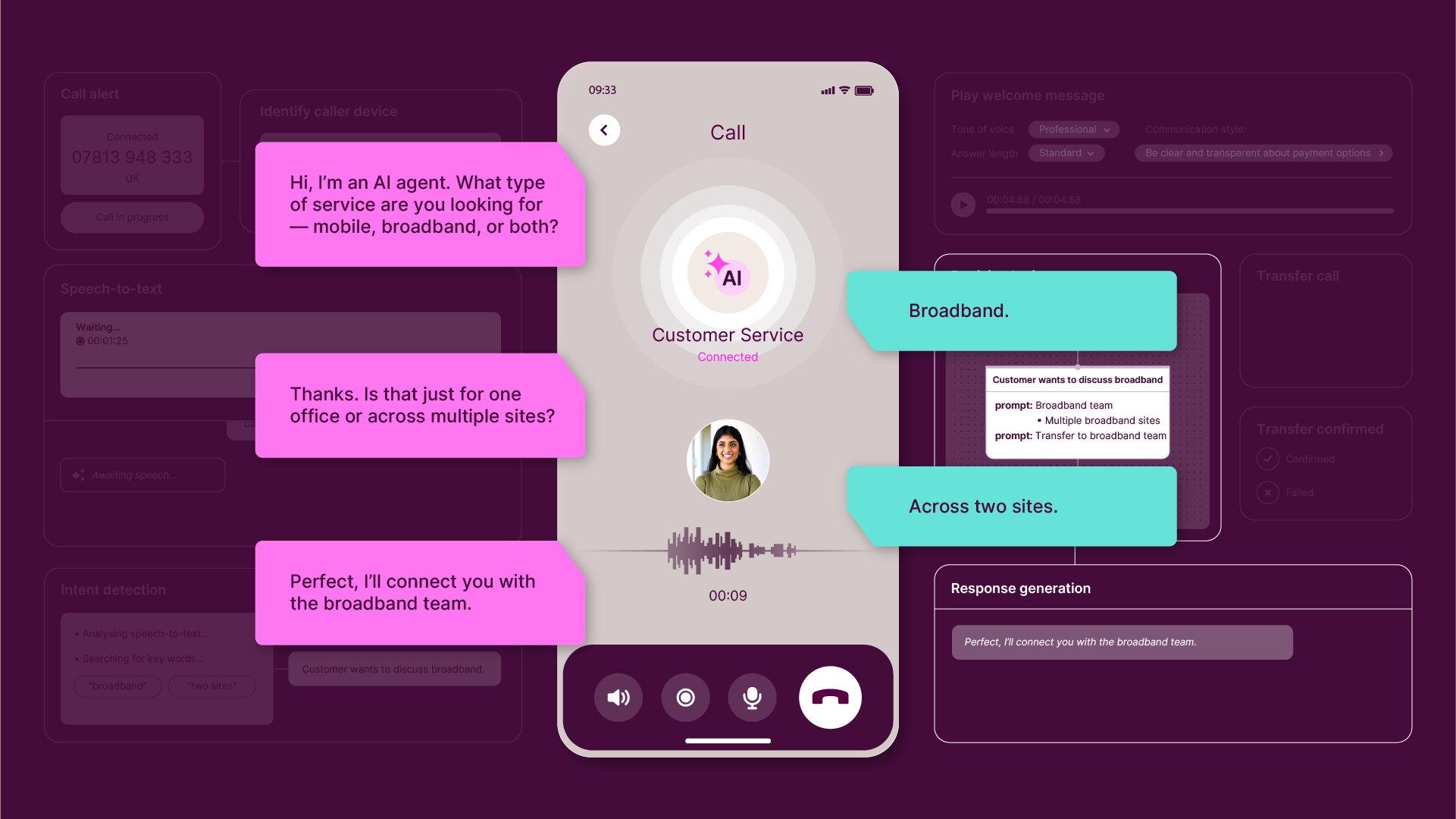
AI Agents deliver ROI by reducing the cost of handling routine interactions and extending service availability without increasing headcount.
Instead of relying solely on human agents to manage every enquiry, AI Agents can handle high-volume, repetitive interactions end-to-end. This includes tasks such as customer authentication, balance enquiries, payment queries and status updates. Each interaction handled by an AI Agent reduces the cost of a human-handled call.
From an ROI perspective, contact centres typically measure:
- Cost per AI-handled interaction (often under £0.50)
- The percentage of total interactions fully handled by AI
- Reductions in out-of-hours staffing costs
- Reduced call queue pressure during peak periods
When AI Agents are used to automate between 40-60% of repetitive interactions, the cost impact is significant. Organisations frequently see monthly savings running into tens of thousands of pounds, driven purely by lower cost per interaction and improved utilisation of human agents.
Extending availability without adding cost is one of the strongest ROI drivers for AI Agents. We explore this in more detail in How to Offer 24/7 Customer Support Without Increasing Headcount.
ROI in Real Terms: Indebted
For Indebted (a contact centre in the debt collection industry), automating repetitive interactions with an AI Agent led to a 30% increase in contact centre productivity and a 12% uplift in resolution rates.
- AI Chatbots: deflection, containment and digital ROI
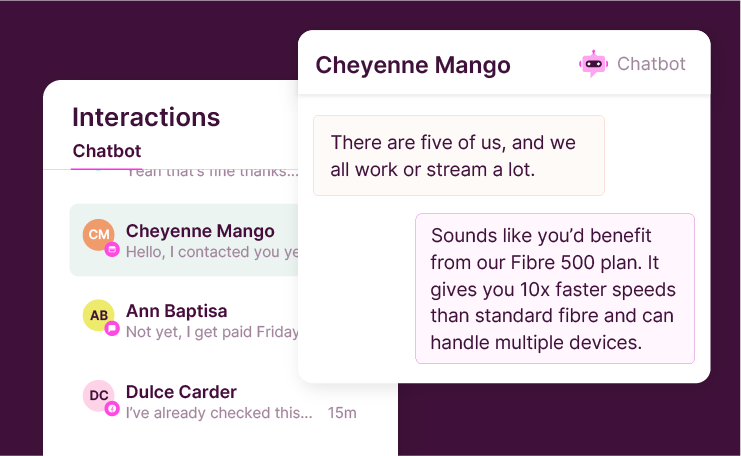
While AI Agents reduce the cost of handling interactions, AI Chatbots drive ROI by preventing interactions from becoming calls in the first place.
AI Chatbots aren’t a separate intelligence layer. They’re a digital channel through which AI Agents operate, using the same logic, workflows and compliance rules. The difference is where the interaction happens.
From an ROI standpoint, AI Chatbots are measured through:
- Deflection rates (queries resolved without reaching an agent)
- Reduction in inbound call volume
- Digital containment rates
- Cost difference between chatbot interactions and human-led webchat or calls
- Impact on Average Handle Time (AHT) by removing routine demand
When routine queries are resolved digitally, contact centres reduce inbound pressure, shorten queues and protect agent capacity. Customers benefit from instant responses, while the organisation avoids the higher cost of voice-based interactions altogether.
For a deeper look at how reducing routine demand directly impacts handle time, see How to Reduce Average Handle Time in Your Call Centre.
- AI-powered conversation analytics: ROI beyond cost reduction
Not all AI-driven ROI comes from removing interactions. Some of the most valuable gains come from making existing interactions more effective.
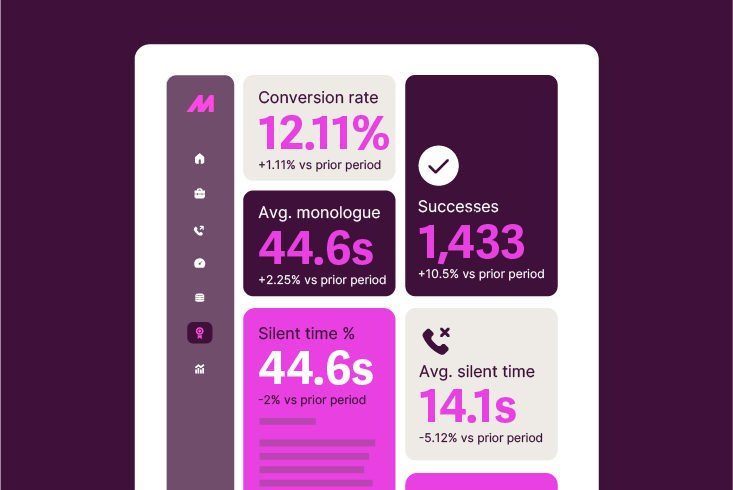
AI-powered conversation analytics deliver ROI by improving visibility, performance and compliance across every conversation. Teams gain insights across 100% of interactions instead of manual samples.
From an ROI perspective, contact centres typically measure:
- Reduced manual QA effort and review time
- Faster onboarding and agent coaching
- Improved compliance monitoring and risk identification
- Earlier identification of call drivers and friction points
- Improvements in agent effectiveness over time
Conversation analytics don’t directly reduce demand. Instead, they help contact centres understand why interactions are happening, where time is being lost, and how performance can be improved at scale.
ROI looks different depending on your contact centre model
The value AI automation delivers depends on how your contact centre operates, what pressures you’re under, and what success looks like to you.
Below are three common models, and how ROI typically shows up in each.
Debt collection & financial services
In debt collection and financial services, ROI is closely tied to cost control, compliance and availability.
Key ROI drivers typically include:
- Lower cost per contact
- Consistent, auditable compliance
- Always-on availability without expensive out-of-hours staffing
AI Agents are particularly effective here because they can handle structured, repeatable interactions reliably, including:
- Customer authentication
- Payment flows
- Balance and status updates
By automating these journeys, organisations reduce inbound demand on human agents while ensuring interactions are handled consistently and compliantly.
As seen with Indebted, automating high-volume, predictable enquiries helped reduce the cost per interaction while maintaining service availability across extended hours.
Outsourced contact centres and BPOs
For outsourced contact centres, ROI is less about absolute cost reduction and more about margin protection and scalability.
Typical ROI focus areas include:
- Improving agent utilisation
- Protecting margins under fixed-price or SLA-based contracts
- Maintaining service levels during demand spikes
AI plays a key role by absorbing predictable demand during peak periods, reducing the need to rapidly scale your headcount. This helps BPOs meet SLAs without over-recruiting or burning out agents during busy periods.
There’s also a longer-term ROI impact through reduced pressure on frontline teams, which can help lower churn and stabilise delivery costs.
Public sector, health and support services
In public sector and support-led environments, ROI is often measured in capacity, continuity and service quality, not just financial savings.
Key ROI considerations include:
- Extending service availability with limited budgets
- Reducing pressure on frontline staff
- Protecting agent wellbeing in emotionally demanding roles
ROI in Real Terms: Quitline Victoria
Using AI Agents to support outbound engagement, Quitline Victoria achieved a 62% answer rate, 18% completion rate and 10% re-engagement rate, extending service reach without increasing pressure on frontline counsellors.
In this context, ROI is realised through better allocation of human effort, improved service continuity and a more sustainable operating model, rather than simple cost removal.
A practical framework for calculating AI automation ROI
Common ROI mistakes to avoid
When measuring the ROI of AI automation, it’s easy to focus on the headline numbers and miss what actually drives long-term value. These are some of the most common pitfalls contact centres run into.
Measuring AI in isolation
AI rarely delivers ROI on its own. Its impact comes from how well it’s embedded into existing journeys, channels and workflows. Measuring AI separately from call routing, workforce management, or analytics often underplays its true value.
Expecting 100% automation
AI isn’t designed to handle every interaction. The biggest gains come from automating the right interactions. The interactions that are predictable, repeatable and time-sensitive. Complex or sensitive conversations should always be assigned to human agents.
Focusing only on call deflection
Reducing inbound volume matters, but it’s not the whole picture. ROI also comes from shorter handle times, better first-contact resolution, smoother handovers and improved agent productivity.
Ignoring quality, compliance and experience
Lower cost interactions mean very little if service quality drops or compliance risk increases. ROI should always be measured alongside consistency and customer outcomes, especially if you’re operating in a regulated environment.
Treating ROI as a short-term metric
AI ROI compounds over time. As models learn, workflows improve, and teams adapt, the value of it grows. Measuring success only in the first few weeks can hide the longer-term gains in capacity, scalability and higher resilience.
ROI is about balance, not replacement
The strongest ROI from AI automation comes from supporting people rather than replacing them.
Used as part of a human-AI hybrid model, AI Agents, AI Chatbots and analytics help contact centres reduce cost per interaction and extend capacity to deliver a more consistent service, without increasing headcount or burning out teams.
ROI isn’t something you measure once and move on from. The most successful contact centres refine automation over time as demand, channels and expectations change.
If you want to understand what ROI could look like in your contact centre, start by exploring how AI can support your existing operation.
Explore AI contact centre solutions


.png)
