We say theoretically, because there’s a caveat here. Reducing AHT mustn’t happen at the expense of service. Rushing calls simply to improve AHT is a recipe for dissatisfaction and, ultimately, unhappy customers.
That’s why modern approaches to AHT reduction increasingly rely on AI Agents, AI Chatbots and intelligent call routing, rather than pressuring (already stretched) agents to work faster.
In the rest of this blog, we’ll define what average handle time is and how it’s calculated. And we’ll also share strategies for reducing average handling time while maintaining or even improving customer satisfaction (CSAT).
What is Average Handle Time (AHT)?
Average Handle Time (AHT) measures the average duration of a single customer interaction. It accounts for total talk time, hold time and after-call work (ACW) divided by the number of calls handled.
Talk time: The total time that agents spend talking to customers.
Hold time: Time customers spend waiting for an agent to deal with their issue(s).
After-call time: The time spent on tasks, such as making notes, sending emails, or categorising the conversation. These are tasks that a call centre agent has to do before handling another call.
Average Handle Time formula:
AHT = (Total Talk Time + Total Hold Time + Total After-Call Work Time) ÷ Number of Calls Handled
What’s considered a good AHT depends to some extent on the industry you’re in. Call Centre Helper’s Erlang calculator lets you enter specific metrics to work out your own AHT, but according to its own example, an AHT of 6m 10s is reasonable.
According to our latest Benchmark Report, around 44% of our respondents reported times between 6 and 9 minutes.
Why is reducing AHT important?
As a general rule, the lower your AHT, the better. It means you can handle more calls, improve efficiency and reduce costs.
AHT also gives you the information to improve resource management, and to help agents improve performance. Taken together, it is one of the key metrics of any call centre operation.
Lowering your Average Handle Time can lead to:
- Increased efficiency, so you can handle more calls with the same number of agents.
- Cost reduction, so you save on operational costs by optimising agent time.
- Improved customer satisfaction due to faster resolutions but only if quality is maintained.
Why is reducing AHT difficult?
There are a few common challenges that stop call centres from achieving lower Average Handling Times.
Complex customer issues
Naturally, some customer enquiries take more time to resolve than others, increasing handling time. These complex issues might include technical difficulties, multiple queries or sensitive situations. In these scenarios, focus on delivering a thorough and effective service over minimising call time.
Outdated systems and procedures
Trying to reduce AHT in a call centre that has inefficient processes and outdated systems is never going to go well. Outdated systems that respond slowly or crash frequently mean agents wait for screens to load or systems to reboot. Lack of integration between platforms can also mean switching between platforms to gather information, which takes extra time during calls.
Complicated workflows and manual tasks that could be automated result in more time spent on simple interactions. Without AI-enabled workflows, agents are forced to handle authentication, basic queries and admin tasks manually.
Overcoming agent knowledge gaps
When call agents lack product knowledge, communication skills and familiarity with internal processes, it inevitably leads to longer call durations as agents spend more time finding information, hesitate during conversations, or place customers on hold to seek support.
Inexperienced agents might mishandle calls and give incorrect information, or fail to resolve issues on the first attempt. This leads to repeat contacts that further inflate AHT.
Balancing AHT with customer satisfaction
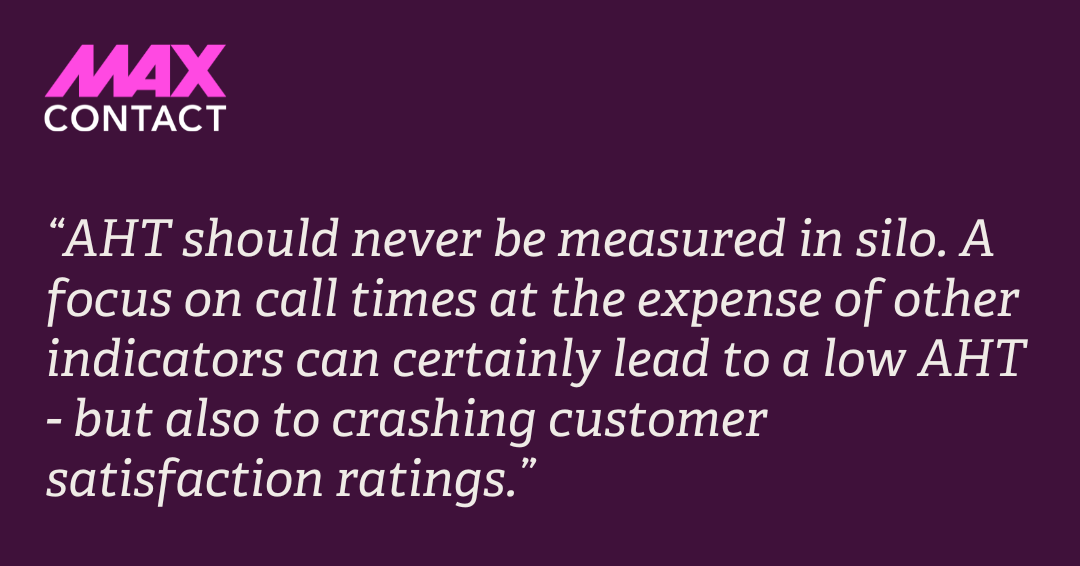
You should never measure AHT in silo. A focus on call times at the expense of other indicators can certainly lead to a low AHT, but also crash customer satisfaction ratings. Agents should never be incentivised to end calls prematurely or rush through conversations.
Agents who feel pressured to end calls quickly are more likely to make mistakes or give bad advice. When that happens, another key call centre metric (first call resolution (FCR) rates) also suffers.
But,AHT is important and, if you do need to bring it down, there are ways of doing so that won’t undermine the experience of your customers.
And this is where modern contact centre technology starts to change the picture.
How AI-powered contact centre software changes the way AHT is reduced
AI-powered contact centre solutions reduce average handle time without rushing conversations or compromising service quality. Here’s how AI features can influence the customer journey:
AI Agents can handle authentication, intent capture and simple issue resolution before a call reaches a human agent. This reduces talk time.
- AI Chatbots can be a credible option to resolve routine queries digitally, reducing unnecessary calls altogether.
- Conversation Analytics can be used to analyse call recordings and pinpoint effective call handling techniques. Understanding what works and what doesn’t in different scenarios and incorporating those learnings into agent training reduces average call handling time.
6 practical ways to reduce Average Handling Time in your call centre
1. Remove avoidable call handle time with AI Agents and AI Chatbots
A big driver of high AHT is unnecessary calls reaching agents in the first place.
AI Chatbots and AI Agents can combat this by handling high-volume, predictable interactions end-to-end. Things like identity checks, balance queries, appointment changes or payment prompts, for example. Customers get instant answers, and agents aren’t stuck dealing with the same repetitive routine requests.
2. Get customers to the right place first time
AHT quickly increases when calls are transferred or if agents have to spend the first few minutes determining what the customer actually needs.
Intelligent contact strategies use intent and context to direct each interaction to the right destination, whether that’s an AI Agent, a chatbot or a specialist human agent. When customers arrive in the right place with the right information already captured, conversations are generally shorter and smoother.
Plus, less time spent re-explaining means more time spent resolving.
3. Use workforce management to reduce avoidable wait time
Average Handle Time is affected by how well contact centres are staffed throughout the day.
By analysing demand patterns, Workforce Management (WFM) ensures the right number of agents are available at the right times. When staffing levels reflect actual call volumes, customers spend less time waiting in queues, and agents aren’t put under unnecessary pressure.
When teams are overwhelmed, calls are longer, hold time increases, and call resolution is slower.
Overstaffing, on the other hand, drives up your overheads without improving outcomes.
By planning resources accurately, contact centres can reduce queue time and keep Average Handle Time under control without increasing headcount or paying for hours they don’t need.
4. Use conversation analytics to understand why calls are running long
If AHT is rising, contact centre leaders should understand why before making moves to try to fix it.
Conversation Analytics and Auto QA make it easier to see where time is being lost. You can spot common points of confusion, repeated questions, policy explanations that take too long, or processes that regularly slow conversations down.
Instead of guessing or pushing agents harder, teams can focus on addressing the root causes of long calls.
5. Combine data with agent feedback to remove friction
Agents are often the first to notice what’s slowing calls down, from unclear processes and missing information to repetitive questions.
When agent feedback is combined with insights from conversation analytics, the learnings become much more actionable. Patterns can be confirmed, call scripts refined and workflows simplified.
Improvements based on real experience, rather than assumptions, are far more effective.
6. Set realistic and balanced KPIs
AHT is an important metric to monitor, but it shouldn't be the only focus. Balance it with other key performance indicators (KPIs) such as First Call Resolution (FCR) and Customer Satisfaction Score (CSAT).
How MaxContact can help
Reducing Average Handle Time consistently comes down to how well your contact centre is set up to support agents and customers through each interaction.
MaxContact helps remove some of the friction that typically slows calls down. AI Agents and AI Chatbots take care of routine interactions and capture useful context early, while features like IVR, intelligent routing and workforce management help customers reach the right place without unnecessary delays.
Alongside this, reporting and conversation analytics give teams a clearer view of where handling time is being lost.
This helps contact centres bring Average Handle Time down in a way that feels sustainable: without rushing agents, adding headcount or compromising the customer experience.
If AHT is something you’re actively trying to improve, it’s worth looking at how the right contact centre technology can support that effort.
Explore MaxContact’s AI-powered contact centre solutions.




.png)
