featured
article
Fresh thinking and practical takeaways to help your business improve customer engagement and unlock better performance.

discover THE
latest articles

Make Call Reviews Faster, Fairer, and Evidence Backed.
Introducing AI Call Scoring — now included within Conversation Analytics at no additional cost.
Here’s a number worth sitting with: 30 minutes.
That's how long it takes to manually score one call. Listen back, fill in the scorecard, write up the notes, log the result. Do that 50 times a month and you've lost on average 4 days per reviewer to scoring alone.
Most QA teams know this. They're not slow or inefficient - the maths just doesn't work. One reviewer for every 25 agents, 30 minutes a call, finite hours in the week. Something must give, and that’s coverage. The industry average sits at around 5% of calls reviewed, which means 95% of what happens on your contact centre floor stays invisible.
Not just to your QA team. To your compliance records. To your coaching programme. To the agents who deserve consistent, fair feedback on every call they handle.
That's the problem AI Call Scoring is built to fix.
Your standards applied to every call you wish to score.
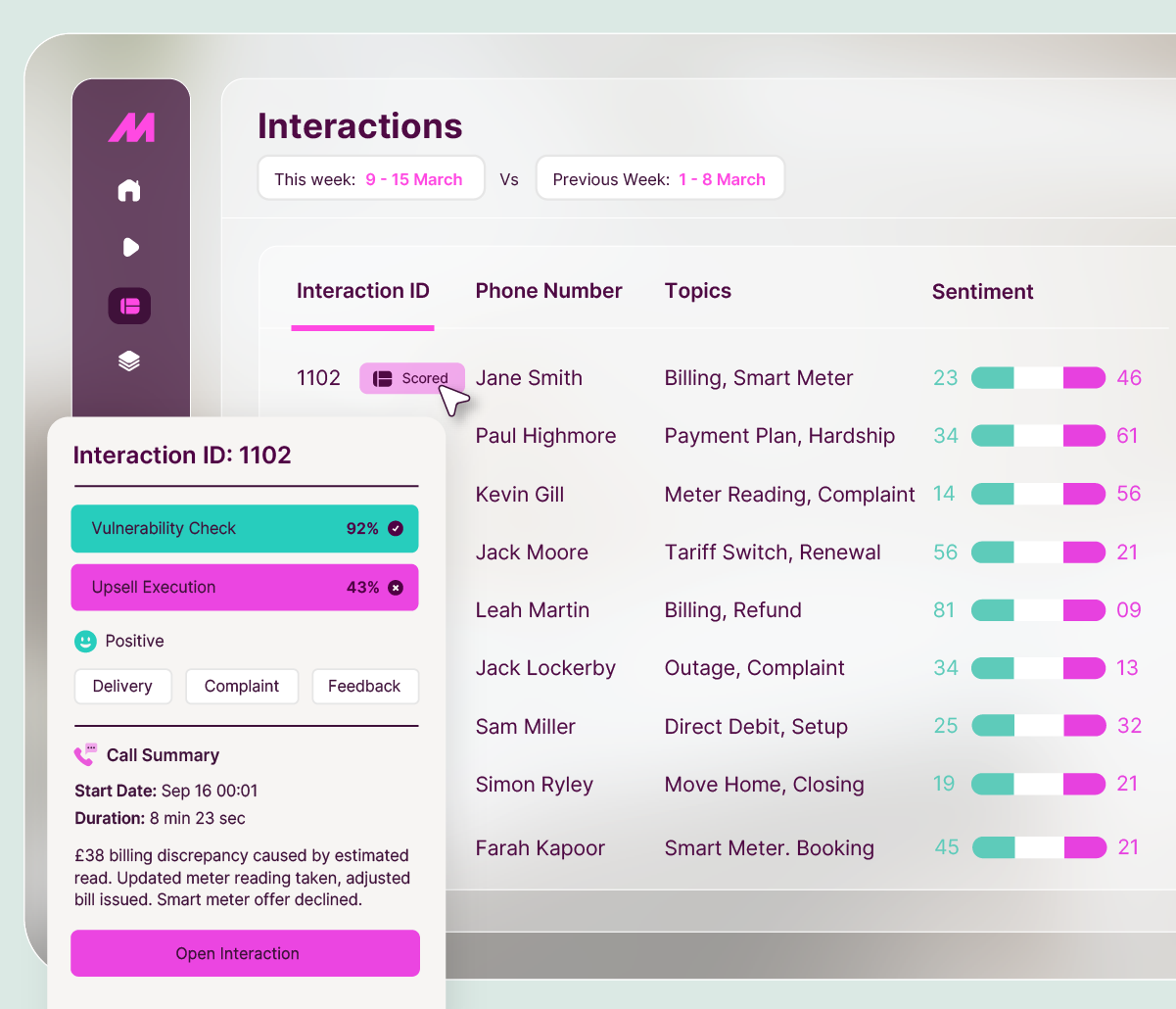
The way it works is straightforward. You define your existing QA standards - built around your business rules, your compliance requirements, your definition of what a good call looks like. AI Call Scoring applies them to your selected calls, scoring each one against your criteria using evidence taken directly from the transcript.
No algorithm deciding what good looks like on your behalf. You set the standard.
.png)
What this means for your QA team day to day
One of the things that doesn't get talked about enough in QA is how demoralising inconsistency is. Two reviewers score the same call differently. An agent pushes back. The process loses credibility. And meanwhile, the team is so buried in manual scoring that the actual coaching - the conversations that change behaviour -never happen.
AI Call Scoring brings review time down from around 30 minutes to about 5 minutes per call. Your QA team stop being a scoring machine and start doing what they're good at - calibrating standards, making judgment calls, and coaching agents to improve.
For a reviewer handling 50 calls a month, that's roughly four days back every month. That's a lot of coaching time that wasn't there before.
It's not just for big teams
This is worth saying clearly because it matters: AI Call Scoring isn't just a tool for large operations with dedicated QA departments.
For teams of 50 or more agents, the time savings are significant - around 133 days per year across four QA staff, worth approximately £15k in team time. But beyond the hours, scoring more calls consistently means you start seeing the patterns that a small sample will never show you.
For smaller teams of 10 to 30 agents, it's even more of a shift. Structured QA without dedicated headcount. Team leaders reviewing scored calls in minutes. Compliance coverage that doesn't require a compliance team. And a framework that grows with the business.
.png)
When compliance is non-negotiable
For contact centres operating in regulated sectors, the stakes have risen. Consumer Duty, now actively enforced by the FCA, places a direct obligation on organisations to evidence that customers are receiving good outcomes.
When a complaint lands, you can't point to a sample. You need evidence that the specific interaction was handled correctly. AI Call Scoring gives you an auditable record of every scored call, with auto-fail rules that catch compliance breaches - a missed disclosure, an incomplete ID check - regardless of how the rest of the call went. Every call you score is evidenced, auditable and defensible.
Your team stays in control
We want to be clear about this: AI Call Scoring is there to support your QA team, not sideline them. Every scored result can be reviewed, edited, challenged or discarded. Your people stay in the loop. The AI does the volume work - your team does the thinking.
It all lives inside Conversation Analytics — scored calls, common objections, objection handling effectiveness, top performers and saved compliance views, together in one place.
Already on Conversation Analytics? It's yours.
AI Call Scoring is included within Conversation Analytics at no extra cost. If you're already using the suite, it's available to you now.
This is also just the start. Automated QA at Scale is coming later this year - fully automated scoring across campaigns at volume. More on that soon.
If you're not yet using Conversation Analytics and want to see what AI Call Scoring could do for your team, come and talk to us. Book a demo and we’ll show you what it looks like in your environment.
Outbound still pays - your customers just need a smarter approach
High-volume cold calling is losing ground. Here's what a high-performing, data-led outbound strategy looks like - and how to sell it to your customers.
High-volume cold calling based on limited data is no longer a cost-effective outbound strategy and in the B2C world can be non-compliant.
With both sales and debt collection, the public has grown wary of unsolicited calls and generic conversations. But that doesn’t mean outbound dialling is over as a revenue engine.
It means it has to be smarter, multi-channel and data-led. Based on real-time information and a refined dialling strategy. Often personalised in tone, timing and approach.
So, if you’re reselling UCaaS today, there’s a strong chance your customers’ outbound results are being held back by the platform they’re on. When revenues stagnate, contact rates fall or conversions get harder to close, the problem usually isn’t effort - it’s strategy, data and tooling. This blog sets out what a high-performing outbound operation looks like, so you can have that conversation with confidence.
The outbound metrics your customers should be measuring
The foundation of any smart outbound strategy is good information. Help your customers understand that without the right data, they can’t tell whether calls are reaching the right people, whether agents are performing, or whether their scripts are working. Measurement isn’t a nice-to-have - it’s where improvement starts.
Outbound KPIs to share with your customers:
• Connect rates: are calls being connected to a real person?
• Contact rate: how often are agents reaching the right decision-maker?
• Data penetration rate: is their data being used effectively - are they making the most of high-value leads?
• Conversion rate: the percentage of contacts that result in a positive outcome
• Calls to success rate: the number of calls needed per successful result
Take conversion rate as a case in point. It tells your customers two things at once: the quality of their contact data, and the effectiveness of their team.
Better data means a higher likelihood of reaching the right person. Skills-based routing - matching the right agent to the right call- increases that further. And stronger training, combined with more refined scripts, means more of those conversations end the way they should.
Qualitative insight matters as much as the numbers
Quantitative KPIs don’t tell the full story.Improving contact rates will generate more conversations - but without the right skills in place to handle them, conversion rates won’t follow.
Encourage your customers to combine the numbers with qualitative insight: what objections are coming up most, what their customers are saying about competitors, and where conversations are breaking down.Helping them bring both lenses together is one of the most valuable things you can do as a partner - and it’s a conversation most resellers never have.
Industry-specific KPIs worth knowing
The metrics above apply broadly, but it’s worth helping your customers zone in on numbers that are specific to their sector.
In debt collection, promise to pay (PTP - the percentage of calls resulting in a commitment to pay) and percentage of debt collected are key indicators. In sales, first-call close rates and average revenue per call say a lot about campaign effectiveness.
MaxContact’s KPI Benchmark Report gives a detailed breakdown of what good looks like across sectors. It’s a useful resource to share with customers who want to know how their numbers stack up.
Benchmarking: what good looks like
Once your customers know what to measure, the next step is helping them understand what the numbers mean.
MaxContact’s own research found that the largest proportion of respondents - 34%, across both sales and debt collection - reported conversion rates of between 10% and 19%. Cold outbound sales calls typically convert at 1–3%; warmer, more targeted calls can reach as high as25%.
Broad benchmark ranges for common outbound KPIs:
• Average handling time: 4–12 minutes
• Contact rate(cold calls): 5–15%
• First call resolution: 10–40%
These are broad ranges and will vary significantly by sector and product complexity. The more important thing for your customers is to track their own numbers consistently over time - and to understand what’s driving movement in either direction.
What your customers can do to improve outbound performance
Once your customers are tracking the right metrics,the focus shifts to moving them. Here are the levers most likely to make a meaningful difference - and the conversations worth having:
• Team training and coaching - conversation analytics can surface objection patterns, benchmark individual and campaign performance, and show exactly where coaching will have the biggest effect.
• Smarter dialling strategy - when are their contacts most likely to answer? Are they prioritising by lead value? Are they using the right dialler mode for the campaign? These are practical questions you can help them think through.
• Omnichannel engagement - how does combining SMS, email and calls affect contact and conversion rates? Could AI agents handle routine calls while human agents focus on more complex or sensitive interactions?
The performance advantage you can offer your customers
Helping your customers understand and act on their outbound performance data is a powerful way to open the door to a bigger conversation. Standard UCaaS platforms can’t offer the range of insight and capability that a specialist customer engagement solution like MaxContact provides - and once customers seethe gap, the case for change makes itself.
Think conversation analytics, AI chatbots, workforce management, intelligent outbound dialling and sophisticated contact strategies - capabilities that standard UCaaS systems simply can’t match, and that enterprise-grade platforms price out of reach for most teams.
MaxContact delivers measurable results - from 200–300% increases in contact rates to doubling sales teams’ conversion rates. Benchmark Insights Report.
That’s because its intelligent, intuitive platform lets teams build smarter outbound strategies and tailor them for every campaign.
Talk to the MaxContact partner team about adding a specialist customer engagement solution to your portfolio. Book a call
.png)
Are You Ready for AI In Your Contact Centre?
Learn what AI readiness really looks like - and download the scorecard to assess yours.
AI doesn’t fix contact centres. It scales them. If your journeys are joined up, automation can reduce the pressure your team is facing. However, if they’re fragmented, AI amplifies the friction - faster transfers, repetition and customer effort. That’s why the most useful question contact centre leaders can ask themselves isn’t “What can AI do?” - it’s, "Are we actually ready for it?".
Whether you’re running sales and retention in telecoms, payment collections with vulnerability considerations in finance, customer support in utilities, or managing multiple client programmes in a BPO, the readiness question is the same - do we have the foundations to automate without increasing customer effort or operational risk?
“Always-on” support is an operating model, not a staffing one. It's built to remove avoidable demand, protecting your team's time for high-judgement conversations, and making escalation safe when risk or complexity arises.
Always-On Service Starts with Resolution, Not Headcount.
Consumers are increasingly expecting help at any time of day, across voice and digital channels. But increasing headcount to meet 24/7 customer support expectations isn’t sustainable for most contact centres operating on tight margins.
An always-on contact centre doesn’t mean agents working around the clock. It means using AI and automation to absorb predictable demand across inbound and outbound – from service updates and appointment changes to sales follow-ups and renewals, to payment reminders and self-serve arrangements - without needing an agent for every interaction.
The trap many leaders fall into is assuming that automation alone creates always-on. It doesn’t. Always-on is the result of clear journeys, consistent rules, and controlled escalation.
The Real Readiness Problem: Avoidable Demand
Most contact centres don’t struggle because customers contact them. They struggle because customers are contacting them more than once.
A lot of volume is created by operational gaps:
- Unresolved issues driving repeat contact
- Too many transfers caused by poor routing
- Long handle times driven by missing context
- Channels operating as seperate service silos
This is the stuff that quietly drains performance. It also explains why some AI programmes stall: they automate interactions on top of broken flows, then wonder why customer effort doesn’t fall, and agent workload doesn’t change.
If you want a pragmatic AI strategy, start by identifying where the operation is generating demand it shouldn’t have to handle.
A Practical Readiness Lens: Demand, Continuity, Control
To make readiness tangible, use this simple lens. If any one of these is weak, automation outcomes will be capped - or worse, you’ll scale the wrong things.
1) Demand: Do You Know What Should Be Automated?
AI delivers value when it absorbs predictable, repeatable demand - the structured interactions that don’t require human judgement. If you can’t clearly separate predictable from complex demand, you’ll either automate the wrong things and frustrate your customers or keep too much with agents and miss the efficiency gains.
A pragmatic starting point is mapping the top drivers and asking: which ones are genuinely structured, and which are only “simple” because we’re not seeing the full context?
2) Continuity: Does Context Move with The Customer?
Customers think in outcomes, not channels. Readiness means your operation can maintain continuity when a conversation starts in chat and moves to voice, or when an outbound reminder triggers an inbound response, or when a customer returns with a follow-up and expects you to remember what happened last time.
If context doesn’t travel, automation becomes a reset button, and resets are where handle time, repeat contact, and frustration grow.
3) Control: Can You Escalate Safely and Measure Outcomes?
Automation should never be a dead end. When complexity rises, or when there’s vulnerability, a complaint, payment risk, or compliance exposure, you need controlled escalation to a human agent with the full context carried across.
If you can’t define escalation rules and success measures beyond containment” you’re not ready to scale. You’re ready to pilot.
Where AI Fits When You’re Ready: Layers, Not Channels
A common mistake is deploying AI as separate tools by channel - a chatbot here, an AI agent there - and expecting it to add up to an always on operation. It simply adds more mini contact centres to the one you already have.
A more practical approach is to treat AI as layers across the operating model:
- Decision layer (AI Agents): Interprets intent, resolves structured interactions, and prevents outbound activity from automatically creating inbound pressure through unmanaged follow-up
- Asynchronous layer (chatbots and messaging): Allows customers to complete routine tasks without joining a queue, while keeping journeys connected across voice and digital
- Visibility Layer (Conversation Analytics): Shows where demand originates, where conversations stall, and what drives repeat contact so you can improve routing, coaching, and automation design based on evidence rather than instinct
When these layers support end-to-end workflows, AI stops being a bolt-on and becomes a genuine performance lever.
A Quick Readiness Check: The Questions Most Teams Skip
If you’re planning AI-enabled automation this quarter, these questions are worth answering before you commit time and budget:
- What proportion of our demand is truly predictable and repeatable?
- Where do customers repeat themselves, get transferred, or drop out?
- What's creating repeat contact and how will we remove it?
- What are our escalation triggers for risk, vulnerability or complexity and do we trust them?
- How will we measure success beyond containment - effort, quality, outcomes, stability?
- Do inbound and outbound journeys reinforce each other, or create extra pressure?
If those answers aren’t clear yet, that’s not a blocker, it's your roadmap.
Pressure-Test Your Readiness With The Scorecard
If you want a structured way to benchmark readiness across the foundations that matter - demand, continuity, escalation, and operational fit - our scorecard is designed for exactly that. Use it to create alignment internally, prioritise improvements, and shape an automation roadmap that holds up under real-world volume, not just pilot conditions. Download the Always-On Contact Centre Readiness Scorecard here.
Automate smarter: how to identify what to automate in your contact centre
Not sure where to start with contact centre automation? Discover a proven framework for identifying the right interactions to automate — and when.
The pressure to introduce AI in contact centres has never been greater. But automating the wrong interactions doesn’t just waste investment - it actively frustrates customers and creates more work for your team. Here’s how to get it right from the start.
This article is based on a recent webinar - Watch the full replay on YouTube.
The real challenge isn’t how to automate - it’s what
Most business leaders today aren’t asking whether to use AI in their contact centre. They’re asking where to start. And that’s exactly the right question to be asking.
We recently hosted a webinar exploring this challenge with Kayleigh Tait, Marketing Director at MaxContact, and Conor Bowler, Principal Product Manager. Together, they walked through the research, the common pitfalls, and a practical framework that helps contact centres make confident, data-driven automation decisions.
Here’s what they covered.
What UK consumers actually think about AI
MaxContact commissioned an independent survey of over 1,000 UK consumers who had interacted with a contact centre in the last 18 months. The findings from the Voice of the UK Consumer Report are revealing.
- 45% of UK consumers say they’re comfortable interacting with an AI-powered chatbot or virtual assistant. But 36% say they’re uncomfortable.
- Only 36% say AI has improved their experience. Almost the same number - 32% - say it has made things worse.
- 65% of 25–34 year-olds are comfortable with AI, compared to just 27% of over-55s.
- 70% want a human when explaining their specific situation. 67% for emergencies. 61% when making a complaint.
- 55% of consumers have abandoned calls because of excessive wait times. 26% because they had to repeat information.
The takeaway? Automation isn’t automatically improving customer experience. It depends entirely on how and when it’s used - and critically, whether the strategy has been built around the customer or around internal efficiency targets.
The modern inbound customer journey
Most businesses treat every interaction the same, routing everything to queues. But inbound demand isn’t evenly distributed. It follows a pattern.
At the start of the journey, volumes are high and queries are simple: balance requests, payment dates, appointment changes, status updates. This is where AI and automation deliver the greatest impact - resolving queries quickly, reducing cost to serve, and freeing agent capacity without compromising experience.
As complexity increases, the role of automation shifts. Intelligent routing, context preservation from AI to human handover, and real-time agent support all help agents handle harder conversations faster and with more confidence.
At the resolution and advocacy stages, humans lead - supported by AI insights, not replaced by them. The goal is that automation removes repetitive workload at the top of the funnel, so people can focus on the interactions where judgment, empathy, and experience really matter.
How Conversation Analytics uncovers automation opportunities
Before you decide what to automate, you need to understand what’s actually happening in your contact centre. Conor Bowler demonstrated exactly how MaxContact’s Conversation Analytics makes this possible - at scale.
In the demo, Conor surfaced 28,000 calls from a single month, immediately identifying intent clusters: appointment booking accounted for 10% of interactions, technical challenges for 4%. Together, that’s 14% of call volume with clear automation potential - identified in minutes.
Using MaxContact’s AI assistant within the platform, teams can drill into individual calls, ask whether elements of those interactions could be automated, and use those insights to design workflows in MaxContact’s Workflow Studio. Those workflows can then be deployed directly to chatbots, voice agents, or email channels - with built-in escalation paths when automation reaches its limits.
For contact centres without Conversation Analytics today, this process is still possible — but relies on manual call sampling, disposition codes, and CRM data. It’s achievable, but slower and harder to repeat consistently over time.
The MaxContact Automation Framework
Based on research findings and direct experience working with contact centres of all sizes, MaxContact has developed a four-step framework for identifying automation opportunities.
Step 1: Start with real interaction data
Automation decisions should be driven by evidence, not assumption. Too often, automation projects are led top-down - driven by boardroom pressure or a use case that sounds innovative rather than one grounded in data. Starting with call recordings, chat transcripts, CRM data, disposition codes, and repeat contact patterns gives you the factual foundation to make better decisions.
Look for patterns: what are the most common reasons for contact? What consistently takes under three to four minutes to handle? What drives re-contact within 24 to 72 hours? Technology makes this repeatable - so you’re not starting from scratch every quarter.
Step 2: Cluster by intent
Rather than analysing by channel (voice vs email vs chat), cluster interactions by customer intent. Instead of ‘20,000 calls’, ask: how many were payment date queries? Balance requests? Appointment changes? Customers don’t think in channels — they think about the problem they want to solve.
Conversation Analytics surfaces these clusters automatically, saving hours of manual analysis and revealing patterns that might otherwise go unnoticed.
Step 3: Rank by volume and effort
Not every repetitive query should be automated. Ranking by two lenses — volume (how often does this occur?) and effort (how much friction does this create?) - helps you prioritise strategically.
- High volume + low effort: immediate automation potential.
- High volume + high effort: may require journey redesign before automation.
- Low volume + high effort: remain human for now.
- Low volume + low effort: monitor and consider as a pilot.
Step 4: Validate with your team
Before you automate anything, validate the decision with the people who handle those conversations every day. Ask: Is this emotionally sensitive? Is it a brand touchpoint that customers value? Does it spike seasonally? Does what looks like a simple query often become a complex one underneath?
A payment query might look straightforward - but if it frequently leads to a conversation about payment difficulty, that’s not a candidate for full end-to-end automation. This step prevents automation decisions that look good on paper but frustrate customers in practice.
How do you know your automation is working?
Automation is working when three things improve simultaneously: business outcomes (cost to serve, conversion, retention), customer experience (faster resolution, less repetition), and operational performance (agents spending less time on repetitive tasks and more on complex conversations). If automation only improves one area, it’s likely not deployed in the right place.
Monitor containment rates, drop-off points, and escalation paths on a weekly basis for early warning signs. Review and optimise on a quarterly basis - or more frequently in fast-moving markets with changing regulation or customer expectations.
Ready to start your automation journey?
Watch the full webinar replay on YouTube.
Download the Voice of the UK Consumer Report.
Book a complimentary automation consultancy session with our Customer Success team and we’ll run you through the MaxContact Automation Framework for your organisation: https://www.maxcontact.com/book-a-demo

How to Measure the ROI of AI Automation in Your Contact Centre
Regardless of the industry they operate in, AI automation is a commercial necessity for contact centres, rather than a tool to experiment with.
According to our latest Benchmark Report, 66% of contact centres are currently using or piloting AI with the aim of reducing operational costs and driving productivity.
But measuring ROI from AI automation isn’t straightforward.
A contact centre specialising in debt collection may measure ROI through reduced cost per contact, improved payment completion rates, or increased compliance consistency. Meanwhile, an outsourced contact centre that handles high-volume inbound enquiries may focus on deflection rates, average handling time or agent utilisation.
Channel mix can also influence impact. Voice-reliant operations see ROI through reduced call queue pressure and lower cost per call, while digital-first environments may prioritise customer containment and response speed.
Measuring AI ROI properly means understanding what success looks like in your specific environment, rather than relying on generic savings estimates.
Start with a baseline: what does a human-handled interaction really cost?
Before you can begin to measure the return from AI automation, you need a clear picture of what interactions cost when they’re handled by people.
For most UK contact centres, the average cost of a human-handled voice call sits between £5.50 and £6.50 per interaction. This is often used as a headline figure, but it doesn’t tell the whole story.
The total cost is driven by other factors, including:
- Agent salaries and on-costs
- Training and onboarding, which are made more expensive by high attrition rates
- Quality assurance and compliance overhead, including call monitoring and reporting
- Out-of-hours staffing, which significantly increases the cost for 24/7 coverage
- Inefficiencies caused by repeat calls, transfers and long handle times
Even when handled efficiently, live calls demand dedicated agent time, whereas digital interactions can be managed asynchronously and at a greater scale.
A voice-heavy operation will feel cost pressure very differently from a digital-first one, and ROI calculations need to reflect that reality.
By contrast, AI-handled interactions typically cost a fraction of a human-handled call, often coming in at under £0.50 per interaction, depending on channel, complexity and volume. That gap is where ROI potential starts to emerge, but only if you understand what you’re replacing or augmenting in the first place.
Put simply, you can’t measure ROI without first understanding what each interaction costs you now. Without a baseline, your savings might look impressive on paper but will prove impossible to validate in practice.
The core ROI generators of AI automation
Not every AI capability is designed to solve the same problem, and not every contact centre will prioritise the same outcomes.
The key to measuring ROI accurately is understanding where value is being created in your operation.
- AI Agents: reducing cost per interaction and extending capacity
AI Agents deliver ROI by reducing the cost of handling routine interactions and extending service availability without increasing headcount.
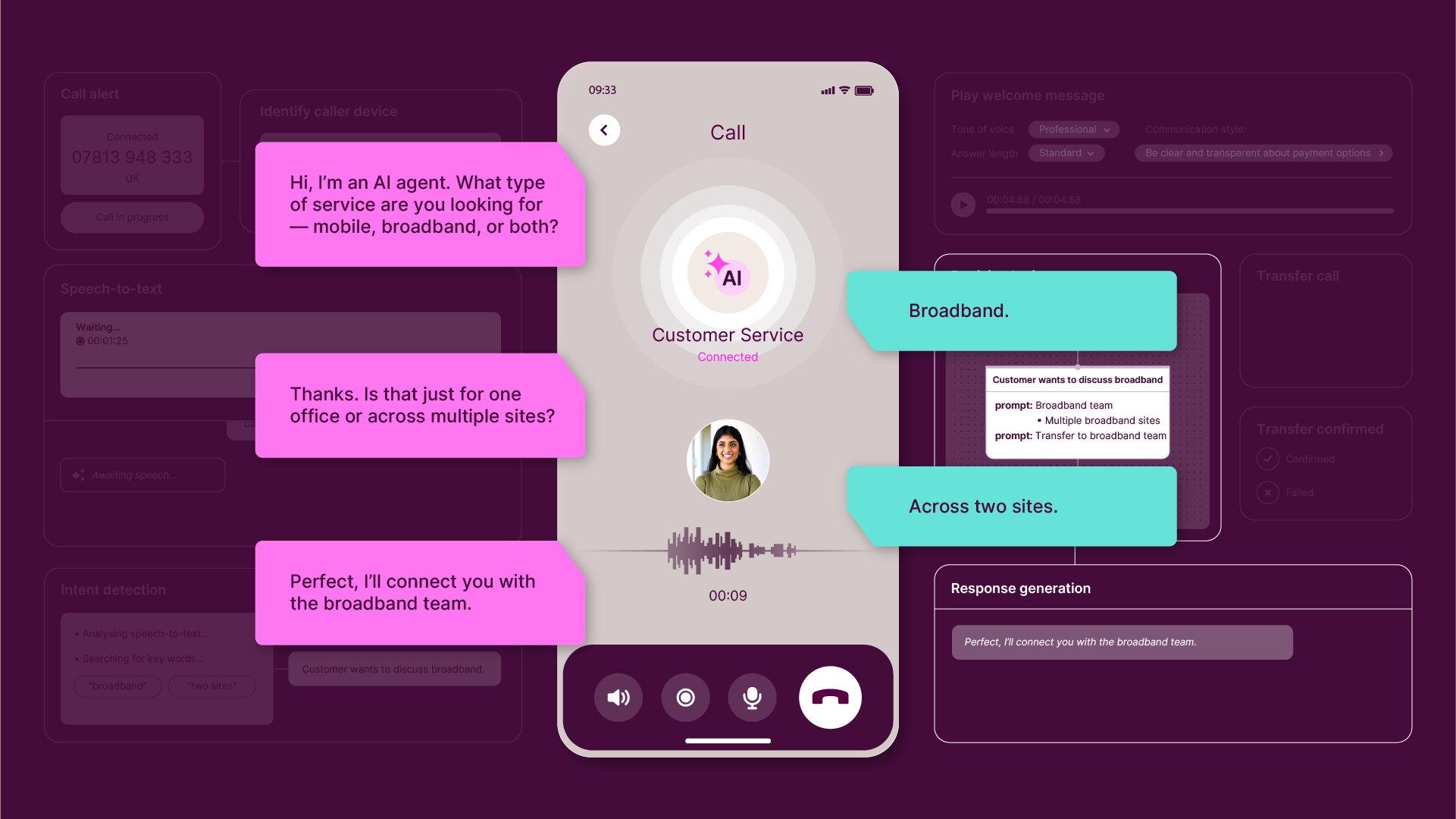
Instead of relying solely on human agents to manage every enquiry, AI Agents can handle high-volume, repetitive interactions end-to-end. This includes tasks such as customer authentication, balance enquiries, payment queries and status updates. Each interaction handled by an AI Agent reduces the cost of a human-handled call.
From an ROI perspective, contact centres typically measure:
- Cost per AI-handled interaction (often under £0.50)
- The percentage of total interactions fully handled by AI
- Reductions in out-of-hours staffing costs
- Reduced call queue pressure during peak periods
When AI Agents are used to automate between 40-60% of repetitive interactions, the cost impact is significant. Organisations frequently see monthly savings running into tens of thousands of pounds, driven purely by lower cost per interaction and improved utilisation of human agents.
Extending availability without adding cost is one of the strongest ROI drivers for AI Agents. We explore this in more detail in How to Offer 24/7 Customer Support Without Increasing Headcount.
ROI in Real Terms: Indebted
For Indebted (a contact centre in the debt collection industry), automating repetitive interactions with an AI Agent led to a 30% increase in contact centre productivity and a 12% uplift in resolution rates.
- AI Chatbots: deflection, containment and digital ROI
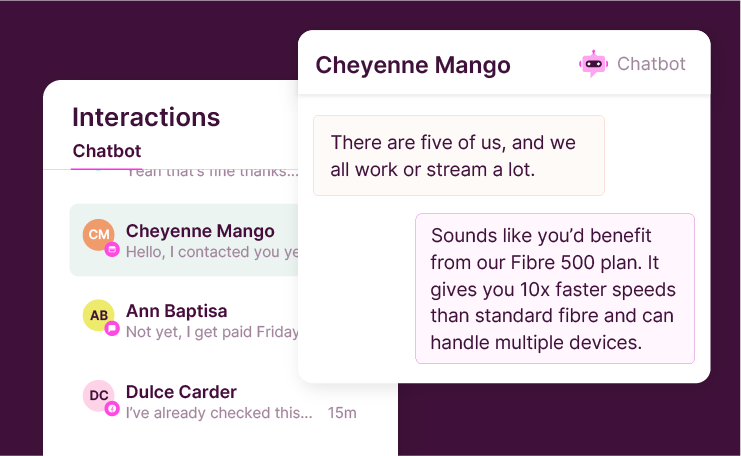
While AI Agents reduce the cost of handling interactions, AI Chatbots drive ROI by preventing interactions from becoming calls in the first place.
AI Chatbots aren’t a separate intelligence layer. They’re a digital channel through which AI Agents operate, using the same logic, workflows and compliance rules. The difference is where the interaction happens.
From an ROI standpoint, AI Chatbots are measured through:
- Deflection rates (queries resolved without reaching an agent)
- Reduction in inbound call volume
- Digital containment rates
- Cost difference between chatbot interactions and human-led webchat or calls
- Impact on Average Handle Time (AHT) by removing routine demand
When routine queries are resolved digitally, contact centres reduce inbound pressure, shorten queues and protect agent capacity. Customers benefit from instant responses, while the organisation avoids the higher cost of voice-based interactions altogether.
For a deeper look at how reducing routine demand directly impacts handle time, see How to Reduce Average Handle Time in Your Call Centre.
- AI-powered conversation analytics: ROI beyond cost reduction
Not all AI-driven ROI comes from removing interactions. Some of the most valuable gains come from making existing interactions more effective.
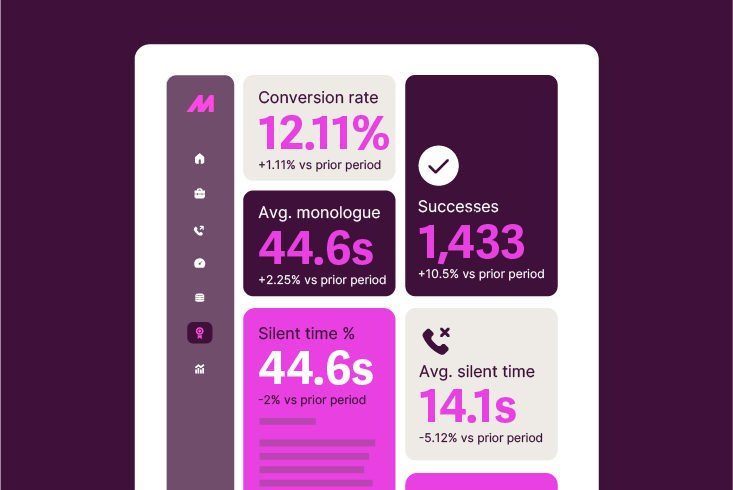
AI-powered conversation analytics deliver ROI by improving visibility, performance and compliance across every conversation. Teams gain insights across 100% of interactions instead of manual samples.
From an ROI perspective, contact centres typically measure:
- Reduced manual QA effort and review time
- Faster onboarding and agent coaching
- Improved compliance monitoring and risk identification
- Earlier identification of call drivers and friction points
- Improvements in agent effectiveness over time
Conversation analytics don’t directly reduce demand. Instead, they help contact centres understand why interactions are happening, where time is being lost, and how performance can be improved at scale.
ROI looks different depending on your contact centre model
The value AI automation delivers depends on how your contact centre operates, what pressures you’re under, and what success looks like to you.
Below are three common models, and how ROI typically shows up in each.
Debt collection & financial services
In debt collection and financial services, ROI is closely tied to cost control, compliance and availability.
Key ROI drivers typically include:
- Lower cost per contact
- Consistent, auditable compliance
- Always-on availability without expensive out-of-hours staffing
AI Agents are particularly effective here because they can handle structured, repeatable interactions reliably, including:
- Customer authentication
- Payment flows
- Balance and status updates
By automating these journeys, organisations reduce inbound demand on human agents while ensuring interactions are handled consistently and compliantly.
As seen with Indebted, automating high-volume, predictable enquiries helped reduce the cost per interaction while maintaining service availability across extended hours.
Outsourced contact centres and BPOs
For outsourced contact centres, ROI is less about absolute cost reduction and more about margin protection and scalability.
Typical ROI focus areas include:
- Improving agent utilisation
- Protecting margins under fixed-price or SLA-based contracts
- Maintaining service levels during demand spikes
AI plays a key role by absorbing predictable demand during peak periods, reducing the need to rapidly scale your headcount. This helps BPOs meet SLAs without over-recruiting or burning out agents during busy periods.
There’s also a longer-term ROI impact through reduced pressure on frontline teams, which can help lower churn and stabilise delivery costs.
Public sector, health and support services
In public sector and support-led environments, ROI is often measured in capacity, continuity and service quality, not just financial savings.
Key ROI considerations include:
- Extending service availability with limited budgets
- Reducing pressure on frontline staff
- Protecting agent wellbeing in emotionally demanding roles
ROI in Real Terms: Quitline Victoria
Using AI Agents to support outbound engagement, Quitline Victoria achieved a 62% answer rate, 18% completion rate and 10% re-engagement rate, extending service reach without increasing pressure on frontline counsellors.
In this context, ROI is realised through better allocation of human effort, improved service continuity and a more sustainable operating model, rather than simple cost removal.
A practical framework for calculating AI automation ROI
| Step | What to assess | What to quantify |
|---|---|---|
| 1. Baseline costs | Understand what interactions cost today | Salary, training, attrition, and out-of-hours premiums. |
| 2. Identify automatable interactions | Pinpoint where AI can add value | % of queries that are “transactional” (Status, Pay, Reset). |
| 3. Estimate containment & deflection | Assess how much demand AI can absorb | The volume of demand AI can fully resolve (usually 40–60%). |
| 4. Compare cost per interaction | Quantify direct cost savings | Monthly volume × (Human Cost − AI Cost). |
| 5. Factor in secondary benefits | Capture longer-term ROI | Reductions in agent churn and manual QA overhead. |
Common ROI mistakes to avoid
When measuring the ROI of AI automation, it’s easy to focus on the headline numbers and miss what actually drives long-term value. These are some of the most common pitfalls contact centres run into.
Measuring AI in isolation
AI rarely delivers ROI on its own. Its impact comes from how well it’s embedded into existing journeys, channels and workflows. Measuring AI separately from call routing, workforce management, or analytics often underplays its true value.
Expecting 100% automation
AI isn’t designed to handle every interaction. The biggest gains come from automating the right interactions. The interactions that are predictable, repeatable and time-sensitive. Complex or sensitive conversations should always be assigned to human agents.
Focusing only on call deflection
Reducing inbound volume matters, but it’s not the whole picture. ROI also comes from shorter handle times, better first-contact resolution, smoother handovers and improved agent productivity.
Ignoring quality, compliance and experience
Lower cost interactions mean very little if service quality drops or compliance risk increases. ROI should always be measured alongside consistency and customer outcomes, especially if you’re operating in a regulated environment.
Treating ROI as a short-term metric
AI ROI compounds over time. As models learn, workflows improve, and teams adapt, the value of it grows. Measuring success only in the first few weeks can hide the longer-term gains in capacity, scalability and higher resilience.
ROI is about balance, not replacement
The strongest ROI from AI automation comes from supporting people rather than replacing them.
Used as part of a human-AI hybrid model, AI Agents, AI Chatbots and analytics help contact centres reduce cost per interaction and extend capacity to deliver a more consistent service, without increasing headcount or burning out teams.
ROI isn’t something you measure once and move on from. The most successful contact centres refine automation over time as demand, channels and expectations change.
If you want to understand what ROI could look like in your contact centre, start by exploring how AI can support your existing operation.
Explore AI contact centre solutions

How to Offer 24/7 Customer Support Without Increasing Headcount
The days of contact centres operating strictly between 9-5 are long gone. Customer expectations have changed.
Today, an always-on, 24/7 approach to inbound and outbound customer journeys is what contact centres must deliver, allowing customers to access information, ask questions or respond to communications whenever it suits them.
And automated customer support isn’t confined to phone calls. Customers want channel choice: the ability to engage and switch across SMS, email, live chat and chatbots, without friction or disruption.
When those expectations aren’t met, the impact is immediate. 42% of customers have switched providers following a poor experience handled in the contact centre, making availability and responsiveness a commercial priority rather than a “nice to have”.
This pressure lands in an already challenging environment for contact centre leaders:
- Cost per call is at a five-year high, averaging between £5.50-£6.50
- First-call sales close rates are down year-on-year, with a 25% reduction in 2025
- The volume of customer interactions continues to grow across multiple touchpoints
- Many leaders report higher agent workloads than the previous year
At the same time, simply increasing headcount is rarely a viable option. As it brings significant financial and operational implications.
As a result, contact centres are balancing on a tightrope: deliver high-quality, always-on customer experiences without increasing costs or overwhelming agents.
It’s a tall order. Traditional contact centre models struggle most. Whereas those that treat AI and automation as a necessity, not an experiment, are far better positioned to succeed.
Why traditional contact centres can’t support a 24/7 approach
Contact centres that rely heavily on manual processes are far more likely to miss the mark on consistent, high-quality customer experiences. Not through lack of effort, but instead through lack of capability.
Without automation or AI-enabled workflows, manual contact centres lack the visibility needed to shape effective contact strategies. Disconnected channels and siloed data across multiple systems make it difficult to understand what’s driving demand, where workflows break down, and where agent intervention adds the most value.
As a result, agents often spend a disproportionate amount of time handling repetitive, low-value enquiries instead of focusing on complex or high-impact conversations. This creates inefficiency and, over time, contributes to lower morale and higher fatigue.
Traditional 24/7 models attempt to solve availability problems with people alone. But scaling this way gets expensive fast. In a typical mid-market contact centre, automating just 50-55% of repetitive interactions with AI Agents can reduce monthly handling costs by £80k-£100k (for midsized contact centres), depending on volume and channel mix.
Without connected, automated systems in place, scaling availability scales cost and pressure, but leaves customer experience to chance.
Orchestrating a multi-channel customer journey
Customer support shouldn’t be confined to a single channel. In omnichannel contact centres, customers regularly move between different channels, including SMS, email, chat and chatbots - sometimes within the same interaction.
A customer might receive an SMS, reply with a question, switch to chat for clarification, and later call expecting the conversation to continue seamlessly. Managing this consistently is difficult in manual contact centres, where channels and context are often treated as separate streams.
AI Agents and AI Chatbots make this easier by connecting voice and digital channels into a single, coordinated experience, handling conversations, retaining context and supporting smooth handovers to human agents when needed.
This orchestration is what makes always-on, 24/7 support achievable at scale, and sets the foundation for supporting inbound and outbound journeys more effectively.
What “always-on 24/7” really means for inbound and outbound support
Inbound and outbound interactions are different. And so is the way that customers expect to access 24/7 customer support.
| Inbound customer support expectations | Outbound customer support expectations |
|---|---|
| Immediate responses when they make contact, regardless of time of day | The freedom to respond on their own terms, often outside traditional working hours |
| Short queues and minimal transfers | Simple ways to ask follow-up questions without needing to call |
| Fast, first-contact resolution wherever possible | Conversations to continue naturally after an initial outbound message |
| The ability to move between voice and digital channels without starting again | Digital-first options for routine responses and updates |
| Context to be retained as they switch channels or return later | Context to carry across replies, channels and time zones |
When inbound and outbound journeys are properly orchestrated and integrate AI customer service solutions:
- Customers can ask questions after receiving outbound messages, without waiting for office hours
- Routine follow-ups are handled digitally, so they don’t automatically become inbound calls
- Conversations continue seamlessly across voice and digital channels, regardless of time zone
- Human agents are reserved for moments where judgement, empathy or complexity matter most
This is what distinguishes always-on availability from simple 24/7 coverage. So, how do contact centre leaders make it a reality?
This is where AI-powered contact centre software becomes essential. Not as a replacement for human agents, but as the execution layer that makes always-on 24/7 customer support possible.
The role of AI Agents in continuous customer support
MaxContact’s AI Agents play a central role in delivering an always-on, 24/7 approach to inbound and outbound customer support, particularly in voice-led contact centres where consistency, compliance and context matter.
Rather than acting as basic automation, AI Agents handle natural, human-like conversations across voice and digital channels. They understand intent, ask clarifying questions and complete tasks end-to-end, from authentication and verification through to troubleshooting, routing and account actions, all without customers waiting in a queue to speak to an agent.
This makes AI Agents especially effective outside core operating hours, when customers still expect fast, accurate responses but human availability is limited. Every interaction is handled consistently and compliantly, with the same rules, prompts and safeguards applied every time.
AI Agents are designed to operate as part of a human-AI hybrid model, not as a replacement for human agents. When a case needs to be escalated due to complexity, risk, sentiment or customer preference, it is, with full conversational context passed on, so customers never have to repeat themselves.
Used this way, AI Agents extend contact centre capacity. They absorb repetitive and time-sensitive demand, pre-qualify and verify customers, and ensure agents are connected to the right conversations at the right time.
The result is faster responses, reduced queue pressure and consistent 24/7 support, without increasing headcount. In cost terms, organisations typically see AI-handled interactions delivered at under £0.50 per contact, compared to £6+ when handled by a human agent.
The role AI Chatbots play in always-on customer support
AI Chatbots aren’t a separate capability from AI Agents. They’re one of the digital channels through which AI Agents operate.
MaxContact’s AI Agents provide the intelligence that understands intent, manages logic and then controls workflows. AI Chatbots maximise that capability across digital touchpoints. This means that the same AI-powered conversations and workflows run consistently across chat, messaging and other digital channels.
In practice, this means customers can get instant answers and can complete simple tasks, such as scheduling a call, or respond to outbound communications through the AI Chatbot, without needing to call or wait in a queue.
Behind the scenes, the AI Agent handles intent, applies rules, and manages the conversation in exactly the same way it would in a voice-led interaction.
This is what makes AI Chatbots so effective in an always-on model. They extend AI Agent capability into digital channels, so contact centres can resolve routine and time-sensitive queries instantly, at any time of day. All whilst maintaining quality and compliance.
How to use AI Chatbots in everyday contact centre situations
In always-on customer journeys, AI Chatbots are particularly effective for handling predictable, high-volume interactions such as:
| Use cases | What AI Chatbots do |
|---|---|
| Payment issues | Guides customers through missed or failed payments, sharing links, options or next steps without involving an agent. |
| Appointment rescheduling | Allows customers to confirm or cancel appointments and automatically updates scheduling systems. |
| Account updates | Answers routine queries around opening hours, balances or policy details with consistent, accurate responses. |
| FAQ deflection | Resolves common “how do I…” questions instantly to reduce repetitive inbound queries. |
| Customer retention flows | Engages customers considering cancellation with guided save-flows or targeted offers. |
| Feedback and surveys | Captures quick NPS or satisfaction feedback at the end of a chat, measuring sentiment in real time. |
Reducing pressure without reducing service
The goal of always-on, 24/7 customer support isn’t to replace human agents or cut corners on service. It’s to remove unnecessary pressure on people, costs and operations while delivering high quality customer experience.
By handling repetitive, predictable and time-sensitive interactions, AI Agents and AI Chatbots absorb demand that would otherwise sit in voice queues or overwhelm frontline teams. Customers still get fast, accurate support, but agents aren’t tied up answering the same questions or repeating the same checks.
This shift allows human agents to focus on high-value conversations. The conversations that need judgement, empathy, reassurance or problem-solving. These moments are where human input makes the biggest difference to outcomes.
Crucially, service levels aren’t reduced. They’re improved. Customers get quicker responses, fewer handoffs and more consistent experiences, while agents work in a more sustainable, focused environment.
Always-on customer support needs the right operational foundations
AI Agents work as a standalone capability. They handle conversations and automate tasks without needing a full contact centre platform.
So, for organisations that don’t operate within a traditional contact centre, AI Agents still deliver immediate value by providing always-on customer support. They handle routine and time-sensitive interactions, and also ensure that customers get fast and consistent responses outside core operating hours.
On the other hand, for organisations that do operate with a contact centre platform in place, AI Agents and AI Chatbots can be easily integrated with core CCaaS capabilities such as:
- intelligent diallers
- real-time call routing
- call queue management
- and contact centre analytics
In a contact centre environment, AI Agents extend and enhance existing workflows, and help contact centres manage demand more intelligently by prioritising interactions, and continuously optimising performance across both inbound and outbound journeys.
With the ability to operate independently, or as part of a wider CCaaS set up, AI Agents give a wide variety of businesses the flexibility to scale availability and responsiveness without increasing headcount or incurring ongoing costs. Turning 24/7 customer support into a sustainable capability rather than an operational headache.
Deliver always-on support without always-on staffing
Customers now expect an always-on, 24/7 approach to inbound and outbound customer journeys. Meeting that expectation is reliant on operational foundations that encourage automated workflows, rather than expanding teams and ongoing costs.
By combining AI Agents, AI Chatbots and contact centre capabilities within a single, connected CCaaS platform, contact centres can deliver continuous, high-quality support that scales efficiently and sustainably.
In this model, 24/7 customer support isn’t a strain, it’s a strength that protects customer experience, teams and costs at the same time.
Deliver always-on customer support without increasing headcount.
Explore AI contact centre solution