How to improve contact strategies in your call centre
How can contact centre teams move with the times and improve contact strategies to push their results to the next level?
In a recent webinar session, Sean McIver, Product Owner at MaxContact, poses this question to two expert guests – Martin Teasdale, Founder of The Team Leader Community and the GOOW Podcast, and Beverley Hughes, Director of Mullard Associates.
They discuss how to improve contact rates in the modern day, why making small changes could be more effective than wholescale transitions and how technology and the pandemic have changed the face of the industry.
Keep reading for the top takeaways, or tune into the webinar below.
What does customer contact strategy mean?
Your customer contact strategy is made up of every mechanism, decision and process that influences how customers are contacted.
It’s the way you interact with customers, the way they interact with you and everything that makes up your approach.
Beverley explains that some of this stress is caused by the fact that customers have two priorities – speed and accuracy.
Martin adds that, in the past, agents who struggled with the stresses of the job would leave. But he thinks it’s essential to consider how you can make the pressure lighter.
Sean tells us 75% of people leaving customer contact centres say they’d be more likely to stay long-term if their employer implemented a more innovative approach to mental health. Things like talking more openly about agent wellbeing processes, giving everybody a seat at the table and aligning processes to work towards common goals.
How to drive continuous improvement in contact strategies today
As the customer contact landscape changes, so does the way we approach it. Martin highlights that traditional call scheduling is a thing of the past.
Here are a few ways things have changed and how they impact the industry:
The pandemic
COVID-19 has resulted in millions of people working from home. Martin explains that this disruption has “wiped the page clean”, leaving teams able to contact customers at many more points throughout the day.
On-demand
Traditionally, contact teams would plan to avoid calling customers during hotly-anticipated television events or the times when their demographic is most likely to be watching their favourite programmes.
But nowadays, on-demand services like Netflix, Amazon Prime and catch-up TV mean people aren’t all watching at the same time. Again, this gives teams wider windows to get in touch.
Despite things seeming clearer in the past, many decisions to contact customers based on these factors were formed on generalisations. Today, we are presented with a new opportunity to discover more about our customers and make informed decisions to improve contact strategies.
Martin also suggests the excess of choice customers have can mean they miss out on the best services for them. It’s vital to inform customers about the add-on services and options that could improve their experiences further.
Improving contact rates
We’ve discussed how we can improve contact strategies, but how can we increase contact rates themselves?
Beverley says it always comes down to one thing – listening to customers. Talk to the people in your team who speak directly to customers and ask for their opinions and suggestions for change.
Martin also put forward the ‘marginal gains’ theory, popularised by cycling coach Sir Dave Brailsford. The theory suggests it’s more constructive to strive towards improving something 1% at a time, rather than aiming for a huge increase in performance.
Goals need to be put in place, but a degree of realism is crucial.
Host Sean points out that: “If every single outbound contact was in a position to have a full and complete conversation, you probably wouldn’t get through all of your data.”
Can too much change be a bad thing?
Change is often a positive thing, and it’s crucial if you want to continue performing highly.
However, as Martin says: “If you do too much, you can’t determine what’s working and what’s not.” It’s wonderful to have great ideas, but you then need to work through them in the right order.
With each change you make, however big or small, you need:
A strong reason why it should be made
A clear outcome to work towards
A plan for how it’s going to be done
With these in place, put the changes in motion and if something doesn’t work don’t be afraid to remove it or review it or retract it. This is not always easy to do, because often in this industry we can be so committed to change that we want it implemented no matter what. However, if it’s not delivering the output you need it to deliver and if it’s at the detriment to your customers or your staff, it needs to be looked at.
As Beverley says,change has to be led from the top in terms of what the objective is for the business, but keep that communication two way. Test in small ways. Test and learn.
To discover more top tips on harnessing innovation to improve contact strategies, watch the full webinar.
(() => {
const run = () => {
const rich = document.querySelector('#rich-text');
const toc = document.querySelector('#toc');
if (!rich || !toc) return;
const headings = rich.querySelectorAll('h2');
if (!headings.length) {
toc.style.display = 'none';
return;
}
const slugCounts = Object.create(null);
const slugify = (str) => {
const base = (str || '')
.trim()
.toLowerCase()
.normalize('NFD').replace(/[\u0300-\u036f]/g, '')
.replace(/[^a-z0-9\s-]/g, '')
.replace(/\s+/g, '-')
.replace(/-+/g, '-');
const n = (slugCounts[base] = (slugCounts[base] || 0) + 1);
return base ? (n > 1 ? `${base}-${n}` : base) : `section-${n}`;
};
// Build TOC off-DOM
const frag = document.createDocumentFragment();
for (let i = 0; i < headings.length; i++) {
const h = headings[i];
const text = (h.textContent || '').trim() || `Section ${i + 1}`;
if (!h.id) h.id = slugify(text);
const a = document.createElement('a');
a.href = `#${h.id}`;
a.className = 'content_link is-secondary';
a.dataset.target = h.id;
a.setAttribute('aria-label', text);
const p = document.createElement('p');
p.className = 'text-size-small';
p.textContent = text;
a.appendChild(p);
frag.appendChild(a);
}
// Single DOM update
toc.innerHTML = '';
toc.appendChild(frag);
toc.addEventListener('click', (e) => {
const link = e.target.closest('a.content_link[href^="#"]');
if (!link) return;
e.preventDefault();
const id = link.getAttribute('href').slice(1);
const target = document.getElementById(id);
if (!target) return;
// Only compute layout once
const targetTop = target.getBoundingClientRect().top + window.scrollY;
const finalY = targetTop - 150;
window.scrollTo({ top: finalY, behavior: 'smooth' });
history.replaceState(null, '', `#${id}`);
}, { passive: false });
};
// Webflow-safe “run after everything is ready”
if (window.Webflow && Webflow.push) {
Webflow.push(() => requestAnimationFrame(run));
} else {
document.addEventListener('DOMContentLoaded', () => requestAnimationFrame(run));
}
})();
related articles
you might also like
Our articles and industry insights give you expert perspectives, practical strategies, and the latest trends to help your business connect smarter and perform better.
(() => {
const WORDS_PER_MINUTE = 200;
const MULTIPLIER = 1; // your choice
const estimateMinutes = (el) => {
if (!el) return null;
const text = (el.innerText || el.textContent || "").trim();
if (!text) return 1;
const words = (text.match(/\S+/g) || []).length;
const baseMinutes = Math.max(1, Math.ceil(words / WORDS_PER_MINUTE));
return Math.max(1, Math.ceil(baseMinutes * MULTIPLIER));
};
const findNearestTargetInItem = (itemRoot, rt) => {
if (!itemRoot) return null;
return itemRoot.querySelector('.is-text');
};
const applyWithin = (root) => {
// More forgiving selector: attribute present or equals "true"
root.querySelectorAll('[data-rich-text], [data-rich-text="true"]').forEach((rt) => {
const itemRoot =
rt.closest('[role="listitem"]') ||
rt.closest('.w-dyn-item') ||
rt.parentElement ||
root;
const target = findNearestTargetInItem(itemRoot, rt);
if (!target) return;
const mins = estimateMinutes(rt);
if (mins != null) target.textContent = `${mins} MIN READ`;
});
};
const init = () => {
applyWithin(document);
// Re-apply on dynamic changes (pagination/filters)
const mo = new MutationObserver((mutations) => {
for (const m of mutations) {
for (const n of m.addedNodes) {
if (!(n instanceof Element)) continue;
if (
n.matches('[data-rich-text], [data-rich-text="true"], [role="list"], .w-dyn-items, .w-dyn-item') ||
n.querySelector?.('[data-rich-text], [data-rich-text="true"]')
) {
applyWithin(n);
}
}
}
});
mo.observe(document.body, { childList: true, subtree: true });
};
// Robust bootstrapping
if (window.Webflow && Array.isArray(window.Webflow)) {
window.Webflow.push(init);
} else if (document.readyState === 'loading') {
document.addEventListener('DOMContentLoaded', init, { once: true });
} else {
// DOM is already ready; run now
init();
}
})();
AI doesn’t fix contact centres. It scales them. If your journeys are joined up, automation can reduce the pressure your team is facing. However, if they’re fragmented, AI amplifies the friction - faster transfers, repetition and customer effort. That’s why the most useful question contact centre leaders can ask themselves isn’t “What can AI do?” - it’s, "Are we actually ready for it?".
Whether you’re running sales and retention in telecoms, payment collections with vulnerability considerations in finance, customer support in utilities, or managing multiple client programmes in a BPO, the readiness question is the same - do we have the foundations to automate without increasing customer effort or operational risk?
“Always-on” support is an operating model, not a staffing one. It's built to remove avoidable demand, protecting your team's time for high-judgement conversations, and making escalation safe when risk or complexity arises.
Always-On Service Starts with Resolution, Not Headcount.
Consumers are increasingly expecting help at any time of day, across voice and digital channels. But increasing headcount to meet 24/7 customer support expectations isn’t sustainable for most contact centres operating on tight margins.
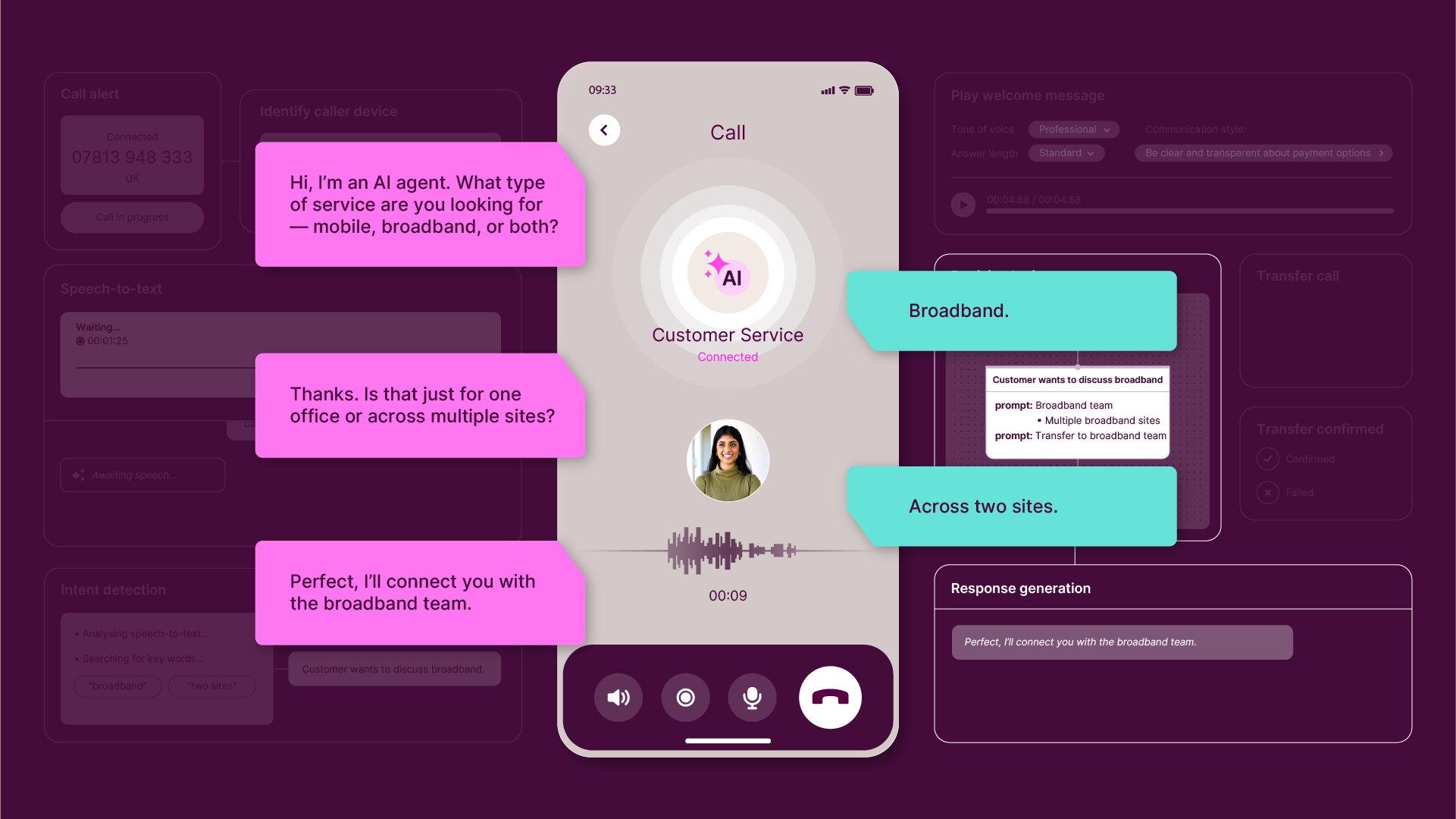
An always-on contact centre doesn’t mean agents working around the clock. It means using AI and automation to absorb predictable demand across inbound and outbound – from service updates and appointment changes to sales follow-ups and renewals, to payment reminders and self-serve arrangements - without needing an agent for every interaction.
The trap many leaders fall into is assuming that automation alone creates always-on. It doesn’t. Always-on is the result of clear journeys, consistent rules, and controlled escalation.
The Real Readiness Problem: Avoidable Demand
Most contact centres don’t struggle because customers contact them. They struggle because customers are contacting them more than once.
A lot of volume is created by operational gaps:
Unresolved issues driving repeat contact
Too many transfers caused by poor routing
Long handle times driven by missing context
Channels operating as seperate service silos
This is the stuff that quietly drains performance. It also explains why some AI programmes stall: they automate interactions on top of broken flows, then wonder why customer effort doesn’t fall, and agent workload doesn’t change.
If you want a pragmatic AI strategy, start by identifying where the operation is generating demand it shouldn’t have to handle.
A Practical Readiness Lens: Demand, Continuity, Control
To make readiness tangible, use this simple lens. If any one of these is weak, automation outcomes will be capped - or worse, you’ll scale the wrong things.
1) Demand: Do You Know What Should Be Automated?
AI delivers value when it absorbs predictable, repeatable demand - the structured interactions that don’t require human judgement. If you can’t clearly separate predictable from complex demand, you’ll either automate the wrong things and frustrate your customers or keep too much with agents and miss the efficiency gains.
A pragmatic starting point is mapping the top drivers and asking: which ones are genuinely structured, and which are only “simple” because we’re not seeing the full context?
2) Continuity: Does Context Move with The Customer?
Customers think in outcomes, not channels. Readiness means your operation can maintain continuity when a conversation starts in chat and moves to voice, or when an outbound reminder triggers an inbound response, or when a customer returns with a follow-up and expects you to remember what happened last time.
If context doesn’t travel, automation becomes a reset button, and resets are where handle time, repeat contact, and frustration grow.
3) Control: Can You Escalate Safely and Measure Outcomes?
Automation should never be a dead end. When complexity rises, or when there’s vulnerability, a complaint, payment risk, or compliance exposure, you need controlled escalation to a human agent with the full context carried across.
If you can’t define escalation rules and success measures beyond containment” you’re not ready to scale. You’re ready to pilot.
Where AI Fits When You’re Ready: Layers, Not Channels
A common mistake is deploying AI as separate tools by channel - a chatbot here, an AI agent there - and expecting it to add up to an always on operation. It simply adds more mini contact centres to the one you already have.
A more practical approach is to treat AI as layers across the operating model:
Decision layer (AI Agents): Interprets intent, resolves structured interactions, and prevents outbound activity from automatically creating inbound pressure through unmanaged follow-up
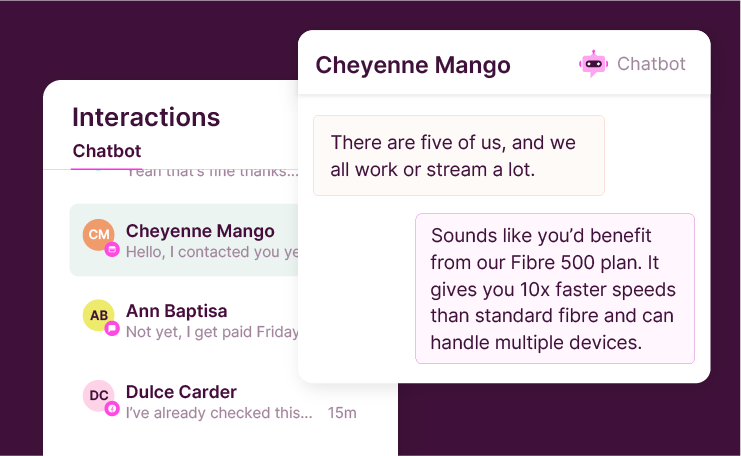
Asynchronous layer (chatbots and messaging): Allows customers to complete routine tasks without joining a queue, while keeping journeys connected across voice and digital
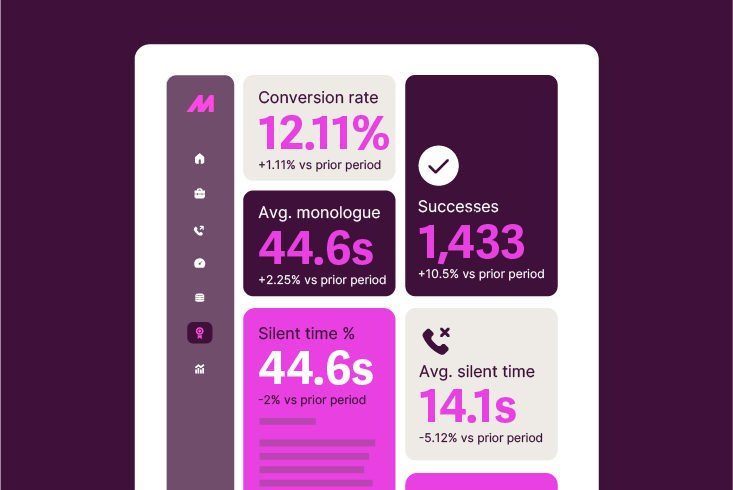
Visibility Layer (Conversation Analytics): Shows where demand originates, where conversations stall, and what drives repeat contact so you can improve routing, coaching, and automation design based on evidence rather than instinct
When these layers support end-to-end workflows, AI stops being a bolt-on and becomes a genuine performance lever.
A Quick Readiness Check: The Questions Most Teams Skip
If you’re planning AI-enabled automation this quarter, these questions are worth answering before you commit time and budget:
What proportion of our demand is truly predictable and repeatable?
Where do customers repeat themselves, get transferred, or drop out?
What's creating repeat contact and how will we remove it?
What are our escalation triggers for risk, vulnerability or complexity and do we trust them?
How will we measure success beyond containment - effort, quality, outcomes, stability?
Do inbound and outbound journeys reinforce each other, or create extra pressure?
If those answers aren’t clear yet, that’s not a blocker, it's your roadmap.
Pressure-Test Your Readiness With The Scorecard
If you want a structured way to benchmark readiness across the foundations that matter - demand, continuity, escalation, and operational fit - our scorecard is designed for exactly that. Use it to create alignment internally, prioritise improvements, and shape an automation roadmap that holds up under real-world volume, not just pilot conditions. Download the Always-On Contact Centre Readiness Scorecard here.
Blog
5 min read
Automate smarter: how to identify what to automate in your contact centre
Not sure where to start with contact centre automation? Discover a proven framework for identifying the right interactions to automate — and when.
(() => {
const WORDS_PER_MINUTE = 200;
const MULTIPLIER = 1; // your choice
const estimateMinutes = (el) => {
if (!el) return null;
const text = (el.innerText || el.textContent || "").trim();
if (!text) return 1;
const words = (text.match(/\S+/g) || []).length;
const baseMinutes = Math.max(1, Math.ceil(words / WORDS_PER_MINUTE));
return Math.max(1, Math.ceil(baseMinutes * MULTIPLIER));
};
const findNearestTargetInItem = (itemRoot, rt) => {
if (!itemRoot) return null;
return itemRoot.querySelector('.is-text');
};
const applyWithin = (root) => {
// More forgiving selector: attribute present or equals "true"
root.querySelectorAll('[data-rich-text], [data-rich-text="true"]').forEach((rt) => {
const itemRoot =
rt.closest('[role="listitem"]') ||
rt.closest('.w-dyn-item') ||
rt.parentElement ||
root;
const target = findNearestTargetInItem(itemRoot, rt);
if (!target) return;
const mins = estimateMinutes(rt);
if (mins != null) target.textContent = `${mins} MIN READ`;
});
};
const init = () => {
applyWithin(document);
// Re-apply on dynamic changes (pagination/filters)
const mo = new MutationObserver((mutations) => {
for (const m of mutations) {
for (const n of m.addedNodes) {
if (!(n instanceof Element)) continue;
if (
n.matches('[data-rich-text], [data-rich-text="true"], [role="list"], .w-dyn-items, .w-dyn-item') ||
n.querySelector?.('[data-rich-text], [data-rich-text="true"]')
) {
applyWithin(n);
}
}
}
});
mo.observe(document.body, { childList: true, subtree: true });
};
// Robust bootstrapping
if (window.Webflow && Array.isArray(window.Webflow)) {
window.Webflow.push(init);
} else if (document.readyState === 'loading') {
document.addEventListener('DOMContentLoaded', init, { once: true });
} else {
// DOM is already ready; run now
init();
}
})();
The pressure to introduce AI in contact centres has never been greater. But automating the wrong interactions doesn’t just waste investment - it actively frustrates customers and creates more work for your team. Here’s how to get it right from the start.
The real challenge isn’t how to automate - it’s what
Most business leaders today aren’t asking whether to use AI in their contact centre. They’re asking where to start. And that’s exactly the right question to be asking.
We recently hosted a webinar exploring this challenge with Kayleigh Tait, Marketing Director at MaxContact, and Conor Bowler, Principal Product Manager. Together, they walked through the research, the common pitfalls, and a practical framework that helps contact centres make confident, data-driven automation decisions.
Here’s what they covered.
What UK consumers actually think about AI
MaxContact commissioned an independent survey of over 1,000 UK consumers who had interacted with a contact centre in the last 18 months. The findings from the Voice of the UK Consumer Report are revealing.
45% of UK consumers say they’re comfortable interacting with an AI-powered chatbot or virtual assistant. But 36% say they’re uncomfortable.
Only 36% say AI has improved their experience. Almost the same number - 32% - say it has made things worse.
65% of 25–34 year-olds are comfortable with AI, compared to just 27% of over-55s.
70% want a human when explaining their specific situation. 67% for emergencies. 61% when making a complaint.
55% of consumers have abandoned calls because of excessive wait times. 26% because they had to repeat information.
The takeaway? Automation isn’t automatically improving customer experience. It depends entirely on how and when it’s used - and critically, whether the strategy has been built around the customer or around internal efficiency targets.
The modern inbound customer journey
Most businesses treat every interaction the same, routing everything to queues. But inbound demand isn’t evenly distributed. It follows a pattern.
At the start of the journey, volumes are high and queries are simple: balance requests, payment dates, appointment changes, status updates. This is where AI and automation deliver the greatest impact - resolving queries quickly, reducing cost to serve, and freeing agent capacity without compromising experience.
As complexity increases, the role of automation shifts. Intelligent routing, context preservation from AI to human handover, and real-time agent support all help agents handle harder conversations faster and with more confidence.
At the resolution and advocacy stages, humans lead - supported by AI insights, not replaced by them. The goal is that automation removes repetitive workload at the top of the funnel, so people can focus on the interactions where judgment, empathy, and experience really matter.
How Conversation Analytics uncovers automation opportunities
Before you decide what to automate, you need to understand what’s actually happening in your contact centre. Conor Bowler demonstrated exactly how MaxContact’s Conversation Analytics makes this possible - at scale.
In the demo, Conor surfaced 28,000 calls from a single month, immediately identifying intent clusters: appointment booking accounted for 10% of interactions, technical challenges for 4%. Together, that’s 14% of call volume with clear automation potential - identified in minutes.
Using MaxContact’s AI assistant within the platform, teams can drill into individual calls, ask whether elements of those interactions could be automated, and use those insights to design workflows in MaxContact’s Workflow Studio. Those workflows can then be deployed directly to chatbots, voice agents, or email channels - with built-in escalation paths when automation reaches its limits.
For contact centres without Conversation Analytics today, this process is still possible — but relies on manual call sampling, disposition codes, and CRM data. It’s achievable, but slower and harder to repeat consistently over time.
The MaxContact Automation Framework
Based on research findings and direct experience working with contact centres of all sizes, MaxContact has developed a four-step framework for identifying automation opportunities.
Step 1: Start with real interaction data
Automation decisions should be driven by evidence, not assumption. Too often, automation projects are led top-down - driven by boardroom pressure or a use case that sounds innovative rather than one grounded in data. Starting with call recordings, chat transcripts, CRM data, disposition codes, and repeat contact patterns gives you the factual foundation to make better decisions.
Look for patterns: what are the most common reasons for contact? What consistently takes under three to four minutes to handle? What drives re-contact within 24 to 72 hours? Technology makes this repeatable - so you’re not starting from scratch every quarter.
Step 2: Cluster by intent
Rather than analysing by channel (voice vs email vs chat), cluster interactions by customer intent. Instead of ‘20,000 calls’, ask: how many were payment date queries? Balance requests? Appointment changes? Customers don’t think in channels — they think about the problem they want to solve.
Conversation Analytics surfaces these clusters automatically, saving hours of manual analysis and revealing patterns that might otherwise go unnoticed.
Step 3: Rank by volume and effort
Not every repetitive query should be automated. Ranking by two lenses — volume (how often does this occur?) and effort (how much friction does this create?) - helps you prioritise strategically.
High volume + low effort: immediate automation potential.
High volume + high effort: may require journey redesign before automation.
Low volume + high effort: remain human for now.
Low volume + low effort: monitor and consider as a pilot.
Step 4: Validate with your team
Before you automate anything, validate the decision with the people who handle those conversations every day. Ask: Is this emotionally sensitive? Is it a brand touchpoint that customers value? Does it spike seasonally? Does what looks like a simple query often become a complex one underneath?
A payment query might look straightforward - but if it frequently leads to a conversation about payment difficulty, that’s not a candidate for full end-to-end automation. This step prevents automation decisions that look good on paper but frustrate customers in practice.
How do you know your automation is working?
Automation is working when three things improve simultaneously: business outcomes (cost to serve, conversion, retention), customer experience (faster resolution, less repetition), and operational performance (agents spending less time on repetitive tasks and more on complex conversations). If automation only improves one area, it’s likely not deployed in the right place.
Monitor containment rates, drop-off points, and escalation paths on a weekly basis for early warning signs. Review and optimise on a quarterly basis - or more frequently in fast-moving markets with changing regulation or customer expectations.
Book a complimentary automation consultancy session with our Customer Success team and we’ll run you through the MaxContact Automation Framework for your organisation: https://www.maxcontact.com/book-a-demo
Blog
5 min read
How to Measure the ROI of AI Automation in Your Contact Centre
Regardless of the industry they operate in, AI automation is a commercial necessity for contact centres, rather than a tool to experiment with.
(() => {
const WORDS_PER_MINUTE = 200;
const MULTIPLIER = 1; // your choice
const estimateMinutes = (el) => {
if (!el) return null;
const text = (el.innerText || el.textContent || "").trim();
if (!text) return 1;
const words = (text.match(/\S+/g) || []).length;
const baseMinutes = Math.max(1, Math.ceil(words / WORDS_PER_MINUTE));
return Math.max(1, Math.ceil(baseMinutes * MULTIPLIER));
};
const findNearestTargetInItem = (itemRoot, rt) => {
if (!itemRoot) return null;
return itemRoot.querySelector('.is-text');
};
const applyWithin = (root) => {
// More forgiving selector: attribute present or equals "true"
root.querySelectorAll('[data-rich-text], [data-rich-text="true"]').forEach((rt) => {
const itemRoot =
rt.closest('[role="listitem"]') ||
rt.closest('.w-dyn-item') ||
rt.parentElement ||
root;
const target = findNearestTargetInItem(itemRoot, rt);
if (!target) return;
const mins = estimateMinutes(rt);
if (mins != null) target.textContent = `${mins} MIN READ`;
});
};
const init = () => {
applyWithin(document);
// Re-apply on dynamic changes (pagination/filters)
const mo = new MutationObserver((mutations) => {
for (const m of mutations) {
for (const n of m.addedNodes) {
if (!(n instanceof Element)) continue;
if (
n.matches('[data-rich-text], [data-rich-text="true"], [role="list"], .w-dyn-items, .w-dyn-item') ||
n.querySelector?.('[data-rich-text], [data-rich-text="true"]')
) {
applyWithin(n);
}
}
}
});
mo.observe(document.body, { childList: true, subtree: true });
};
// Robust bootstrapping
if (window.Webflow && Array.isArray(window.Webflow)) {
window.Webflow.push(init);
} else if (document.readyState === 'loading') {
document.addEventListener('DOMContentLoaded', init, { once: true });
} else {
// DOM is already ready; run now
init();
}
})();
According to our latest Benchmark Report, 66% of contact centres are currently using or piloting AI with the aim of reducing operational costs and driving productivity.
But measuring ROI from AI automation isn’t straightforward.
A contact centre specialising in debt collection may measure ROI through reduced cost per contact, improved payment completion rates, or increased compliance consistency. Meanwhile, an outsourced contact centre that handles high-volume inbound enquiries may focus on deflection rates, average handling time or agent utilisation.
Channel mix can also influence impact. Voice-reliant operations see ROI through reduced call queue pressure and lower cost per call, while digital-first environments may prioritise customer containment and response speed.
Measuring AI ROI properly means understanding what success looks like in your specific environment, rather than relying on generic savings estimates.
Start with a baseline: what does a human-handled interaction really cost?
Before you can begin to measure the return from AI automation, you need a clear picture of what interactions cost when they’re handled by people.
For most UK contact centres, the average cost of a human-handled voice call sits between £5.50 and £6.50 per interaction. This is often used as a headline figure, but it doesn’t tell the whole story.
The total cost is driven by other factors, including:
Agent salaries and on-costs
Training and onboarding, which are made more expensive by high attrition rates
Quality assurance and compliance overhead, including call monitoring and reporting
Out-of-hours staffing, which significantly increases the cost for 24/7 coverage
Inefficiencies caused by repeat calls, transfers and long handle times
Even when handled efficiently, live calls demand dedicated agent time, whereas digital interactions can be managed asynchronously and at a greater scale.
A voice-heavy operation will feel cost pressure very differently from a digital-first one, and ROI calculations need to reflect that reality.
By contrast, AI-handled interactions typically cost a fraction of a human-handled call, often coming in at under £0.50 per interaction, depending on channel, complexity and volume. That gap is where ROI potential starts to emerge, but only if you understand what you’re replacing or augmenting in the first place.
Put simply, you can’t measure ROI without first understanding what each interaction costs you now. Without a baseline, your savings might look impressive on paper but will prove impossible to validate in practice.
The core ROI generators of AI automation
Not every AI capability is designed to solve the same problem, and not every contact centre will prioritise the same outcomes.
The key to measuring ROI accurately is understanding where value is being created in your operation.
AI Agents: reducing cost per interaction and extending capacity
AI Agents deliver ROI by reducing the cost of handling routine interactions and extending service availability without increasing headcount.
Instead of relying solely on human agents to manage every enquiry, AI Agents can handle high-volume, repetitive interactions end-to-end. This includes tasks such as customer authentication, balance enquiries, payment queries and status updates. Each interaction handled by an AI Agent reduces the cost of a human-handled call.
From an ROI perspective, contact centres typically measure:
Cost per AI-handled interaction (often under £0.50)
The percentage of total interactions fully handled by AI
Reductions in out-of-hours staffing costs
Reduced call queue pressure during peak periods
When AI Agents are used to automate between 40-60% of repetitive interactions, the cost impact is significant. Organisations frequently see monthly savings running into tens of thousands of pounds, driven purely by lower cost per interaction and improved utilisation of human agents.
For Indebted (a contact centre in the debt collection industry), automating repetitive interactions with an AI Agent led to a 30% increase in contact centre productivity and a 12% uplift in resolution rates.
AI Chatbots: deflection, containment and digital ROI
While AI Agents reduce the cost of handling interactions, AI Chatbots drive ROI by preventing interactions from becoming calls in the first place.
AI Chatbots aren’t a separate intelligence layer. They’re a digital channel through which AI Agents operate, using the same logic, workflows and compliance rules. The difference is where the interaction happens.
From an ROI standpoint, AI Chatbots are measured through:
Deflection rates (queries resolved without reaching an agent)
Reduction in inbound call volume
Digital containment rates
Cost difference between chatbot interactions and human-led webchat or calls
Impact on Average Handle Time (AHT) by removing routine demand
When routine queries are resolved digitally, contact centres reduce inbound pressure, shorten queues and protect agent capacity. Customers benefit from instant responses, while the organisation avoids the higher cost of voice-based interactions altogether.
AI-powered conversation analytics: ROI beyond cost reduction
Not all AI-driven ROI comes from removing interactions. Some of the most valuable gains come from making existing interactions more effective.
AI-powered conversation analytics deliver ROI by improving visibility, performance and compliance across every conversation. Teams gain insights across 100% of interactions instead of manual samples.
From an ROI perspective, contact centres typically measure:
Reduced manual QA effort and review time
Faster onboarding and agent coaching
Improved compliance monitoring and risk identification
Earlier identification of call drivers and friction points
Improvements in agent effectiveness over time
Conversation analytics don’t directly reduce demand. Instead, they help contact centres understand why interactions are happening, where time is being lost, and how performance can be improved at scale.
ROI looks different depending on your contact centre model
The value AI automation delivers depends on how your contact centre operates, what pressures you’re under, and what success looks like to you.
Below are three common models, and how ROI typically shows up in each.
Debt collection & financial services
In debt collection and financial services, ROI is closely tied to cost control, compliance and availability.
Key ROI drivers typically include:
Lower cost per contact
Consistent, auditable compliance
Always-on availability without expensive out-of-hours staffing
AI Agents are particularly effective here because they can handle structured, repeatable interactions reliably, including:
Customer authentication
Payment flows
Balance and status updates
By automating these journeys, organisations reduce inbound demand on human agents while ensuring interactions are handled consistently and compliantly.
As seen with Indebted, automating high-volume, predictable enquiries helped reduce the cost per interaction while maintaining service availability across extended hours.
Outsourced contact centres and BPOs
For outsourced contact centres, ROI is less about absolute cost reduction and more about margin protection and scalability.
Typical ROI focus areas include:
Improving agent utilisation
Protecting margins under fixed-price or SLA-based contracts
Maintaining service levels during demand spikes
AI plays a key role by absorbing predictable demand during peak periods, reducing the need to rapidly scale your headcount. This helps BPOs meet SLAs without over-recruiting or burning out agents during busy periods.
There’s also a longer-term ROI impact through reduced pressure on frontline teams, which can help lower churn and stabilise delivery costs.
Public sector, health and support services
In public sector and support-led environments, ROI is often measured in capacity, continuity and service quality, not just financial savings.
Key ROI considerations include:
Extending service availability with limited budgets
Reducing pressure on frontline staff
Protecting agent wellbeing in emotionally demanding roles
ROI in Real Terms: Quitline Victoria
Using AI Agents to support outbound engagement, Quitline Victoria achieved a 62% answer rate, 18% completion rate and 10% re-engagement rate, extending service reach without increasing pressure on frontline counsellors.
In this context, ROI is realised through better allocation of human effort, improved service continuity and a more sustainable operating model, rather than simple cost removal.
A practical framework for calculating AI automation ROI
Step
What to assess
What to quantify
1. Baseline costs
Understand what interactions cost today
Salary, training, attrition, and out-of-hours premiums.
2. Identify automatable interactions
Pinpoint where AI can add value
% of queries that are “transactional” (Status, Pay, Reset).
3. Estimate containment & deflection
Assess how much demand AI can absorb
The volume of demand AI can fully resolve (usually 40–60%).
4. Compare cost per interaction
Quantify direct cost savings
Monthly volume × (Human Cost − AI Cost).
5. Factor in secondary benefits
Capture longer-term ROI
Reductions in agent churn and manual QA overhead.
Common ROI mistakes to avoid
When measuring the ROI of AI automation, it’s easy to focus on the headline numbers and miss what actually drives long-term value. These are some of the most common pitfalls contact centres run into.
Measuring AI in isolation AI rarely delivers ROI on its own. Its impact comes from how well it’s embedded into existing journeys, channels and workflows. Measuring AI separately from call routing, workforce management, or analytics often underplays its true value.
Expecting 100% automation AI isn’t designed to handle every interaction. The biggest gains come from automating the right interactions. The interactions that are predictable, repeatable and time-sensitive. Complex or sensitive conversations should always be assigned to human agents.
Focusing only on call deflection Reducing inbound volume matters, but it’s not the whole picture. ROI also comes from shorter handle times, better first-contact resolution, smoother handovers and improved agent productivity.
Ignoring quality, compliance and experience Lower cost interactions mean very little if service quality drops or compliance risk increases. ROI should always be measured alongside consistency and customer outcomes, especially if you’re operating in a regulated environment.
Treating ROI as a short-term metric AI ROI compounds over time. As models learn, workflows improve, and teams adapt, the value of it grows. Measuring success only in the first few weeks can hide the longer-term gains in capacity, scalability and higher resilience.
ROI is about balance, not replacement
The strongest ROI from AI automation comes from supporting people rather than replacing them.
Used as part of a human-AI hybrid model, AI Agents, AI Chatbots and analytics help contact centres reduce cost per interaction and extend capacity to deliver a more consistent service, without increasing headcount or burning out teams.
ROI isn’t something you measure once and move on from. The most successful contact centres refine automation over time as demand, channels and expectations change.
If you want to understand what ROI could look like in your contact centre, start by exploring how AI can support your existing operation.

.png)