Every salesperson has heard them before:
❌ “How did you get my number?”
❌ “No, I’m not interested.”
❌ “I’m already with [competitor].”
Everyone who works in the industry knows that sales objections are inevitable. Particularly if you work in a high-pressure environment like a call centre where agents handle hundreds of calls every day.
It’s easy to view objections as a rejection, but a recent analysis of 800,000+ objections calls carried out by MaxContact from annoymynised platform data revealed that 39% can be overturned if they are handled well.
Objections should be viewed as opportunities. The chance to address concerns, show value, build stronger customer relationships, and move prospects closer to saying yes.
“When I first started in sales, the biggest challenge wasn’t hearing objections, it was knowing how to respond instead of just saying ‘Oh right, OK’ and ending the call.” – Business Development Manager, MaxContact
However, mastering objection handling doesn’t come down to persistence alone; it’s about having the right tools, techniques, and insights to guide conversations, understand prospect needs, and ultimately, improve conversions.
In this article, we’ll explore:
- Proven objection-handling techniques that empower sales teams.
- How AI-driven insights from MaxContact’s Conversation Analytics platform (including our success intelligence feature) can improve objection-handling strategies.
It builds confidence within your sales team
When salespeople feel equipped to handle objections, they perform better. Our data shows that some objections are highly recoverable, for example:
- 46% of “No Immediate Need” objections were overturned
- 46% of “Lack of Time” objections were also successfully handled
This proves that when a sales team adopts the mentality that objections are hesitations, and signal the end of a conversation, they are more likely to find ways to adapt and refine their sales approach, instead of cutting their losses
It improves conversion rates
Many objections aren’t a firm no; instead, they’re usually a sign that the prospect is missing key information and needs more clarity.
Our data analysis revealed that while “Not Interested” is one of the most common objections, occurring over 150,000 times. It’s also one of the hardest to overcome, with a 23% success rate.
Agents need to listen to and address these objections by being armed with a deep understanding of the right information to turn conversations around.
It strengthens team performance
The most successful sales teams share best practices rather than keep them to themselves. They learn from each other’s handling techniques and replicate the best strategies across the team.
With MaxContact’s Success Intelligence feature, which is part of our Conversation Analytics product, sales leaders can identify patterns in objections. Leaders can see:
- Which objections appear most frequently
- Which ones agents struggle with
- Which top performers consistently overturn
- Coaching opportunities based on data, not assumptions
For example, cost-related objections account for 18% of all objections, but teams overturn almost 40% of them when they use strong value framing.
It creates better customer experiences
Even if a sale doesn’t happen immediately (the majority don’t), a well-handled objection and respectful interaction builds trust, increasing the likelihood of a conversion further down the line.
Trust-based objections (which account for 22% of all objections) are among the hardest to overcome, especially “Lack of Trust,” which has just a 32% success rate.
A professional and respectful interaction can leave a positive impression, which means when things change in the future, they are more likely to consider you and get back in touch
Objection handling techniques for sales calls
1. Be prepared with a decent script
Why? A structured script helps your sales team be consistent and shows agents what good looks like. It is also easier to refine your approach and build agent confidence when handling objections.
Top Tip: You should regularly review and update your call scripts to mirror common objections. Refinements should be based on real-world responses and positive past outcomes.
Want ready-to-use objection-handling scripts? Download our Scripting Templates for Dealing with Difficult Customers to train your team with proven responses.
2. Anticipate and address objections before the call
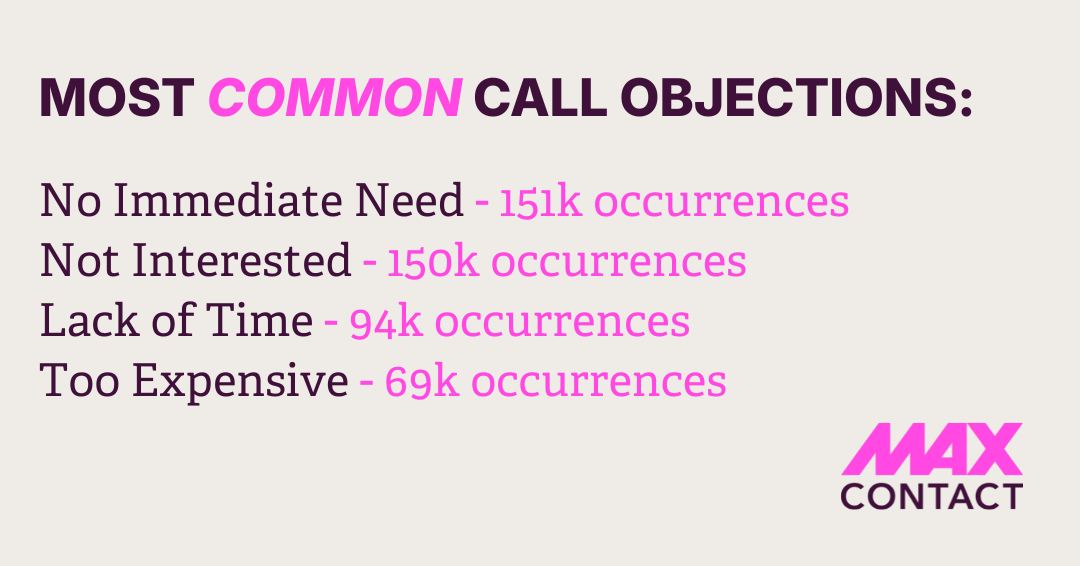
Proactively addressing potential concerns reduces resistance later in the conversation. Our dataset shows the most common objections are:
- No Immediate Need - 151k occurrences
- Not Interested - 150k occurrences
- Lack of Time - 94k occurrences
- Too Expensive - 69k occurrences
Top Tip: Do your research before the call and think about what their objections are likely to be. If you proactively address these pain points early in your pitch, you prevent them from derailing conversations later.
3. Focus on building value
Cost objections make up nearly 70,000 conversations, but almost 45% of “Disputes Amount” objections are overturned when agents clearly demonstrate value. If you can confidently demonstrate how your product or service meets your prospect’s unique needs, it paves the way for a conversation with fewer objections to overcome.
Top Tip: Tailor your sales pitch so it addresses their specific pain points and priorities to make the benefits more relevant and persuasive.
4. Uncover the real concerns behind the objection
Surface-level objections can often mask deeper customer concerns.
“Scepticism,” for example, occurred 50,364 times, with agents successfully resolving 44% when they probed deeper into customer concerns.
Listening, probing and clarifying explore the real motivations behind a “no.”
Top Tip: Use probing questions to encourage the customer to open up and really listen to what they have to say:
“What are your biggest challenges with your current system?”
“What keeps you up at night about this issue?”
“What does a good day vs. a bad day look like?”
Sales Specialist Insight: “Ask and then be quiet and listen. If you can keep the conversation going, you’ll build rapport, understand their needs, and have a better chance of addressing their true concerns.”
5. Know when to cut your losses
It’s a skill in itself to realise that not every prospect is worth pursuing. At the end of the day, your time is a valuable resource, and some objections are genuine dead-ends, contractual commitments being one.
Our data analysis uncovered that “Contractual Obligations” appears less often as an objection but has a low recovery rate of just 35%.
Top Tip: Learn to recognise the signs that an objection is a hard “no” rather than a request for reassurance. Feel comfortable to politely bring the conversation to a close when it’s necessary.
Example: What does a ‘hard no’ sound like?
Agent: “I think our solution can really help you with [pain point]. Are you free for a quick call next week?”
Prospect: “Well, we’ve actually just signed a five-year contract with another provider, so we’re locked in with them.”
Agent: "Oh ok, sounds like you’re set for now, but I’d like to stay in touch in case your needs change in the future. Would you be happy for me to check back in with you in a few months to see how everything is going?"
Instead of pushing further, the agent sees that this isn’t a timing objection; it’s a contractual commitment. Instead they:
- Respect the prospect’s situation and don’t waste time.
- Keep the door open for future conversations.
- Avoid the hard-sell approach, which could damage the relationship.
6. Understand it’s a numbers game
Why? Not every call ends with a sale, but persistence and efficiency are part of what drives success.
How? It’s important that sales agents don’t get hung up on rejections. Call volume and quality interactions are key, so the best thing to do is move on to the next prospect.
Top Tip: Use automated dialler software to improve connection rates and reduce wasted time. Skills-based call routing can also help to match the right agents to potential opportunities to match their knowledge and experience.
Objection handling cheat sheet
How AI-driven insights take objection handling to the next level
Not every call ends with a sale, but persistence and efficiency are part of what drives success. Across all 803,000 objections, agents overcame 39% overall.
It’s important that sales agents don’t get hung up on rejections. Call volume and quality interactions are key, so the best thing to do is move on to the next prospect.
Top Tip: Use automated dialler software to improve connection rates and reduce wasted time. Skills-based call routing can also help to match the right agents to potential opportunities using their relevant knowledge and experience.
MaxContact’s Conversation Analytics & Success Intelligence - Turning Insights into Sales Success
Traditionally, sales coaching relies on manual call reviews, which are time-consuming and only capture a small percentage of conversations.
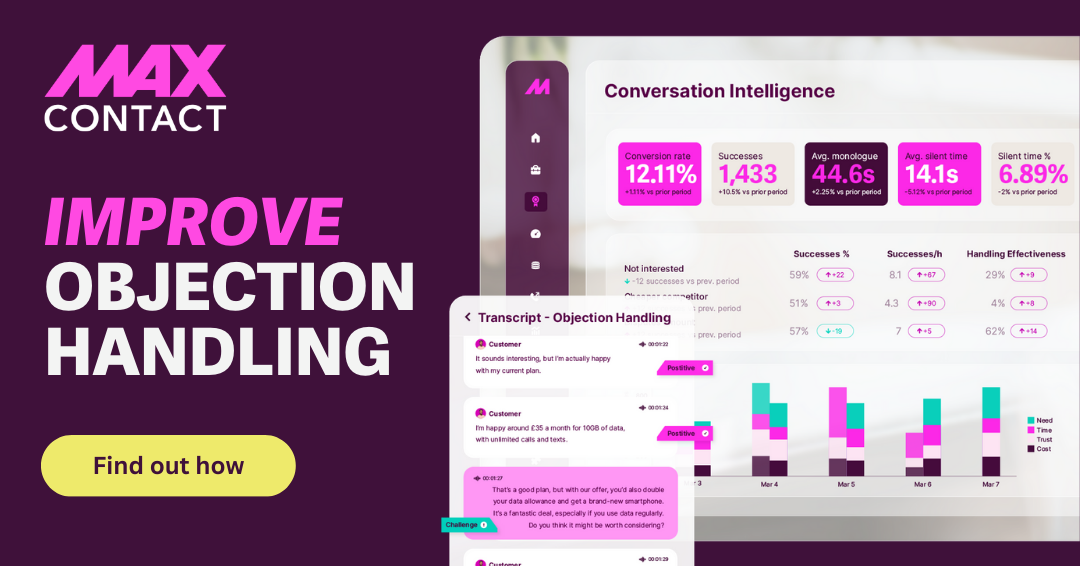
But with Conversation Analytics and Success Intelligence, sales teams can now use post-call insights and AI-powered analytics to enhance objection handling across teams.
Here’s how it is used in call centres.
Speech analytics that goes beyond transcription
- Transcribe and analyse 100% of calls with speech analytics. Instead of analysing small call samples taken at random, you can search and analyse a higher volume of calls, so fewer objections go unnoticed.
- Identify trends in objections and understand the most common customer concerns within your sales process.
- Track sentiment and review call summaries to explore where or when conversations take a negative turn.
- Use AI-powered analytics to enhance coaching with data-backed insights that help agents improve faster.
Success Intelligence - AI that measures & improves objection handling
- Categorise and analyse objections and help agents refine their approach.
- Identify what top performers do differently to overcome objections and use it as a blueprint for coaching agents who struggle.
- Provide actionable insights based on performance trends and data, not just opinions based on limited call samples.
“Success Intelligence highlights your best-performing agents and allows you to compare them with lesser-performing agents to see where improvements can be made. Instead of just reviewing a handful of calls, we now have insights into every objection raised and whether or not it was handled effectively.”
Ready to handle objections in sales the smarter way?
Handling objections is more than just a desirable sales skill; it’s a competitive advantage.
The best sales teams:
✔ Use structured scripts and refined techniques.
✔ Stay adaptive and customer-focused.
✔ Use AI-driven insights to continuously improve strategies.
Want to see these techniques in action?
Book a free demo of MaxContact’s Conversation Analytics to see how AI-powered insights can improve your sales team’s objection handling





.png)
