Many BPO leaders are under growing pressure to deliver consistent performance, all whilst operating in an environment that’s increasingly competitive and cost-sensitive.
One of the biggest challenges is not the lack of data, but knowing how to interpret it. BPOs often track dozens of metrics, yet they still struggle to understand whether performance is strong, weak, or simply average for the market. Without a clear point of comparison, it’s impossible to know where to focus improvement efforts, or how to demonstrate value to clients.
In this article, we explore how accurate benchmarking helps outsourced contact centres to:
- Assess performance more accurately.
- Identify meaningful improvement opportunities.
- Use data to drive better outcomes across sales, service and debt collection operations.
What is Benchmarking?
Benchmarking is the process of comparing your contact centre’s performance against industry standards or peer groups to understand how well you’re really performing.
Rather than viewing KPIs in isolation, benchmarking provides context. It shows where performance is competitive, where gaps exist, and which metrics matter most for your operating model.
There are two primary approaches:
- Competitive benchmarking: Comparing performance against similar BPOs or outsourced contact centres
- Process benchmarking: Comparing workflows against recognised best practice, sometimes drawn from other industries (used less frequently in contact centres)
The Benchmarking Challenge for BPOs
In practice, benchmarking is not always straightforward. BPOs often face inconsistent data, varying KPI definitions between clients, and limited visibility of reliable industry standards. Combined with the pace and pressure of contact centre operations, this makes it difficult to establish benchmarks that are both accurate and actionable.
Despite this, benchmarking remains essential for BPO performance and long-term competitiveness.
Done well, benchmarking allows BPOs to:
- Understand whether KPIs reflect strength or emerging risk
- Use objective data to support operational and commercial decisions
- Identify best practices and apply them consistently across teams
- Spot early warning signs, such as rising agent workload or churn, before they impact service delivery
Overcoming benchmarking challenges starts with a clear strategy: defining objectives, selecting relevant KPIs and measuring performance consistently over time. Our complete guide to call centre reporting metrics explains which KPIs matter most and how they should be read together, rather than in isolation.
What are the Top KPIs Contact Centres Prioritise in 2026?
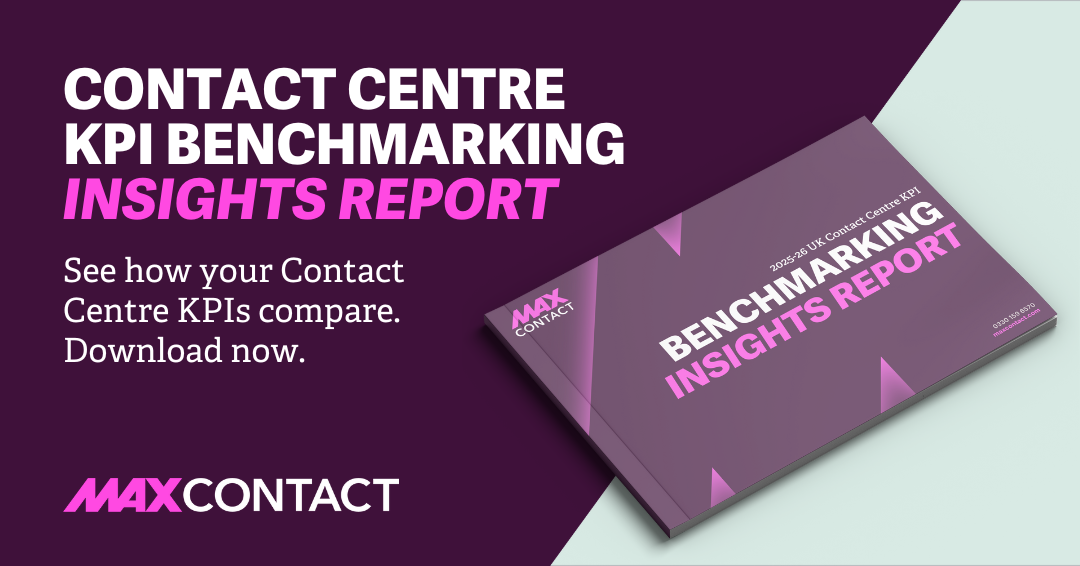
MaxContact’s 2025/26 UK Contact Centre KPI Benchmarking Insights Report reveals a shift in how contact centres prioritise performance metrics. Rather than focusing on a single efficiency measure, decision makers are increasingly balancing customer experience, responsiveness and commercial outcomes.
Based on responses from 300 UK contact centre leaders, the three most focused on KPIs are:
- Customer Satisfaction (CSAT) – prioritised by 48% of respondents
- Speed of Answer – cited by 35% as a critical performance metric
- Service Level Achievement – selected by 34% of contact centres

Close behind these sit commercially focused metrics such as conversion rate (33%), first call resolution (33%), and revenue per contact (32%), reflecting the ongoing pressure to balance service quality with financial performance.
We explore why a blended approach to call centre metrics is the best way to measure call centre efficiency.
Of course, the metrics that contact centres report on, is also dependent on the industry they operate in.
Key KPIs for Sales and Debt Resolution BPOs
Understanding which KPIs matter most is critical for BPOs operating in sales and debt resolution. While both rely on outbound performance, the metrics that drive success (and the way they should be interpreted) differ significantly between the two.
The latest benchmark data shows that high-performing BPOs don’t track more metrics than their peers. They focus on the right ones and use them together to guide decisions, not just report outcomes.
Sales-focused BPOs
For sales-driven BPOs, performance is ultimately measured by revenue. But revenue outcomes are shaped by a combination of efficiency, lead quality and agent effectiveness.
The 2025/26 Benchmark Report shows that while sales volumes have softened slightly year-on-year, revenue performance is holding up, suggesting agents are working harder and conversations are becoming more complex.
Key KPIs for sales BPOs include:
- Conversion rate: Measures the percentage of contacts that result in a sale. Benchmark data shows a mean conversion rate of 16%, with nearly 30% of teams achieving rates between 20-29%. Improving conversion is less about increasing call volume and more about better lead prioritisation, agent coaching and script effectiveness.
- First-call close rate: Indicates how often a sale is achieved on the first interaction. The benchmark mean sits at 25%, down slightly year-on-year, reflecting a tougher sales environment. Falling first-call close rates can point to lead-quality issues or gaps in agent confidence and product knowledge.
- Average revenue per call: The mean revenue per call now sits at just under £230, although this figure is heavily skewed by top performers. Over 45% of sales teams generate less than £59 per call, highlighting a significant performance gap between average and high-performing BPOs.
- Calls to success ratio: Tracks how many calls are needed to secure a sale. A rising ratio often signals inefficiencies in targeting, messaging or dialling strategy, issues that cannot be solved by increasing activity alone.
High-performing sales teams use these metrics together to understand why performance varies between campaigns, agents or lead sources, not simply whether targets were met. We explore how sales teams follow data effectively in our article Is your outbound sales team truly data-driven?
Debt Resolution BPOs
Debt resolution BPOs face a different challenge: recovering outstanding balances while navigating increasingly complex and sensitive customer conversations.
Benchmark data suggests debt collection teams are operating in a more difficult economic environment, with performance under pressure despite consistent effort.
Key KPIs for debt resolution BPOs include:
- Right Party Contact (RPC): Measures how effectively agents are reaching the correct individual. The current benchmark mean is 27%, making RPC one of the most important early indicators of list quality and call timing effectiveness.
- Promise to Pay (PTP) rate: Indicates the percentage of contacts that result in a commitment to pay. The benchmark mean sits at 28%, broadly in line with last year, suggesting agents are maintaining performance despite tougher circumstances.
- First Call Resolution (FCR): Measures whether a payment or promise to pay is achieved on the first interaction. The benchmark mean has fallen to 37%, down five percentage points year-on-year. A meaningful decline that reflects more complex debtor situations rather than declining agent capability.
- Percentage of debt collected: A high-level indicator of overall effectiveness. The benchmark mean has dropped to 28%, down from 32% last year, reinforcing the need for smarter call strategies, better timing and more personalised conversations.
For debt resolution BPOs, these KPIs must be interpreted in context. Falling FCR or recovery rates may signal broader economic pressure rather than operational failure. But without benchmarking, that distinction is impossible to make.
The Role of Technology for Benchmarking Success
Benchmarking only becomes valuable when insight leads to action. This is where technology plays a critical role.
The 2025/26 Benchmark Report shows that 66% of contact centres are already using or piloting AI, with 60% planning further investment in AI and automation in 2026. This reflects a clear shift away from retrospective reporting and towards real-time performance control.
Modern contact centre platforms enable BPOs to:
- Optimise agent performance: Use real-time dashboards, coaching tools and conversation analytics to identify what high performers do differently and replicate it at scale.
- Improve customer outcomes: Balance efficiency with experience by monitoring metrics such as conversion, FCR and CSAT together rather than in isolation.
- Drive operational efficiency: Adjust dialling strategies, lead prioritisation and resource allocation based on live performance data, not end-of-day reports.
In a highly competitive outsourcing market, technology is no longer a differentiator on its own. The advantage lies in how effectively BPOs use data to benchmark performance, guide decisions and demonstrate value to clients.
Not Sure How You Measure Up?
The 2025/26 UK Contact Centre KPI Benchmarking Insights Report provides in-depth analysis of industry performance, with actionable insight for sales and debt resolution BPOs.
Download the report to compare your KPIs against UK benchmarks, identify performance gaps and understand what high-performing outsourced contact centres do differently.




.png)
