MaxContact Wins at the 2025 Megabuyte Emerging Stars Awards
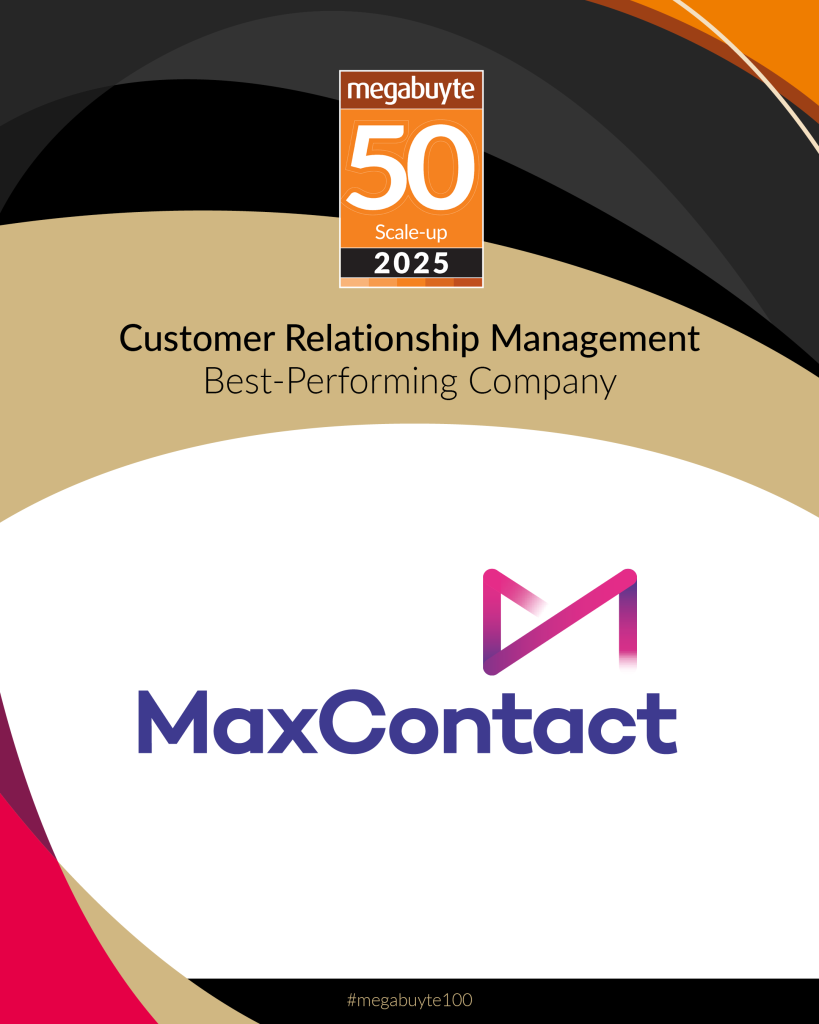
We’re proud to announce that MaxContact has been named the Best Performing Company in Customer Relationship Management at the 2025 Megabuyte Emerging Stars Awards!
A Significant Achievement
This recognition places us among an elite group of 50 Emerging Stars, selected from an initial pool of over 6,000 companies. With only 825 meeting the strict eligibility criteria in a challenging economic climate, this award reflects our team’s commitment to innovation and excellence.
“Despite experiencing some softness in sectors like energy and longer sales cycles in recent years, MaxContact has maintained c. 30% revenue growth, ahead of most other vendors in the contact centre software market. A key proponent of this is its conversational AI product strategy, with AI-enabled products featuring in 80%+ of deals.”
Moving Forward
This award validates our strategic direction and focus on delivering innovative solutions that address real customer needs. Our investment in conversational AI technology, Spokn AI, continues to drive our success and differentiate us in the market.
We remain committed to supporting our 100+ UK customers across BPO, communications, financial services, utilities, and retail sectors with solutions that enhance their customer engagement capabilities.
We’d like to thank our dedicated team, partners and valued customers for their ongoing support and confidence in MaxContact.
About Megabuyte
Megabuyte supports UK scale-up and mid-market software & ICT Services companies to develop robust growth strategies, understand their competitive landscape and customer sentiment, benchmark their financial performance and valuation, and identify and track M&A targets. They provide proprietary insights and data through their subscription research service, offer packaged consulting services, and give access to their network of some 500 tech sector CEOs through events and their expert network.
About the Emerging Stars Awards
The Emerging Stars awards are part of the Megabuyte100 award series which collectively celebrate the 100 best-performing technology companies in the UK. The awards identify the UK’s best-performing technology scale-ups as defined by Megabuyte’s proprietary Scorecard methodology, complemented by expert qualitative insights from their analysts. Evaluation criteria encompass factors such as size, growth, and margins, highlighting the top 50 best-performing scale-up companies in the UK.
Learn More
For further information about the 2025 Megabuyte Emerging Stars Awards and to see the complete list of winners, click here to access the full Megabuyte report.
Here’s to continued success and innovation throughout 2025!
(() => {
const run = () => {
const rich = document.querySelector('#rich-text');
const toc = document.querySelector('#toc');
if (!rich || !toc) return;
const headings = rich.querySelectorAll('h2');
if (!headings.length) {
toc.style.display = 'none';
return;
}
const slugCounts = Object.create(null);
const slugify = (str) => {
const base = (str || '')
.trim()
.toLowerCase()
.normalize('NFD').replace(/[\u0300-\u036f]/g, '')
.replace(/[^a-z0-9\s-]/g, '')
.replace(/\s+/g, '-')
.replace(/-+/g, '-');
const n = (slugCounts[base] = (slugCounts[base] || 0) + 1);
return base ? (n > 1 ? `${base}-${n}` : base) : `section-${n}`;
};
// Build TOC off-DOM
const frag = document.createDocumentFragment();
for (let i = 0; i < headings.length; i++) {
const h = headings[i];
const text = (h.textContent || '').trim() || `Section ${i + 1}`;
if (!h.id) h.id = slugify(text);
const a = document.createElement('a');
a.href = `#${h.id}`;
a.className = 'content_link is-secondary';
a.dataset.target = h.id;
a.setAttribute('aria-label', text);
const p = document.createElement('p');
p.className = 'text-size-small';
p.textContent = text;
a.appendChild(p);
frag.appendChild(a);
}
// Single DOM update
toc.innerHTML = '';
toc.appendChild(frag);
toc.addEventListener('click', (e) => {
const link = e.target.closest('a.content_link[href^="#"]');
if (!link) return;
e.preventDefault();
const id = link.getAttribute('href').slice(1);
const target = document.getElementById(id);
if (!target) return;
// Only compute layout once
const targetTop = target.getBoundingClientRect().top + window.scrollY;
const finalY = targetTop - 150;
window.scrollTo({ top: finalY, behavior: 'smooth' });
history.replaceState(null, '', `#${id}`);
}, { passive: false });
};
// Webflow-safe “run after everything is ready”
if (window.Webflow && Webflow.push) {
Webflow.push(() => requestAnimationFrame(run));
} else {
document.addEventListener('DOMContentLoaded', () => requestAnimationFrame(run));
}
})();
related articles
you might also like
Our articles and industry insights give you expert perspectives, practical strategies, and the latest trends to help your business connect smarter and perform better.
(() => {
const WORDS_PER_MINUTE = 200;
const MULTIPLIER = 1; // your choice
const estimateMinutes = (el) => {
if (!el) return null;
const text = (el.innerText || el.textContent || "").trim();
if (!text) return 1;
const words = (text.match(/\S+/g) || []).length;
const baseMinutes = Math.max(1, Math.ceil(words / WORDS_PER_MINUTE));
return Math.max(1, Math.ceil(baseMinutes * MULTIPLIER));
};
const findNearestTargetInItem = (itemRoot, rt) => {
if (!itemRoot) return null;
return itemRoot.querySelector('.is-text');
};
const applyWithin = (root) => {
// More forgiving selector: attribute present or equals "true"
root.querySelectorAll('[data-rich-text], [data-rich-text="true"]').forEach((rt) => {
const itemRoot =
rt.closest('[role="listitem"]') ||
rt.closest('.w-dyn-item') ||
rt.parentElement ||
root;
const target = findNearestTargetInItem(itemRoot, rt);
if (!target) return;
const mins = estimateMinutes(rt);
if (mins != null) target.textContent = `${mins} MIN READ`;
});
};
const init = () => {
applyWithin(document);
// Re-apply on dynamic changes (pagination/filters)
const mo = new MutationObserver((mutations) => {
for (const m of mutations) {
for (const n of m.addedNodes) {
if (!(n instanceof Element)) continue;
if (
n.matches('[data-rich-text], [data-rich-text="true"], [role="list"], .w-dyn-items, .w-dyn-item') ||
n.querySelector?.('[data-rich-text], [data-rich-text="true"]')
) {
applyWithin(n);
}
}
}
});
mo.observe(document.body, { childList: true, subtree: true });
};
// Robust bootstrapping
if (window.Webflow && Array.isArray(window.Webflow)) {
window.Webflow.push(init);
} else if (document.readyState === 'loading') {
document.addEventListener('DOMContentLoaded', init, { once: true });
} else {
// DOM is already ready; run now
init();
}
})();
Are we at the beginning of the end, or the end of the beginning? As far as Covid-19 is concerned, nobody seems entirely sure. The vaccination rollout promises an eventual release from lockdown, but scientists remain cagey about when everyday life might properly resume.
In the meantime, many of your sales and customer service staff are getting used to working from home. They may be there for a while yet, at least until a combination of the vaccine rollout and better summer weather allows for a cautious return to the office.
Even then, not every business will be forcing staff back into work full time. Social distancing rules are likely to remain in place for the foreseeable future, limiting the number of employees in the same space at the same time.
There’s also growing speculation that many companies will never return to pre-Covid work practices, and that some form of flexible working will become standard practice. A recent Call Centre Helper poll showed that just 7% of contact centres planned to return to the office as normal2, and ONS reported a 47% increase in demand for home working amongst call centre staff1. The data’s there to see, hybrid working, where employees spend some of the week in the office and some working from home, will become far more widespread once the pandemic ends.
The hybrid model of work
There are certainly benefits to it. According to research from Slack, most knowledge workers want a hybrid remote-office model in future. Hardly any want to return to the office full time. Those results are mirrored across sectors and industries, inferring that companies who want to attract the best talent may have to offer hybrid working as a benefit.
Even among businesses with large sales and customer service teams, the benefits of hybrid working may outweigh inevitable misgivings. Many businesses believe they can cut post-pandemic costs by reducing office estates and moving to smaller premises that only have to accommodate a proportion of a firm’s total workforce at any one time.
Put it all together, and it means remote working probably isn’t going anywhere, even after Covid. And even businesses that remain determined to return en masse to the office eventually have no real idea of when that time might be.
So, we’re trying to balance all of this, with changing consumer contact habits – increased adoption of new channels and differing contact patterns – as well as a globally reported increase in contact centre demand, with support firm ZenDesk seeing a steady 16 per cent increase in support contact requests above pre-pandemic levels3.
Productivity challenges
So instead of holding on to pre-pandemic processes, businesses might be better asking how they can adapt more effectively to the ‘normal’ of today while also preparing for whatever tomorrow might throw at them.
Or to put it simply, how do you equip your remote staff with the tools they need to work as productively away from the office as they can in it? How do you train and mentor your teams remotely? How do you continue to delight customers and drive sales when most of your team is working from home? When your workforce returns to a socially distanced office, or splits its time between the office and home, how do you maintain a consistent customer experience?
Businesses have been asking similar questions since last March, of course. But many now realise that the sticking-plaster solutions hastily implemented then are no longer enough, especially when it comes to customer contact. Communications platforms need to give employees the tools they need today, while future-proofing businesses for whatever next month, next year or even the next decade might bring.
Is cloud-first the answer?
It’s for that reason that businesses of all kinds are turning to cloud-based solutions. When your contact centre solution lives in the cloud, your agents can access it from anywhere, on any device, onboarding new starters and completing system training remotely is easier. And, with solutions like MaxContact, new features and functionality are consistently introduced as market trends and business needs change.
But there’s more to a future-proof solution than simply the convenience of cloud. It has to be highly reliable, flexible and secure, while giving you the data you need to measure performance and implement change.
MaxContact is cloud-native for that reason. You get the assurances with the combination of a fully equipped contact centre solution that fulfils all these requirements combined with a resilient uptime guarantee of 99.999% so dropouts and downtime won’t affect sales and customer service. Whilst real-time dashboards and custom reporting give managers full transparency over their teams’ efficiency, wherever they happen to be located.
reduction in training, the issue of training a workforce in the contact centre fast and easily remotely has been of major benefit
This valuable data can eventually be used to inform decision making around post-pandemic working models, giving a real insight into the benefits and challenges of remote working models based on your specific circumstances for every campaign and every call centre agent. This data becomes invaluable in a world were presenteeism in some form has been part of most of our everyday lives for the past 12 months.
Security concerns
Working from home has meant that the companies networks – that were once a secure perimeter – have expanded to every employee home and the plethora of devices they use. There’s now an increasing need to deploy communications solutions with network and data centre security baked in. But we go further. Granular permissions mean you can limit the data your home working teams have access to and remove restrictions at the click of a mouse on those days when they are working from the office.
In fact, MaxContact gives you that kind of agility throughout your contact centre operation. You can add and remove users in minutes, and equip new sites in just a couple of days. MaxContact lets you calculate your staffing requirements using statistical analysis so that, wherever your workforce is based, you always have the right staff with the right skills in place.
In other words, powerful contact centre solutions like MaxContact don’t just solve the temporary challenges of remote working. They equip your business for an uncertain future.
Use our powerful cloud platform to create an agile, secure and streamlined contact centre that not only adapts to the unpredictable challenges of the post-pandemic world.
Most outbound sales teams would describe themselves as “data-driven”. They track activity, review performance reports and measure success against targets.
(() => {
const WORDS_PER_MINUTE = 200;
const MULTIPLIER = 1; // your choice
const estimateMinutes = (el) => {
if (!el) return null;
const text = (el.innerText || el.textContent || "").trim();
if (!text) return 1;
const words = (text.match(/\S+/g) || []).length;
const baseMinutes = Math.max(1, Math.ceil(words / WORDS_PER_MINUTE));
return Math.max(1, Math.ceil(baseMinutes * MULTIPLIER));
};
const findNearestTargetInItem = (itemRoot, rt) => {
if (!itemRoot) return null;
return itemRoot.querySelector('.is-text');
};
const applyWithin = (root) => {
// More forgiving selector: attribute present or equals "true"
root.querySelectorAll('[data-rich-text], [data-rich-text="true"]').forEach((rt) => {
const itemRoot =
rt.closest('[role="listitem"]') ||
rt.closest('.w-dyn-item') ||
rt.parentElement ||
root;
const target = findNearestTargetInItem(itemRoot, rt);
if (!target) return;
const mins = estimateMinutes(rt);
if (mins != null) target.textContent = `${mins} MIN READ`;
});
};
const init = () => {
applyWithin(document);
// Re-apply on dynamic changes (pagination/filters)
const mo = new MutationObserver((mutations) => {
for (const m of mutations) {
for (const n of m.addedNodes) {
if (!(n instanceof Element)) continue;
if (
n.matches('[data-rich-text], [data-rich-text="true"], [role="list"], .w-dyn-items, .w-dyn-item') ||
n.querySelector?.('[data-rich-text], [data-rich-text="true"]')
) {
applyWithin(n);
}
}
}
});
mo.observe(document.body, { childList: true, subtree: true });
};
// Robust bootstrapping
if (window.Webflow && Array.isArray(window.Webflow)) {
window.Webflow.push(init);
} else if (document.readyState === 'loading') {
document.addEventListener('DOMContentLoaded', init, { once: true });
} else {
// DOM is already ready; run now
init();
}
})();
But reporting on results isn’t the same as being data-driven. In outbound sales, data only creates value when it is used to actively influence decisions; ideally, while activity is still happening rather than when it is reviewed days later.
A genuinely data-driven outbound sales team will use live performance data to shape how calls are placed, which leads are prioritised, how agents are routed and where coaching is applied. Data, technology and execution work together as a single system.
In this article, we explore what “data-driven” should really mean for outbound sales teams operating in a contact centre environment. We look at the outbound sales metrics that matter most, how technology turns those metrics into real-time decisions, and share the latest data from our Benchmark Report to help you determine whether your performance is average or genuinely competitive.
Use data to decide which leads deserve agent time
Outbound sales teams should focus on maximising productive talk time as the foundation. But the next question becomes, who should agents be spending that time speaking to?
The average first-call close rate across outbound sales teams is 25%, with 31% of teams achieving rates between 20% and 29%. This shows that conversion performance is driven less by how many calls are made and more by how effectively effort is focused.
Understanding which metrics genuinely influence outcomes is critical here. Our complete guide to call centre reporting metrics breaks down the KPIs that matter most, and how they should be interpreted in context rather than in isolation.
Sales teams should concentrate on prospects that are most likely to convert. Which means the first-in, first-out approach to lead prioritisation is an ineffective strategy.
This is where intelligent lead prioritisation tools powered by AI have a huge operational impact. By pulling data from multiple sources, such as recent engagement, historical call outcomes, conversion performance, and potential deal value, intelligent lead prioritisation ranks leads dynamically. As prospect data signals change, prioritisation updates are applied automatically, which means agents consistently spend their available talk time on the opportunities most likely to deliver results.
Use data to match the right agent to the right lead
Data-insights need not stop at determining high-value and high-intent leads. It can also influence who handles them.
While the mean average revenue per call across outbound sales teams is just under £230, over 45% of teams generate less than £59 per call. This gap highlights how widely outcomes can vary depending on agent capability.
When data is used to create value, agent assignment isn’t random or purely availability-based. Instead, performance data is used to match leads with the agents most likely to convert them. For example:
Higher-value or more complex opportunities can be routed to experienced agents with deeper product knowledge or a proven track record of closing similar deals.
Price-sensitive or early-stage leads may be better suited to agents who perform strongly at qualification and objection handling.
Sector-specific prospects can be matched with agents who have previous success in that industry or campaign type.
Skill-based routing makes this possible by using historical performance data such as conversion rates by product, deal size, objection type, or lead source. As new performance signals are captured, routing rules can be refined so decisions improve continuously.
Use real-time performance data to intervene early
Outbound sales performance can change quickly. So, relying on end-of-day or weekly reports limits how effectively teams can respond. Retrospective reporting removes the opportunity to correct issues such as poor lead targeting or gaps in agent performance.
Access to real-time performance data gives sales managers the visibility they need to intervene without burning through contact. Live dashboards show early signals, such as declining connect rates, falling conversion performance, or uneven agent productivity.
Instead of waiting for performance reviews, managers can guide execution as it happens. This might involve reallocating resources, adjusting call scripts, changing lead allocation, or providing targeted coaching.
Contact centres that use real-time insight to guide daily decision-making are better positioned to protect conversion rates and maximise the impact of agent time.
For outsourced or multi-client environments, this ability to intervene early is particularly important. Our article on how BPOs can meet their KPIs explores the additional performance and reporting challenges faced by outsourced contact centres.
Use Conversation Analytics to understand why performance varies
Surface-level metrics such as contact rate, conversion rate and first-call close rate explain what is happening in outbound sales. But the why behind performance differentiation is dependent on agents, campaigns, or lead types, and teams need insight from the conversation itself.
Our Conversation Analytics analyses 100% of outbound calls, transforming unstructured call audio into actionable insight that would be impossible to capture through manual review or random sampling.
With the ability to analyse conversations at scale, sales leaders can review and identify the underlying drivers of performance. This insight helps explain why certain agents convert more effectively, why objections stall progress, or why specific lead types underperform despite similar call volumes.
In practice, Conversation Analytics supports data-driven outbound sales teams by enabling:
More targeted coaching: Identify the techniques used in successful calls and pinpoint where individual agents need support
Better script and messaging optimisation: Surface patterns in high-performing conversations and common objections
Improved quality and compliance oversight: Analyse every call rather than small samples
Earlier identification of emerging issues: Spot shifts in sentiment, objections, or competitor mentions
If you’re looking for a broader view of how these metrics work together, our guide on how to measure call centre efficiencyexplores how performance indicators combine to drive overall effectiveness.)
Key benefits for outbound sales teams include:
Enhanced Agent Training: Identify successful techniques and areas for improvement, allowing for targeted training programmes.
Customer Sentiment Analysis: Detect changes in tone and emotion, helping agents adapt their approach in real-time.
Quality Assurance at Scale: Analyse every call, ensuring comprehensive QA and quick identification of compliance issues.
Identifying Sales Opportunities: Recognise patterns in successful calls to refine sales scripts and strategies.
Competitor Intelligence: Flag mentions of competitors, providing valuable market insights.
Trend Identification: Quickly spot emerging trends in customer behaviour or common objections.
By implementing speech analytics, outbound sales teams can gain data-driven insights that lead to more effective strategies, improved customer experiences, and better business outcomes. Use these insights to identify common objections, spot successful sales techniques, and provide targeted coaching to your team. A recent study by Forrester found that companies using AI-driven speech analytics saw a 10% increase in customer satisfaction scores and a 15% improvement in first-call resolution rates.
With speech analytics, you’re not just collecting more data – you’re gaining the ability to understand and act on the nuances of every customer interaction, transforming your outbound sales operation into a truly data-driven powerhouse.
Sustaining data-driven outbound sales performance
When combined with performance data, conversation analytics closes the loop between insight and action. Conversation analytics doesn’t sit alongside metrics. It explains them and enables more confident decisions and continuous improvement.
Using more tools or tracking additional metrics doesn’t automatically make an outbound sales team data-driven. Data only becomes valuable when it actively guides decisions across the contact strategy, from how calls are dialled, and leads are prioritised, to how agents are routed, coached and optimised.
In genuinely data-driven teams, agents and managers understand what key metrics mean, how they influence outcomes and when intervention is needed. Performance reviews focus on interpreting trends and agreeing on clear next actions, rather than simply reporting on results after the fact.
The most effective outbound sales teams connect data. By linking real-time performance insight with intelligent technology and informed decision-making, they improve results while activity is still in progress, not once opportunities have already passed.
If you want to understand how your outbound sales performance compares to other UK contact centres, benchmarking is the most effective next step.
Sampling isn’t evidence: what the new compliance rules mean for your contact centre
Fines are up 35x, the FCA wants proof, and most breaches are slipping through the calls nobody reviews. Here’s what the data says — and what to do about it.
(() => {
const WORDS_PER_MINUTE = 200;
const MULTIPLIER = 1; // your choice
const estimateMinutes = (el) => {
if (!el) return null;
const text = (el.innerText || el.textContent || "").trim();
if (!text) return 1;
const words = (text.match(/\S+/g) || []).length;
const baseMinutes = Math.max(1, Math.ceil(words / WORDS_PER_MINUTE));
return Math.max(1, Math.ceil(baseMinutes * MULTIPLIER));
};
const findNearestTargetInItem = (itemRoot, rt) => {
if (!itemRoot) return null;
return itemRoot.querySelector('.is-text');
};
const applyWithin = (root) => {
// More forgiving selector: attribute present or equals "true"
root.querySelectorAll('[data-rich-text], [data-rich-text="true"]').forEach((rt) => {
const itemRoot =
rt.closest('[role="listitem"]') ||
rt.closest('.w-dyn-item') ||
rt.parentElement ||
root;
const target = findNearestTargetInItem(itemRoot, rt);
if (!target) return;
const mins = estimateMinutes(rt);
if (mins != null) target.textContent = `${mins} MIN READ`;
});
};
const init = () => {
applyWithin(document);
// Re-apply on dynamic changes (pagination/filters)
const mo = new MutationObserver((mutations) => {
for (const m of mutations) {
for (const n of m.addedNodes) {
if (!(n instanceof Element)) continue;
if (
n.matches('[data-rich-text], [data-rich-text="true"], [role="list"], .w-dyn-items, .w-dyn-item') ||
n.querySelector?.('[data-rich-text], [data-rich-text="true"]')
) {
applyWithin(n);
}
}
}
});
mo.observe(document.body, { childList: true, subtree: true });
};
// Robust bootstrapping
if (window.Webflow && Array.isArray(window.Webflow)) {
window.Webflow.push(init);
} else if (document.readyState === 'loading') {
document.addEventListener('DOMContentLoaded', init, { once: true });
} else {
// DOM is already ready; run now
init();
}
})();
Compliance used to be something you could, quietly, budget for. A fine here, a sample there, a QA process that reviewed a small slice of calls and hoped the rest looked the same.
That maths no longer works.
In 2026 the cost of getting it wrong has changed by an order of magnitude, and regulators have moved from asking whether you’ve done the work to asking you to prove it. In our recent webinar, Kayleigh Tait and Conor Bowler walked through what’s changed, shared new research from more than 300 UK contact centre leaders, and showed how MaxContact’s Auto-QA closes the gap. Here’s the summary.
The 2026 compliance landscape
Two things have shifted at once.
First, the numbers. PECR - the regulation governing outbound calls, texts and marketing communications - used to cap fines at £500,000. Since the Data (Use and Access) Act came into force in February 2026, that cap has risen to £17.5 million, or 4% of global turnover, whichever is higher. That’s a 35x increase in maximum exposure. And for the first time, company directors can be held personally liable, up to £500,000 each.
Second, the FCA’s stance. Consumer Duty has been law since 2023, but the regulator has moved from “have you put this in place?” to “prove it with evidence.” Of the 180 board reports the FCA reviewed last year, the most common failure wasn’t that firms hadn’t done the work - it was that they couldn’t evidence the outcomes for vulnerable customers.
At these levels, a fine isn’t a line item you plan for. It’s a risk you have to design out.
What the research found
To ground this in reality rather than headline numbers, MaxContact commissioned independent research across 300+ UK contact centre leaders, 285 of them FCA-regulated. A few findings stood out.
Coverage has matured - but gaps remain. Asked how they review calls today:
49.5% still sample manually
46.7% already use AI to review every call
2.8% review nothing systematically
That’s a more mature picture than the “2–3% sampled” figure often quoted in industry research. But it also confirms that a real share of organisations still aren’t solving the problem with technology.
Sampling leaves you exposed. More than half - 54% - said a compliance breach or harm had occurred outside their routine QA process. 16.5% said it had happened more than once. The point is simple: if you only look at a sample, the problems tend to live in the calls you didn’t look at.
And it costs real money. Across everyone surveyed - including firms that paid nothing - the average regulatory fine in the last 12 months was £81,000, with 31% paying £50,000 or more. Fines weren’t the whole story either: the average lost revenue from non-compliant sales (refunds, cancellations, deals that fell through) was £22,000, and 50.2% said they’d lost a sale, contract or customer over a compliance issue.
The confidence gap
One of the more revealing findings came from asking teams two questions. First: how confident are you that you could evidence fair treatment if the FCA came knocking? Confidence was high across the board.
Then we flipped it: have you actually found a breach outside your QA sample? The gap between the two is the interesting bit.
It’s less about how hard a team looks and more about what they’re looking at. Sales and collections calls tend to follow scripts and structured flows, so there are only so many ways a conversation can drift out of compliance. Customer care and technical support calls are far less scripted - troubleshooting, escalations, one-off advice - so there’s more variance per call, and more chance of a breach hiding in the calls that never make it into the sample.
The feedback delay problem
Even when issues are caught, they’re caught slowly. On average, it takes 3.08 days between a call happening and the person who took it getting feedback. Only 10.9% hear back within a day; over a third (37.2%) wait three days or more.
The blocker isn’t attitude. Time, cost and headcount accounted for 37.4% of the reasons given, while only 6% felt there was no genuine need for faster feedback.
That delay matters, because feedback has a shelf life. Third-party research shows employees are 3.6x more likely to say they’re motivated to do outstanding work when feedback comes daily rather than at a quarterly or annual review. Put the two together and the risk is clear: if something’s going wrong on a call and nobody flags it for the best part of a working week, it’s probably happening again and again in the meantime.
AI Call Scoring vs Auto QA at Scale
MaxContact addresses this with two features inside Conversation Analytics. They’re easy to blur together, so it’s worth being precise.
AI Call Scoring is an AI scorecard builder, included in the Conversation Analytics base package. You write the scorecard in plain English, and it scores individual calls — a human still picks which calls to run it against. It cuts review time from 2–3x the length of the call down to around five minutes per call.
Auto QA at Scale takes those same scorecards and runs them on a schedule - historically and as new calls come in - so you get consistent coverage across 100% of eligible calls. Every result is backed by evidence in the transcript, and calls are grouped by outcome (pass, fail, auto-fail, not applicable) so your team can focus human review where it’s needed.
What Auto-QA looks like in practice
In the demo, Conor built an FCA compliance scorecard and showed how it runs at scale. A few things worth knowing:
Build the scorecard the way that suits you. You can draft it in a tool like Excel first - using comments and track changes to collaborate - then bring it into Conversation Analytics. Each criterion is defined across what to detect, what to listen for, and how to score it, using a decision tree where possible to keep scoring consistent.
It handles vulnerability. The scorecard can detect drivers of vulnerability across health, life events, resilience and capability, and score whether the agent acknowledged, semi-acknowledged or missed the indicators - directly relevant to the FCA’s focus on vulnerable customers.
Schedules do the running. Choose an always-on schedule (new calls scored as they come in) or a one-time run (for example, 5% of last quarter’s calls to check historical compliance). Add rules - minimum call length, successful outcomes only - set the sample size, activate, and it runs.
Filter and report on what matters. Build views by result - passes, fails, auto-fails - and drill into any call to see the evaluation summary and exactly why it failed. Performance reporting breaks results down by campaign, team and user, with more question-level reporting arriving shortly.
Common questions from the session
Isn’t AI scoring just swapping one compliance risk for another? No - because it isn’t a black box. Every score links straight back to the exact part of the transcript it came from, so a QA lead can check any result against the call in seconds. The AI decides what needs looking at; a human still decides what to do about it.
We already run Conversation Analytics with AI Call Scoring - is Auto-QA a big project? No. It sits on infrastructure you already have, so it’s a matter of turning the feature on. Your existing scorecards carry straight over — you’re not rebuilding anything. What changes is that scoring runs on a schedule against every eligible call, rather than a person choosing which calls to score.
Can results be shown to agents, not just QA? This is in development, and it’s permissions-based - you control the level of detail. The plan is three layers of feedback: calls scored in real time as they happen, a daily “top three to improve, top three strengths” summary, and the same across a rolling seven-day view.
The takeaway
The rules have changed, and sampling no longer counts as evidence. When breaches hide in the calls you don’t review, and feedback takes three days to land, the fix is coverage that’s complete, evidenced and fast. That’s exactly the gap Auto-QA is built to close.
About MaxContact
MaxContact is an AI-powered customer engagement platform that helps businesses turn every customer conversation into a revenue-driving outcome. Our platform spans contact centre software, conversation analytics, and AI agents and chatbots - working together as one connected solution. Book a demo.
Blog
5 min read
Auto QA is live: every call scored, every score evidenced
Auto QA is available today as an add-on to MaxContact Conversation Analytics.
(() => {
const WORDS_PER_MINUTE = 200;
const MULTIPLIER = 1; // your choice
const estimateMinutes = (el) => {
if (!el) return null;
const text = (el.innerText || el.textContent || "").trim();
if (!text) return 1;
const words = (text.match(/\S+/g) || []).length;
const baseMinutes = Math.max(1, Math.ceil(words / WORDS_PER_MINUTE));
return Math.max(1, Math.ceil(baseMinutes * MULTIPLIER));
};
const findNearestTargetInItem = (itemRoot, rt) => {
if (!itemRoot) return null;
return itemRoot.querySelector('.is-text');
};
const applyWithin = (root) => {
// More forgiving selector: attribute present or equals "true"
root.querySelectorAll('[data-rich-text], [data-rich-text="true"]').forEach((rt) => {
const itemRoot =
rt.closest('[role="listitem"]') ||
rt.closest('.w-dyn-item') ||
rt.parentElement ||
root;
const target = findNearestTargetInItem(itemRoot, rt);
if (!target) return;
const mins = estimateMinutes(rt);
if (mins != null) target.textContent = `${mins} MIN READ`;
});
};
const init = () => {
applyWithin(document);
// Re-apply on dynamic changes (pagination/filters)
const mo = new MutationObserver((mutations) => {
for (const m of mutations) {
for (const n of m.addedNodes) {
if (!(n instanceof Element)) continue;
if (
n.matches('[data-rich-text], [data-rich-text="true"], [role="list"], .w-dyn-items, .w-dyn-item') ||
n.querySelector?.('[data-rich-text], [data-rich-text="true"]')
) {
applyWithin(n);
}
}
}
});
mo.observe(document.body, { childList: true, subtree: true });
};
// Robust bootstrapping
if (window.Webflow && Array.isArray(window.Webflow)) {
window.Webflow.push(init);
} else if (document.readyState === 'loading') {
document.addEventListener('DOMContentLoaded', init, { once: true });
} else {
// DOM is already ready; run now
init();
}
})();
Auto QA scores 100% of your eligible interactions against your own criteria and links every score back to the exact exchange in the transcript. When a regulator, an ombudsman or the board asks about a specific call, the evidence already exists.
Reviewing every call turns out not to be the finish line
We surveyed 300 UK contact centre managers and directors in August. 285 of them operate under FCA regulation, and among that group, 46.7% already have AI reviewing every single call. For years the case for automating Quality Assurance was that you could only ever listen to a fraction of your conversations. For half this market, that's no longer the problem. So, we asked those same 285 people whether they'd ever found a compliance breach or harm issue outside their routine Quality Assurance sample.
54.0% said yes. 16.5% had found more than one.
Reviewing everything, it turns out, isn't the same as being able to prove anything. Consumer Duty doesn't ask whether a conversation was recorded or even scanned. It asks for an assessment against defined criteria, applied consistently, with an audit trail and a demonstrable link between what you found and what you did about it. Plenty of businesses now have automated review across all their calls. Far fewer could produce that chain for one named customer, on one named call, this week.
The part that costs money is the wait
The other finding that shaped this product was about speed. Only 10.9% of regulated – businesses get feedback to an agent within a day of the call. The mean is 3.08 days. And when we asked what stops teams reviewing more, the answers were about resource rather than capability - time, cost and headcount accounted for 67.4% between them. Three days is a long time on a contact centre floor. A missed disclosure or a mishandled vulnerability marker usually isn't a one-off; it's a habit, and it carries on across conversations nobody has flagged yet.
The end of the Quality Assurance Sample
Every eligible interaction is scored automatically, as soon as the transcript is available. There are no selection step and no queue. Scorecard criteria are written in plain English rather than built from keyword rules or complex logic, so your Quality Assurance team can create and change them quickly and without waiting on us. Every score is evidence-linked, so a result can be defended in a coaching session, an internal audit or a regulatory review.
And because it's one evidence layer rather than three, Operations, Quality Assurance and Compliance are working from the same view of the same conversations instead of separate samples and separate conclusions. Your reviewers keep the final say throughout. They can challenge a score, question an output and recalibrate criteria whenever the operation changes.
If you already use MaxContact’s Conversation Analytics, you already have AI Call Scoring. That lets your team score selected calls against your existing scorecard, taking a review from roughly thirty minutes down to five - around four days a month back for a reviewer. Auto QA is the paid add-on that removes the selection step entirely and turns that output into a complete, auditable record across every call.
Available today
Auto QA is available now as an add-on to Conversation Analytics. Existing customers can speak to their Customer Success contact about switching it on. If you'd like to see it working on your own call volume rather than ours, book a demo and we'll walk you through it.
Sales want to push performance. Compliance want to protect against risk. 77.5% of the managers and directors in our research agreed that pushing performance raises compliance risk - so this isn't a tension anyone needs convincing of. Score every call and both teams are at least arguing from the same evidence.
How do consumers actually feel about AI in customer engagement?
As more UK businesses cut contact centre jobs in favour of AI, we asked over 1,000 UK consumers where they actually want automation - and where they still expect a human. The answers aren't as simple as "customers are moving online."
(() => {
const WORDS_PER_MINUTE = 200;
const MULTIPLIER = 1; // your choice
const estimateMinutes = (el) => {
if (!el) return null;
const text = (el.innerText || el.textContent || "").trim();
if (!text) return 1;
const words = (text.match(/\S+/g) || []).length;
const baseMinutes = Math.max(1, Math.ceil(words / WORDS_PER_MINUTE));
return Math.max(1, Math.ceil(baseMinutes * MULTIPLIER));
};
const findNearestTargetInItem = (itemRoot, rt) => {
if (!itemRoot) return null;
return itemRoot.querySelector('.is-text');
};
const applyWithin = (root) => {
// More forgiving selector: attribute present or equals "true"
root.querySelectorAll('[data-rich-text], [data-rich-text="true"]').forEach((rt) => {
const itemRoot =
rt.closest('[role="listitem"]') ||
rt.closest('.w-dyn-item') ||
rt.parentElement ||
root;
const target = findNearestTargetInItem(itemRoot, rt);
if (!target) return;
const mins = estimateMinutes(rt);
if (mins != null) target.textContent = `${mins} MIN READ`;
});
};
const init = () => {
applyWithin(document);
// Re-apply on dynamic changes (pagination/filters)
const mo = new MutationObserver((mutations) => {
for (const m of mutations) {
for (const n of m.addedNodes) {
if (!(n instanceof Element)) continue;
if (
n.matches('[data-rich-text], [data-rich-text="true"], [role="list"], .w-dyn-items, .w-dyn-item') ||
n.querySelector?.('[data-rich-text], [data-rich-text="true"]')
) {
applyWithin(n);
}
}
}
});
mo.observe(document.body, { childList: true, subtree: true });
};
// Robust bootstrapping
if (window.Webflow && Array.isArray(window.Webflow)) {
window.Webflow.push(init);
} else if (document.readyState === 'loading') {
document.addEventListener('DOMContentLoaded', init, { once: true });
} else {
// DOM is already ready; run now
init();
}
})();
A major UK utility provider announced this week that it's cutting 1,300 jobs, leaning harder into AI and digital service. It won't be the last business to make this call, and it's not the first either. Across most industries right now, there's a version of the same bet being placed: that customers are ready to swap people for bots.
Our sales team has had some version of this conversation with almost every customer and prospect this week. The question underneath it is always the same - should we be doing this too?
"It's the question everyone's asking right now," says Richard Langham, VP of Sales at MaxContact. "Listening to your customers is exactly the right instinct. The mistake is assuming what worked for one business, in one industry, applies everywhere else. Consumer behaviour isn't uniform, and neither are the moments that matter to people. Before following someone else's playbook, it's worth checking what your own customers think - not what another sector's did."
We put that question to the public directly. Our Voice of the UK Consumer 2026 report surveyed over 1,000 UK consumers on exactly this: where do you want AI, and where do you want a human? The answers are more specific, and more useful, than "customers are moving online."
Consumers draw a hard line on where AI belongs
We asked people which situations they'd want to keep AI out of entirely. They were clear. Over half (54%) don't want AI anywhere near an emergency. Half say the same for complex account problems. Financial discussions (49%) and negotiating terms (46%) aren't far behind.
Flip the question and ask where a human matters most, and you get the same answer from the other direction: emergencies top the list at 41%, then complex account queries (33%), financial discussions (29%), and explaining something personal or sensitive (26%).
These situations are more common than they might sound. A missed bill. A bereavement. A boiler packing in over winter. Someone explaining a difficult situation to a company for the first time. Contact centres deal with moments like these every single day - and our data says people want a person on the other end when it happens.
AI has its place
There's real appetite for automation where it's genuinely useful: answering FAQs, routing calls, pulling up account updates. People are happy to let a bot handle the boring stuff.
There's even one situation where AI wins outright: talking to a lender about financial difficulty. More people choose AI here than a human agent. But when you dig into why, it's not enthusiasm for the technology - it's privacy. People find it easier to admit they're struggling to a screen than to a person. That's not proof consumers prefer bots. It's proof they want to avoid judgement.
Listen to your own customers, not someone else's headline
"A telecoms customer, an insurance customer and an energy customer don't necessarily feel the same way about AI," Langham says. "What one industry can get away with, another can't. What worked for one company's customer base might land completely differently with yours."
Here's what to get right before making any move on the back of someone else's numbers:
Check your own data before borrowing someone else's conclusion - a drop in call volume tells you what stopped happening, not why, and not whether it's safe to read as "customers don't want people anymore."
Keep the human path open exactly where our data says it counts - emergencies, complex issues, money problems, anything personal. These are the situations where AI is least welcome, and where getting it wrong does the most damage to trust.
Tell people when they're talking to AI - 88% of consumers say this matters, half calling it very important. If AI is handling more of your first-line contact, being upfront about it isn't optional. It's what keeps trust intact.
Moving contact online doesn't close the trust gap on its own. Keeping a human reachable for the moments people care about most does, and knowing which moments those are for your customers - not someone else's - is the bit worth getting right.
If you're weighing up a similar decision, don't do it on assumptions borrowed from a headline. Get the full picture - including sector-by-sector breakdowns for utilities, telecoms, finance/debt and insurance - in our Voice of the UK Consumer 2026 report.Download here.




.png)
