featured
article
Fresh thinking and practical takeaways to help your business improve customer engagement and unlock better performance.

discover THE
latest articles

7 Outbound Dialler Features You Need In Your Call Centre
Whether you’re looking to supercharge sales, streamline debt collection, or elevate customer service, the right outbound dialler can redefine how you connect and communicate. Learn more about automated diallers and discover the potential they hold for your contact centre’s success.
Also known as an auto dialler, an outbound dialler automates the process of making calls to customers and contacts and routes the answered calls to your available agents.
Manual vs auto dialling
Dialling can be done manually on a mobile or business phone, with an agent placing calls one after another from a list. Many contact centres use automated dialling for high-volume outbound campaigns, as agents spend less time dialling and waiting for calls to be answered and more time having conversations.
If you’re considering incorporating dialler technology into your contact strategy here are the dialler features you should look out for when choosing a provider.
7 outbound dialler features to look for
1. Multiple dialling modes available
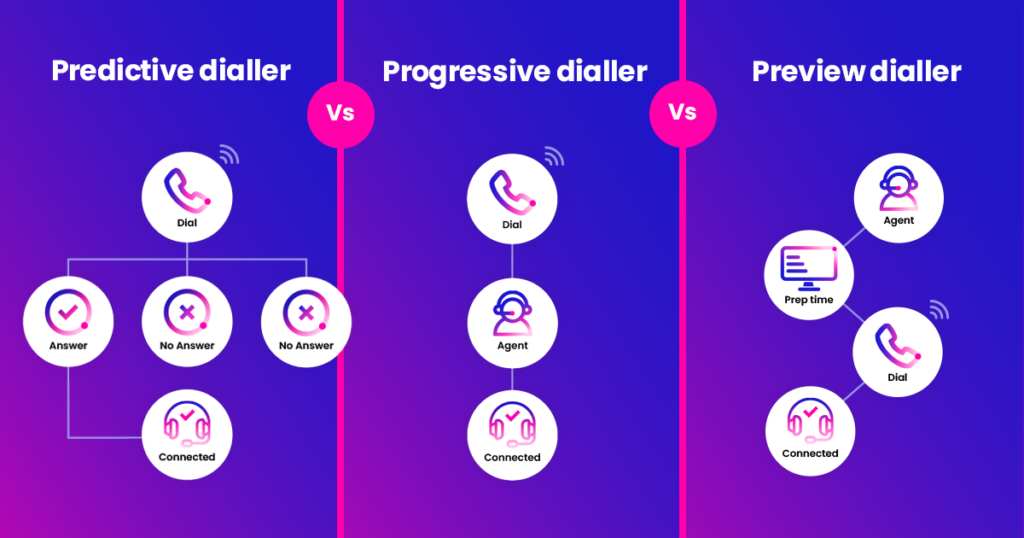
Most auto-diallers have three dialling modes that teams switch between depending on the type of outbound campaign you are doing. These modes are predictive, progressive and preview.
Predictive dialling
Predictive dialling places calls ahead of agents becoming free based on the software’s predictions of agent availability. It dials multiple numbers simultaneously, so that when agents finish one call, they can be instantly connected to the next to maximise talk-time. It suits high-volume campaigns with experienced teams and mature contact lists.
Progressive dialling
Progressive diallers have a slower pace, only dialling a number when an agent is ready and available to take the call. Dialling is instant and automatic, so call volumes stay relatively high, but it is best suited to regulated campaigns and collections, where consistency matters more than volume.
Preview dialling
A preview dialler shows the agent the contact record first, and after a short preview period dials automatically. This delay lets the agent prepare for the call, using information typically taken from the company CRM system, which is often integrated into the dialler. Preview dialling mode suits high-value or complex calls where context changes the outcome.
For more detail on different dialling modes, read our predictive, progressive and preview dialler modes guide.
2. Answer Machine Detection (AMD)
Answer machine detection (AMD) identifies voicemails and answering machines before they reach an agent. This means agents only spend time on live conversations, saving them valuable time and boosting productivity.
If the system can't confidently tell within a couple of seconds whether a call is live, it passes the call to the agent, so real conversations aren't lost to false positives. MaxContact's dialler gives up to 40% less time lost to voicemails and no-answers.
3. Built in compliance controls
Automated outbound dialling is an area that’s closely regulated in the UK, with silent and abandoned calls often a talking point due to the fines and reputational damage if they are handled wrong.
When you’re comparing dialler platforms, look for controls that are built in rather than bolted on, so compliance doesn't depend on someone remembering to configure it.
Here are some key controls to look out for:
- Pacing that aims for zero abandoned calls. A call is abandoned when a customer answers and no agent is free. Ofcom's target is 0%, not the old 3% figure some diallers are still set to.
- 72-hour rule handling. A number that received an abandoned call should only be recalled within 72 hours if an agent is guaranteed, for example by switching it to preview mode.
- Minimum ring time, in line with Ofcom's 15-second guidance.
- Valid CLI on every call. See our guide to CLI compliance.
- Do Not Call and TPS screening, so registered numbers are removed automatically.
- Calling windows, configurable for each campaign.
- Audit trails, with call recording and data capture, so you can evidence compliance if Ofcom or the FCA ask.
For more on how the rules work in practice, see our guide to Ofcom and PECR regulations.
4. Number recycling and retries
Many calls go unanswered the first time, so a good dialler doesn't just move on, as that means lost leads. Instead, it puts unanswered numbers back in the queue to be retried, so more leads are reached, and it keeps how often each contact is called within official limits, so they're never pestered. Look for control over how many attempts each number gets and how long the dialler waits between them, so you can retry at different times without overdoing it. It should also handle customers who ask to be called back later, so those conversations aren't lost.
5. CRM integration
A powerful dialler is even better when it works hand in hand with your existing systems. It gives an agent access to customer history, preferred contact methods, and past feedback – all within the dialler interface.
This allows for personalised conversations that address specific needs, leading to happier customers and improved call outcomes. Easy integration applies to after-sales and debt resolution teams too.
By connecting your dialler with other systems, you can put all relevant information at agents’ fingertips, reducing the time spent searching for information. MaxContact connects with Salesforce, HubSpot, Zoho and AutoConvert, with open APIs for other systems.
6. Outbound skill-based routing
Skill-based routing isn't only for inbound calls. Outbound skill-based routing matches each lead to the agent best placed to handle it, based on skills and proficiency, and it works in preview, progressive and predictive modes. It stops high-value or sensitive leads reaching an agent who isn't equipped for the conversation. Read how outbound skill-based routing works.
7. Reporting and dashboards
You can only improve contact centre performance when you can measure it. Look for reporting and analytics dashboards that give you complete visibility around call metrics and agent performance, as well as scheduled reports so you can set targets and track them across campaigns, teams, and agents.
Choosing an outbound dialler
Use this list as a checklist when comparing providers, whether you're running sales, debt collection or customer service campaigns. To see how MaxContact's dialler handles these features, explore our outbound dialler software or book a demo.
Sampling isn’t evidence: what the new compliance rules mean for your contact centre
Fines are up 35x, the FCA wants proof, and most breaches are slipping through the calls nobody reviews. Here’s what the data says — and what to do about it.
Compliance used to be something you could, quietly, budget for. A fine here, a sample there, a QA process that reviewed a small slice of calls and hoped the rest looked the same.
That maths no longer works.
In 2026 the cost of getting it wrong has changed by an order of magnitude, and regulators have moved from asking whether you’ve done the work to asking you to prove it. In our recent webinar, Kayleigh Tait and Conor Bowler walked through what’s changed, shared new research from more than 300 UK contact centre leaders, and showed how MaxContact’s Auto-QA closes the gap. Here’s the summary.
The 2026 compliance landscape
Two things have shifted at once.
First, the numbers. PECR - the regulation governing outbound calls, texts and marketing communications - used to cap fines at £500,000. Since the Data (Use and Access) Act came into force in February 2026, that cap has risen to £17.5 million, or 4% of global turnover, whichever is higher. That’s a 35x increase in maximum exposure. And for the first time, company directors can be held personally liable, up to £500,000 each.
Second, the FCA’s stance. Consumer Duty has been law since 2023, but the regulator has moved from “have you put this in place?” to “prove it with evidence.” Of the 180 board reports the FCA reviewed last year, the most common failure wasn’t that firms hadn’t done the work - it was that they couldn’t evidence the outcomes for vulnerable customers.
At these levels, a fine isn’t a line item you plan for. It’s a risk you have to design out.
What the research found
To ground this in reality rather than headline numbers, MaxContact commissioned independent research across 300+ UK contact centre leaders, 285 of them FCA-regulated. A few findings stood out.
Coverage has matured - but gaps remain. Asked how they review calls today:
- 49.5% still sample manually
- 46.7% already use AI to review every call
- 2.8% review nothing systematically
That’s a more mature picture than the “2–3% sampled” figure often quoted in industry research. But it also confirms that a real share of organisations still aren’t solving the problem with technology.
Sampling leaves you exposed. More than half - 54% - said a compliance breach or harm had occurred outside their routine QA process. 16.5% said it had happened more than once. The point is simple: if you only look at a sample, the problems tend to live in the calls you didn’t look at.
And it costs real money. Across everyone surveyed - including firms that paid nothing - the average regulatory fine in the last 12 months was £81,000, with 31% paying £50,000 or more. Fines weren’t the whole story either: the average lost revenue from non-compliant sales (refunds, cancellations, deals that fell through) was £22,000, and 50.2% said they’d lost a sale, contract or customer over a compliance issue.

The confidence gap
One of the more revealing findings came from asking teams two questions. First: how confident are you that you could evidence fair treatment if the FCA came knocking? Confidence was high across the board.
Then we flipped it: have you actually found a breach outside your QA sample? The gap between the two is the interesting bit.
It’s less about how hard a team looks and more about what they’re looking at. Sales and collections calls tend to follow scripts and structured flows, so there are only so many ways a conversation can drift out of compliance. Customer care and technical support calls are far less scripted - troubleshooting, escalations, one-off advice - so there’s more variance per call, and more chance of a breach hiding in the calls that never make it into the sample.
The feedback delay problem
Even when issues are caught, they’re caught slowly. On average, it takes 3.08 days between a call happening and the person who took it getting feedback. Only 10.9% hear back within a day; over a third (37.2%) wait three days or more.
The blocker isn’t attitude. Time, cost and headcount accounted for 37.4% of the reasons given, while only 6% felt there was no genuine need for faster feedback.
That delay matters, because feedback has a shelf life. Third-party research shows employees are 3.6x more likely to say they’re motivated to do outstanding work when feedback comes daily rather than at a quarterly or annual review. Put the two together and the risk is clear: if something’s going wrong on a call and nobody flags it for the best part of a working week, it’s probably happening again and again in the meantime.
AI Call Scoring vs Auto QA at Scale
MaxContact addresses this with two features inside Conversation Analytics. They’re easy to blur together, so it’s worth being precise.
AI Call Scoring is an AI scorecard builder, included in the Conversation Analytics base package. You write the scorecard in plain English, and it scores individual calls — a human still picks which calls to run it against. It cuts review time from 2–3x the length of the call down to around five minutes per call.
Auto QA at Scale takes those same scorecards and runs them on a schedule - historically and as new calls come in - so you get consistent coverage across 100% of eligible calls. Every result is backed by evidence in the transcript, and calls are grouped by outcome (pass, fail, auto-fail, not applicable) so your team can focus human review where it’s needed.
What Auto-QA looks like in practice
In the demo, Conor built an FCA compliance scorecard and showed how it runs at scale. A few things worth knowing:
- Build the scorecard the way that suits you. You can draft it in a tool like Excel first - using comments and track changes to collaborate - then bring it into Conversation Analytics. Each criterion is defined across what to detect, what to listen for, and how to score it, using a decision tree where possible to keep scoring consistent.
- It handles vulnerability. The scorecard can detect drivers of vulnerability across health, life events, resilience and capability, and score whether the agent acknowledged, semi-acknowledged or missed the indicators - directly relevant to the FCA’s focus on vulnerable customers.
- Schedules do the running. Choose an always-on schedule (new calls scored as they come in) or a one-time run (for example, 5% of last quarter’s calls to check historical compliance). Add rules - minimum call length, successful outcomes only - set the sample size, activate, and it runs.
- Filter and report on what matters. Build views by result - passes, fails, auto-fails - and drill into any call to see the evaluation summary and exactly why it failed. Performance reporting breaks results down by campaign, team and user, with more question-level reporting arriving shortly.
Common questions from the session
Isn’t AI scoring just swapping one compliance risk for another? No - because it isn’t a black box. Every score links straight back to the exact part of the transcript it came from, so a QA lead can check any result against the call in seconds. The AI decides what needs looking at; a human still decides what to do about it.
We already run Conversation Analytics with AI Call Scoring - is Auto-QA a big project? No. It sits on infrastructure you already have, so it’s a matter of turning the feature on. Your existing scorecards carry straight over — you’re not rebuilding anything. What changes is that scoring runs on a schedule against every eligible call, rather than a person choosing which calls to score.
Can results be shown to agents, not just QA? This is in development, and it’s permissions-based - you control the level of detail. The plan is three layers of feedback: calls scored in real time as they happen, a daily “top three to improve, top three strengths” summary, and the same across a rolling seven-day view.
The takeaway
The rules have changed, and sampling no longer counts as evidence. When breaches hide in the calls you don’t review, and feedback takes three days to land, the fix is coverage that’s complete, evidenced and fast. That’s exactly the gap Auto-QA is built to close.
About MaxContact
MaxContact is an AI-powered customer engagement platform that helps businesses turn every customer conversation into a revenue-driving outcome. Our platform spans contact centre software, conversation analytics, and AI agents and chatbots - working together as one connected solution. Book a demo.
Auto QA is live: every call scored, every score evidenced
Auto QA is available today as an add-on to MaxContact Conversation Analytics.
Auto QA scores 100% of your eligible interactions against your own criteria and links every score back to the exact exchange in the transcript. When a regulator, an ombudsman or the board asks about a specific call, the evidence already exists.
Reviewing every call turns out not to be the finish line
We surveyed 300 UK contact centre managers and directors in August. 285 of them operate under FCA regulation, and among that group, 46.7% already have AI reviewing every single call. For years the case for automating Quality Assurance was that you could only ever listen to a fraction of your conversations. For half this market, that's no longer the problem. So, we asked those same 285 people whether they'd ever found a compliance breach or harm issue outside their routine Quality Assurance sample.
54.0% said yes. 16.5% had found more than one.
Reviewing everything, it turns out, isn't the same as being able to prove anything. Consumer Duty doesn't ask whether a conversation was recorded or even scanned. It asks for an assessment against defined criteria, applied consistently, with an audit trail and a demonstrable link between what you found and what you did about it. Plenty of businesses now have automated review across all their calls. Far fewer could produce that chain for one named customer, on one named call, this week.
The part that costs money is the wait
The other finding that shaped this product was about speed. Only 10.9% of regulated – businesses get feedback to an agent within a day of the call. The mean is 3.08 days. And when we asked what stops teams reviewing more, the answers were about resource rather than capability - time, cost and headcount accounted for 67.4% between them. Three days is a long time on a contact centre floor. A missed disclosure or a mishandled vulnerability marker usually isn't a one-off; it's a habit, and it carries on across conversations nobody has flagged yet.
The end of the Quality Assurance Sample
Every eligible interaction is scored automatically, as soon as the transcript is available. There are no selection step and no queue. Scorecard criteria are written in plain English rather than built from keyword rules or complex logic, so your Quality Assurance team can create and change them quickly and without waiting on us. Every score is evidence-linked, so a result can be defended in a coaching session, an internal audit or a regulatory review.
And because it's one evidence layer rather than three, Operations, Quality Assurance and Compliance are working from the same view of the same conversations instead of separate samples and separate conclusions. Your reviewers keep the final say throughout. They can challenge a score, question an output and recalibrate criteria whenever the operation changes.
If you already use MaxContact’s Conversation Analytics, you already have AI Call Scoring. That lets your team score selected calls against your existing scorecard, taking a review from roughly thirty minutes down to five - around four days a month back for a reviewer. Auto QA is the paid add-on that removes the selection step entirely and turns that output into a complete, auditable record across every call.
Available today
Auto QA is available now as an add-on to Conversation Analytics. Existing customers can speak to their Customer Success contact about switching it on. If you'd like to see it working on your own call volume rather than ours, book a demo and we'll walk you through it.
Sales want to push performance. Compliance want to protect against risk. 77.5% of the managers and directors in our research agreed that pushing performance raises compliance risk - so this isn't a tension anyone needs convincing of. Score every call and both teams are at least arguing from the same evidence.
Let sales win. Let compliance sleep.
The full research is in Confidence Is Not Evidence: The 2026 UK Conduct Risk Report - findings from all 285 regulated respondents, plus five questions we think belong in a Consumer Duty board report this year. For more on how automated Quality Assurance works in practice, see AI Quality Assurance in Contact Centres: Why Reviewing Every Call Isn't Enough.

What Good Contact Centre Performance Looks Like… and Why Most Fall Short
Most contact centres are measuring the right things. But often, they're drawing the wrong conclusions from the data.
Tracking KPIs quarter-on-quarter tells you whether you're improving. It doesn't tell you whether the number you're improving towards is actually good. And it doesn't tell you whether your measurement is giving you an accurate picture of your operation in the first place.
That last point is where the real performance gap comes from.
Two thirds of UK contact centres are now using or piloting AI, with 99% of those operations feeling confident in its impact. Yet across the metrics that matter most, performance has barely shifted year-on-year. FCR is flat or declining. Conversion rates are down. AHT is unchanged. Agent workloads are up 10%. The sector has invested heavily in technology but the performance gap remains as wide as ever.
The reason isn't that AI doesn't work. It's that most organisations use it in response to visible symptoms such as reducing call volume or speeding up response times, which leaves poor performance problems unaddressed at the root cause.
To understand where that gap sits, MaxContact surveyed 300 UK contact centre decision makers across sales, customer service and debt collection for our 2025-26 KPI Benchmarking Insights Report. It's the second year we've run the research, so we can track how performance is shifting over time.
The measurement problem nobody's talking about
Before we get to the performance benchmarks, let's draw your attention to the issue that runs through all of them.
Most contact centres measure performance through post-call surveys, manual QA sampling and periodic reporting. Post-call surveys capture a small sample of interactions, skewed toward customers at the extremes of satisfaction. Manual QA in organisations we speak to reaches max 5% of calls. Periodic reporting tells you what happened last month.
At that sample rate, you can identify which metric is underperforming but you can't reliably identify why. And if you can't identify why, you can't fix it. You're just guessing, which is what most performance optimisations actually are, dressed up as data-driven decision making.
This matters because every benchmark in this piece is only useful if your measurement is telling you the truth. A CSAT score built on 10% of calls, an FCR rate from manually sampled interactions, a conversion rate that looks reasonable against a sector average you've never questioned. These numbers can give you false confidence about performance you haven't really achieved.
If you want to review how your operation is capturing performance data, our complete guide to call centre reporting metrics covers the full picture. Keep that in mind as we work through each benchmark.
CSAT: the conditions matter more than the score
48% of contact centre leaders rank CSAT as a top 5 KPI
CSAT is the metric most contact centre leaders care about most. It's also the one where the gap between stated priority and operational reality is widest.
There's no single sector mean for CSAT in our data. Satisfaction scores vary too much by sector, use case and measurement method to produce a meaningful average. That variability is the first signal that something's wrong with how most operations approach it.
The more useful question isn't "what's a good CSAT score." It's "what conditions in your operation are producing the score you have." And on that measure, the benchmark data reveals a problem most operations aren't looking at directly.
Agent workloads increased at 53% of contact centres last year, a 10% rise on the year before. Annual agent turnover sits at 31.2% on average, with some operations reporting churn of 41-50%. These metrics are the direct mechanism through which CSAT deteriorates. Stretched agents handle calls differently, and high turnover means less experienced people managing more complex conversations. Neither produces the kind of consistent interactions that drive strong satisfaction scores.
Only 10% of contact centres in our survey reported annual churn below 20%. Those operations aren't just performing better on a staffing metric. They're building the kind of service consistency that CSAT is actually measuring. For most, high turnover is a structural drag on service quality that no post-call survey will fix. The survey measures the symptom. The cause goes unaddressed.
What good looks like also depends on your use case. In outbound sales, CSAT is partly a lead quality and script problem. Customers who feel mismatched to a product will score you poorly regardless of how the agent handled the call. In inbound customer service, resolution and wait time are the key drivers. The levers are different, so the benchmarks should be treated differently too.
The contact centres with the strongest CSAT scores aren't waiting for survey results to tell them something's wrong. They're using Conversation Analytics to understand sentiment across 100% of calls, spotting where calls are going wrong before it shows up in a survey score and before the customer has already decided not to come back.
Speed of answer: you're prioritising a metric you're not hitting
Sector mean: 17.4 seconds. High performer target: under 10 seconds
Speed of answer is the second most prioritised KPI in our survey, with 35% of respondents ranking it in their top five. The benchmark data reveals something uncomfortable about it.
Across all contact centres, the mean is 17.4 seconds. The high performer target is 10 seconds. Nearly 40% of respondents are already hitting between 2 and 10 seconds. That's the bracket that defines good. Therefore, most contact centres are actively prioritising a metric they're not hitting, against a standard they may not have explicitly set.
The difference between 17 seconds and 10 seconds may not sound critical. But for a customer who has already decided to pick up the phone, who has exhausted self-service and committed to the friction of a call, every additional second in a queue adds to existing frustration. Our data shows mean call abandonment sits at 4.1%. Operations answering in under 10 seconds are less exposed to that abandonment, and the customers they do lose are disproportionately the ones closest to walking away entirely.
Speed of answer is primarily an inbound metric. For outbound sales and debt collection, the equivalent is connect rate, the percentage of dialled numbers that reach a person. The sector mean is 42.8%, with high performers achieving 60-79%. If your operation is outbound-led, that's the speed benchmark driving your performance.
For inbound teams, closing the gap between 17 and 10 seconds comes down to workforce management and call deflection. Smarter IVR design, AI-assisted resolution of routine queries, and capacity planning that reflects actual demand patterns. Our report shows 38% of respondents are already using predictive analytics for capacity planning. Those operations hold speed of answer during demand spikes without the cost of permanent overstaffing.
Service level achievement: a baseline, not a definition of good
34% of contact centre leaders rank service level achievement as a top 5 KPI
Service level achievement sits third in our KPI rankings. It's also the metric where the definition of good is most taken for granted.
The standard most operations work to is the 80/20 rule: 80% of calls answered within 20 seconds. It's been around long enough to feel like a law of physics rather than a performance target. Most contact centres treat hitting it as the definition of good when it isn't. It's the definition of acceptable.
The operations genuinely performing well on service level aren't managing to 80/20. They're using it as a floor. The 39% of respondents answering calls within 2-10 seconds haven't set a different target. They've built operations that outperform the standard because their workforce management, demand forecasting and deflection are sophisticated enough to absorb volume spikes without queue times creeping up.
The biggest threat to service level is workload. Agent workloads increased at 53% of contact centres last year. When demand rises faster than capacity, service level is the first metric to suffer and the one customers feel most directly. You can have strong FCR and solid CSAT and still lose customers at the queue stage because they simply couldn't get through.
For outbound operations, service level works differently. It's less about queue management and more about campaign pacing, maintaining consistent contact rates without burning through call lists or hitting compliance thresholds. Good performance in any channel means holding your numbers when conditions get difficult, not just when demand is manageable.
The 38% of respondents using predictive analytics for capacity planning are better placed here than those still forecasting from historical averages. Demand patterns have shifted, and operations working from last year's data are likely to be caught short. Service level is where that shows up first.
80/20 is where you start. Consistently beating it is what good actually looks like.
Conversion rate: you're solving the wrong problem
Sector mean: 16%. High performer bracket: 20-29%. MaxContact platform average: 38.8%
Most contact centres trying to improve conversion rate start in the wrong place. They review scripts. They add coaching. They push agents to make more calls. The data suggests none of those things address the primary problem.
The sector mean conversion rate is 16%. Average daily calls per agent have fallen from 65.5 to 59 year-on-year. First-call close rates have dropped from 28% to 25%. That looks like a performance decline. But consumer confidence has fallen sharply over the same period. Agents aren't getting worse. They're working harder against a more resistant environment. Pushing them to make more calls doesn't close the gap. It increases attrition.
The operations holding conversion rates above 20% are doing it by being more precise about when they call, who they call, and which dialling mode they use for which campaign type. Most operations run one dialling mode across all campaign types and wonder why conversion is flat.
To show how wide that gap can be: across 7.8 million calls on the MaxContact platform, our customers achieve a 38.8% success rate against a sector mean of 16%. That difference doesn't come from better agents. It comes from smarter contact strategies. Predictive dialling for high-volume campaigns, preview dialling for high-value or sensitive conversations, and call timing built around when a specific customer is likely to answer.
For debt collection, the benchmarks shift but the underlying point holds. Promise to pay rate sits at a sector mean of 28%, and good is above 30%. Right party contact averages 27%. FCR in debt collection has dropped five percentage points to 37%, reflecting economic pressure on consumers rather than operational failure. But 15% of debt collection operations are still hitting collection rates of 40-49% in those same conditions. Reaching the right person at the right moment with an agent trained for a sensitive financial conversation produces a fundamentally different result than high-volume dialling and hoping for the best, and the operations hitting those numbers know it.
If your conversion rate is below the sector mean, the most useful question isn't "how do we improve our scripts." It's "are we contacting the right people, at the right time, in the right way" and do we have the data to answer that honestly.
FCR and AHT: the metric relationship that determines everything else
Inbound FCR mean: 40.9%. High performer bracket: 50-79%. Mean AHT: 7.8 minutes
FCR and AHT are the two metrics most likely to be misread in isolation and most likely to be managed against each other in ways that make both worse.
The pattern is familiar. Leadership sees AHT creeping up and pushes agents to handle calls faster. AHT comes down. FCR comes down with it, because customers whose issues weren't properly resolved call back. Cost per contact rises. CSAT drops. The operation has optimised for a number and degraded its actual performance in the process.
The metric that looked like it was improving was masking a problem getting worse. This is why FCR and AHT need to be read together, always.
The inbound FCR mean is 40.9%. High performers, the top 27% of respondents, achieve 50-79%. That's the bracket to aim for. Mean inbound AHT is 7.8 minutes, with over a third of respondents reporting 10-15 minutes. That higher figure isn't a problem in isolation. A 12-minute call that resolves the issue completely is a better outcome for the customer, the agent and the cost base than a 5-minute call that generates a callback.
Good isn't a low AHT. It's a high FCR with an AHT that reflects the complexity of what your operation actually handles.
The use case split matters here. In inbound customer service, FCR above 50% is the high performer threshold. The operations hitting it aren't rushing calls. They're doing it through better agent knowledge, faster access to customer history, and calls that get to the point without losing the quality of the resolution. In debt collection, FCR has dropped five percentage points year-on-year to 37%, reflecting economic pressure on consumers. The 15% of debt collection operations achieving 40-49% FCR in those conditions are differentiating on contact precision and conversation quality, not volume. For outbound sales, the paired benchmarks that matter are calls to success ratio, with a mean of 15.6 calls per sale, and handle time, where 4-5 minutes is the sweet spot.
The performance gap on FCR is also where the measurement problem bites hardest. Most operations run manual QA on 2-5% of calls. At that sample rate, you can identify that FCR is low but you can't reliably identify why, which means you can't fix it systematically. Is it a knowledge gap? A script failure? A specific objection type agents aren't equipped to handle? A process breakdown adding unnecessary handle time without improving resolution? You can't answer those questions from 2-5% of your call data.
If AHT is the metric you're most focused on right now, our guide to reducing average handle time without sacrificing customer experience covers the specific tactics for closing that gap without pushing FCR in the wrong direction.
Why the performance gap isn't closing
Two-thirds of UK contact centres are using or piloting AI, and sentiment is overwhelmingly positive. So why haven't the numbers moved?
The answer is in where the investment is going. Chatbots and virtual agents are the most common AI applications in our survey, at 57% and 56% respectively. Both are built to stop calls reaching agents in the first place. That's a legitimate goal. But deflection doesn't tell you anything about the conversations that do get through. It can't explain why your FCR is sitting at 40% when high performers are hitting 60%. It won't surface the objection that keeps killing conversions at the same point in the call. It has no view on where resolution breaks down, or why.
The contact centres with the strongest metrics aren't necessarily running more AI tools. They're running them in a different place. Conversation Analytics applied across 100% of calls gives you a fundamentally different picture than manual QA on 2-5%. You can see patterns. You can identify what high-performing agents are doing differently. You can stop guessing at why a metric is underperforming and start knowing. Most contact centres already have the technology to do this. The question is whether it's being pointed at the right thing.
Where does your contact centre performance sit?
These benchmarks aren't a verdict. An FCR of 38% or a conversion rate below the sector mean doesn't mean your operation is in trouble, it means you now have a clearer sense of where the gap is and roughly how wide it is. Most operations never get that far.
The contact centres pulling ahead aren't doing anything the average operation couldn't. Agent stability is managed deliberately rather than accepted as an inevitability. Dialling strategy is matched to campaign type. FCR and AHT are read together. And critically, performance decisions are based on what's happening across the full call volume, not the fraction that manual QA and post-call surveys ever reach.
That last point is what makes underperformance so persistent. If your measurement is only capturing part of what's happening, you're optimising against an incomplete picture. The benchmarks in this report are only useful if the data behind your own metrics is sound.
For a broader look at efficiency measurement across your operation, our guide to measuring call centre efficiency is worth a read.
Want to go deeper on the data? The full 2025-26 UK Contact Centre KPI Benchmarking Insights Report covers all 300 respondents, segmented by use case, with year-on-year comparisons across every metric in this piece.
Download the 2025-26 UK Contact Centre KPI Benchmarking Insights Report
Using AI Speech Analytics for Quality Assurance (QA) in Contact Centres
Contact centres that are introducing conversation analytics and automated quality assurance must define success criteria before implementation begins, otherwise, they risk undermining its potential impact.
Vague objectives mean QA scorecards and reporting tend to focus on superficial metrics rather than what moves the needle. Even a well-configured platform struggles to prove ROI if nobody has defined what "working" looks like in the first place.
This article covers what a good setup looks like, where implementations tend to go wrong, and what results contact centres can expect. Whether you're evaluating speech analytics software or about to switch one on, this is the practical detail worth knowing before you commit.
How Conversation Analytics powers effective quality assurance
Conversation Analytics is MaxContact's speech analytics platform. It transcribes every call, identifies patterns in topics and phrases, and surfaces sentiment across the full call population rather than a sample.
Two capabilities sit on top of that data, and they solve different problems. AI Call Scoring lets your QA team select which calls to score against your existing scorecard. Using transcript evidence, a traditional thirty-minute review becomes a five-minute one. Auto QA at scale goes further: every eligible interaction is scored automatically as soon as the transcript is available, with no selection step at all.
There's also AI Assist, which works alongside the scorecard. Once a call is transcribed and scored, you can ask it open questions a fixed scorecard was never built to answer, such as how could this agent have shifted the sentiment of that call, or where was the actual turning point in the conversation. It's closer to having a coaching conversation about a specific call than reading a score with supporting evidence.
Scoring quality will always depend on what data feeds it. Accurate transcription, well-categorised topics, and clearly defined criteria all come out of Conversation Analytics itself, which is why the setup sequence is a critical part of implementation.
Start with outcomes, not configuration
When clients implement our Conversation Analytics and Auto QA capabilities, we don't rush into configuration. Instead, we start with one question: what does success look like for your contact centre environment?
Success for a financial services contact centre managing FCA Consumer Duty obligations looks much different compared to success for a BPO needing to reduce QA workload. Which looks different again from a sales team trying to understand what separates their best converting calls from average ones. Conversation Analytics and Auto QA can serve all of those outcomes. But they can't define them for you.
The contact centres that get the most from the platform do this work before implementation begins. "Better quality assurance" is not a useful benchmark. A clear definition means specifying what you're trying to improve, how you'll measure it, and what meaningful progress looks like at 30, 60, and 90 days.
That definition shapes everything that follows: which scorecards you build, which call types you prioritise, how you configure Auto QA, and how you report results internally.
Why the setup sequence matters
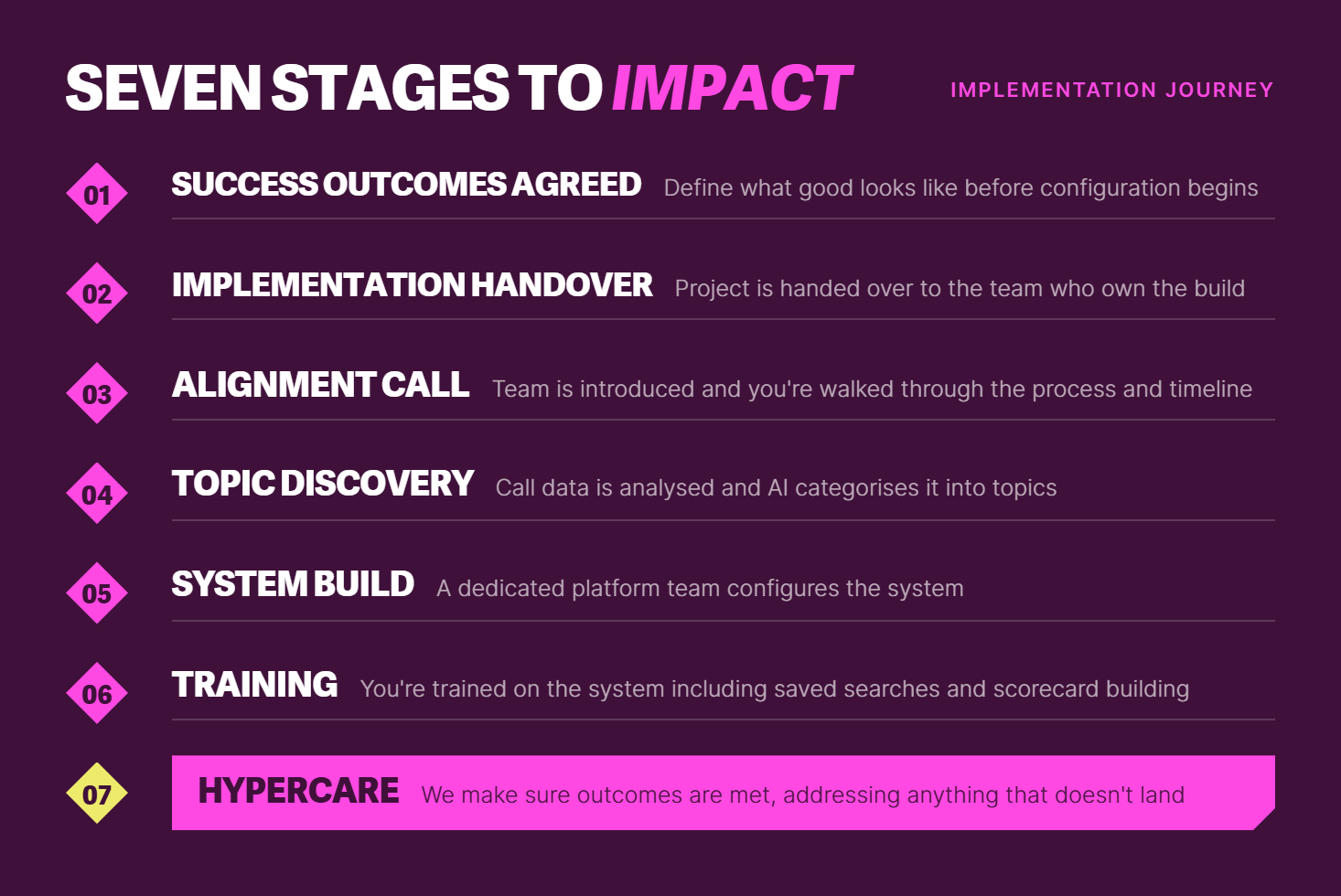
Each stage of implementation exists to reduce risk in the one after it. Skip or rush the discovery stage and it is much harder to prove ROI later on.
Why Topic Discovery changes everything
Topic Discovery is the step most implementations underestimate.
Before any scorecard gets built, Conversation Analytics analyses existing call data and categorises what's being discussed; the topics, phrases, and patterns from actual interactions, rather than what a team assumes is happening based on memory or anecdote. Scorecard criteria built on that foundation reflects the calls you're actually having, which shows up directly in how reliable the Auto QA scoring ends up being.
Conversation Analytics: Realistic results and timelines
One question most people ask is how quickly you'll see a return. Efficiency improvements are different from quality improvements, and the two don't follow the same timeline.
Efficiency gains are immediate
Review time drops from day one. This part is structural rather than something that builds up gradually. As soon as scoring is live, review time falls from around 30 minutes per call to somewhere in the 2-5 minute range, depending on call complexity.
The results across our customer base are consistent:
- An automotive contact centre reduced QA review time from 30 minutes to approximately two minutes per call, seeing a 93% reduction
- An education provider reduced call review time from 30 minutes to three minutes, a 90% reduction
- A BPO running Auto QA across 45 client scorecards confirmed 83-84% of QA tasks as automatable
Broader QA improvement takes longer.
Broader improvements, such as compliance rates shifting or call quality lifting across the board, take longer to show up, and the exact timeline varies by customer size and sector. Based on what we've seen so far, a window of roughly 4-6 weeks is a reasonable starting expectation, though this depends on how much call volume you're scoring and how quickly coaching conversations are acted on. The platform creates visibility; but what your team does with it determines the pace.
ICX moved from time-intensive manual call reviews to surfacing compliance issues as they happened, and then used that visibility to build a smarter coaching programme. Read the ICX Conversation Analytics case study.
What mature Auto QA looks like in practice
Most operations start with the efficiency win; faster reviews, full call coverage, and that's the right place to start. The difference in mature operations is what happens to the output after scoring, not the scoring itself.
In regulated environments such as financial services, insurance and debt collection, that means treating Auto QA output as compliance evidence rather than a coaching tool that happens to also help with audits. Every scored call becomes part of a documented trail covering the whole call population, which is a different proposition to a QA reviewer's sample.
For sales and collections teams, the same principle plays out differently: Conversation Analytics surfaces objection handling patterns and sentiment shifts through a call, showing which phrases and approaches tend to show up in calls that convert.
In both cases, the output only earns its value once someone's acting on it. Scoring feeds regular coaching conversations, compliance drift gets caught before it embeds itself, and team leads use the platform directly rather than waiting on a report from someone else. That level of adoption tends to build during training, as teams get more comfortable acting on what the data's telling them.
What to look for when evaluating a Conversation Analytics platform
Not all conversation analytics and quality assurance software works the same way. The differences that matter most aren't always visible in a demo. These are the questions worth asking before you commit.
Is scoring evidence-backed or black-box?
Some tools return an AI-generated score without showing what produced it. That's a problem the moment you need to defend a QA decision in a coaching conversation, a compliance audit, or to a regulator directly. A score should link back to the exact transcript exchange behind it.
Can you build scorecards without technical configuration?
Defining scorecard criteria in plain English, rather than through keyword rules or technical logic, determines how quickly your QA team can build, test, and refine scoring frameworks without depending on vendor support. It also determines how well scoring reflects the nuance of real conversations.
Does the platform distinguish between selective scoring and always-on coverage?
As covered above with AI Call Scoring and Auto QA at Scale, this isn't just semantics. For regulated contact centres, the distinction has direct compliance implications, and it's worth confirming which one you're actually being sold.
Is human oversight built in?
Auto QA should support your QA team. Reviewers need to be able to question outputs, challenge scores, and recalibrate criteria as things change. The governance stays with the people who understand the operation.
What does implementation actually look like?
How success outcomes are defined, how Topic Discovery informs scorecard build, what training and hypercare look like; these are worth asking of any vendor you're evaluating. Implementation is where the gap between a platform that delivers and one that doesn't usually opens up.
Ready to see it in action?
The difference between a speech analytics rollout that delivers and one that disappoints rarely comes down to the technology itself; it usually comes down to how it's implemented, how success gets measured, and how quickly a team turns what it's shown into something it acts on.
MaxContact combines Conversation Analytics, AI Call Scoring, Auto QA at Scale, Topic Discovery, training, and ongoing Customer Success support in a structured implementation process built around that. Whatever you're trying to fix, whether it’s QA workload, call coverage, compliance monitoring, or getting more out of the conversations you're already having, we'll work with you to define what success looks like and build toward it.
Book a demo to see how Conversation Analytics and Auto QA work in practice.

How do consumers actually feel about AI in customer engagement?
As more UK businesses cut contact centre jobs in favour of AI, we asked over 1,000 UK consumers where they actually want automation - and where they still expect a human. The answers aren't as simple as "customers are moving online."
A major UK utility provider announced this week that it's cutting 1,300 jobs, leaning harder into AI and digital service. It won't be the last business to make this call, and it's not the first either. Across most industries right now, there's a version of the same bet being placed: that customers are ready to swap people for bots.
Our sales team has had some version of this conversation with almost every customer and prospect this week. The question underneath it is always the same - should we be doing this too?
"It's the question everyone's asking right now," says Richard Langham, VP of Sales at MaxContact. "Listening to your customers is exactly the right instinct. The mistake is assuming what worked for one business, in one industry, applies everywhere else. Consumer behaviour isn't uniform, and neither are the moments that matter to people. Before following someone else's playbook, it's worth checking what your own customers think - not what another sector's did."
We put that question to the public directly. Our Voice of the UK Consumer 2026 report surveyed over 1,000 UK consumers on exactly this: where do you want AI, and where do you want a human? The answers are more specific, and more useful, than "customers are moving online."
Consumers draw a hard line on where AI belongs
We asked people which situations they'd want to keep AI out of entirely. They were clear. Over half (54%) don't want AI anywhere near an emergency. Half say the same for complex account problems. Financial discussions (49%) and negotiating terms (46%) aren't far behind.
Flip the question and ask where a human matters most, and you get the same answer from the other direction: emergencies top the list at 41%, then complex account queries (33%), financial discussions (29%), and explaining something personal or sensitive (26%).
These situations are more common than they might sound. A missed bill. A bereavement. A boiler packing in over winter. Someone explaining a difficult situation to a company for the first time. Contact centres deal with moments like these every single day - and our data says people want a person on the other end when it happens.
AI has its place
There's real appetite for automation where it's genuinely useful: answering FAQs, routing calls, pulling up account updates. People are happy to let a bot handle the boring stuff.
There's even one situation where AI wins outright: talking to a lender about financial difficulty. More people choose AI here than a human agent. But when you dig into why, it's not enthusiasm for the technology - it's privacy. People find it easier to admit they're struggling to a screen than to a person. That's not proof consumers prefer bots. It's proof they want to avoid judgement.
Listen to your own customers, not someone else's headline
"A telecoms customer, an insurance customer and an energy customer don't necessarily feel the same way about AI," Langham says. "What one industry can get away with, another can't. What worked for one company's customer base might land completely differently with yours."
Here's what to get right before making any move on the back of someone else's numbers:
- Check your own data before borrowing someone else's conclusion - a drop in call volume tells you what stopped happening, not why, and not whether it's safe to read as "customers don't want people anymore."
- Keep the human path open exactly where our data says it counts - emergencies, complex issues, money problems, anything personal. These are the situations where AI is least welcome, and where getting it wrong does the most damage to trust.
- Tell people when they're talking to AI - 88% of consumers say this matters, half calling it very important. If AI is handling more of your first-line contact, being upfront about it isn't optional. It's what keeps trust intact.
- Moving contact online doesn't close the trust gap on its own. Keeping a human reachable for the moments people care about most does, and knowing which moments those are for your customers - not someone else's - is the bit worth getting right.
If you're weighing up a similar decision, don't do it on assumptions borrowed from a headline. Get the full picture - including sector-by-sector breakdowns for utilities, telecoms, finance/debt and insurance - in our Voice of the UK Consumer 2026 report. Download here.