What Is An Outbound Call? Call Centre Best Practices
If you’re an outsourced contact centre dealing with high-volume calls, outbound calling campaigns are vital for driving business growth, acquiring new customers, and nurturing existing relationships. However, executing an effective outbound strategy requires careful planning, the right tools, and a deep understanding of best practices.
In this guide, we’ll explore the essential elements for mastering outbound calling in your call centre.
What Are Outbound Calls?
Understanding the different types of outbound calls before turning your attention to strategy is crucial. The various objectives behind outbound calling initiatives are important to consider:
Sales and Lead Generation: The bread and butter of outbound efforts are often sales calls and lead qualification, whether it’s cold calling for new business or upselling/cross-selling to existing customers.
Market Research: Outbound surveys provide invaluable market intelligence, gathering insights into consumer behaviour, product feedback, and industry trends.
Customer Experience: Proactive outreach can enhance the customer experience by addressing issues before they escalate and gauging satisfaction through post-transaction surveys.
While the specific goals may differ depending on use cases, successful outbound strategies share a common foundation: aligning the right tactics to your unique business needs.
What Can a Strong Outbound Calling Strategy Achieve?
A well-planned outbound strategy, coupled with the right technology, can significantly benefit your business:
| Boost brand awareness and lead generation | Proactively reach a wider audience, introduce your brand, and generate a pipeline of qualified leads. ||-------------------------------------------------------|---------------------------------------------------------------------------------------------------------------------------------|| Strengthen customer relationships and drive retention | Nurture existing relationships with personalised outreach, exclusive promotions, and addressing potential concerns. || Gather valuable market research and sales data | Conduct market research to gain insights into customer preferences and buying habits, ultimately giving you a competitive edge. || Targeted communication for specific campaigns | Execute targeted campaigns for customer satisfaction surveys, new product launches, and more. |
Optimising Call Centre Technology: Inbound vs. Outbound
While the right technology is crucial for both inbound and outbound calls, their needs differ. Inbound centres focus on agent workflow and empowering customers (think IVR and call routing). Outbound centres prioritise lead generation and call efficiency (think predictive dialers and ACD). For centres handling both, a comprehensive, integrated solution is key.
Make Outbound Calling Successful with Powerful Technology
We’ve established that the right contact centre software is make or break when it comes to outbound calling. But which features and capabilities should you prioritise if you’re looking to boost results of your outbound campaigns?
Auto Diallers: Boost agent productivity with an outbound dialler that connects them directly to live prospects, eliminating wasted time on unanswered calls.
Call Recording: Use call recordings to identify coaching opportunities and help agents refine their communication skills and objection handling techniques.
CRM Integration: Painless CRM integration provides agents with a centralised view of customer information, enabling personalised conversations and stronger relationships.
Automatic Call Distribution (ACD): Intelligent call routing means every call is directed to the most qualified agent based on skills, language proficiency, and availability.
Answer Machine Detection (AMD): Avoid wasted time on answering machines by using AMD technology to identify and skip over voicemails.
Dynamic Call Scripting: Empower agents with flexible, interactive call scripts that can adapt to each conversation while maintaining consistency and accurate data capture.
Outbound Skills-Based Routing: Match customers with agents who possess the most relevant expertise, encouraging rapport and efficient resolution.
Data Management: Use data segmentation tools to target the right audience and prioritise contacts most likely to convert, optimising your outreach efforts.
Outbound Calling Best Practices
When it comes to outbound activity, utilising the right technology alone isn’t enough. Successful outbound strategies also rest on implementing proven best practices:
Planning and Preparation
Clearly define campaign objectives and target your call lists to match.
Develop call scripts that act as flexible conversation guides, not rigid scripts.
Ensure compliance with relevant regulations, such as obtaining necessary consent.
Agent Skills and Training
Refine agents’ communication abilities, focusing on active listening, empathy, and objection handling.
For sales campaigns, provide comprehensive product knowledge training.
Measuring Your Outbound Calling Performance
Measuring the success of outbound calling must look beyond the number of calls made. Tracking relevant KPIs helps you to achieve two things. Firstly, it gives you valuable insights that enhance the effectiveness of your campaigns. Secondly, it empowers you to make data-driven decisions for continuous improvement.
Key KPIs to Track for Outbound Calling Success
Here are some of the essential KPIs you should monitor to gain a comprehensive understanding of your outbound calling performance:
Connect Rate: Measure the percentage of your outbound calls that reach live prospects. A high connect rate indicates efficient dialling strategies and minimal wasted time on busy signals or unanswered calls.
Average Handle Time (AHT): Track the average duration of your outbound calls. While a lower AHT might seem ideal, it’s important to consider the context of your campaign goals. For example, a complex sales call might naturally have a higher AHT compared to an appointment scheduling call.
Conversion Rate: This is the golden metric for many outbound calling campaigns. Measure the percentage of calls that achieve your desired outcome, such as a completed sale, appointment booked, or survey completion.
First Call Resolution (FCR): Track the percentage of customer issues resolved during the initial call. A high FCR indicates efficient problem-solving by your agents and minimises the need for frustrating callbacks for customers.
Customer Satisfaction Ratings: Customer feedback is invaluable. Regularly monitor customer satisfaction ratings to gauge their perception of your outbound calling experience. Positive ratings indicate a well-executed strategy, while negative feedback highlights areas for improvement.
Enhance your outbound calls with MaxContact
Successful outbound calling is a continuous process. By acting on the insights gained from tracking KPIs and consistently refining your approach based on data and best practices, you can transform your outbound calling operation so that your activity consistently delivers exceptional results.
MaxContact is a leading provider of outbound call software, combining powerful diallers with reporting, AI, and optimisation tools. Our cloud-based outbound solution can simplify your call centre operations and boost productivity.
(() => {
const run = () => {
const rich = document.querySelector('#rich-text');
const toc = document.querySelector('#toc');
if (!rich || !toc) return;
const headings = rich.querySelectorAll('h2');
if (!headings.length) {
toc.style.display = 'none';
return;
}
const slugCounts = Object.create(null);
const slugify = (str) => {
const base = (str || '')
.trim()
.toLowerCase()
.normalize('NFD').replace(/[\u0300-\u036f]/g, '')
.replace(/[^a-z0-9\s-]/g, '')
.replace(/\s+/g, '-')
.replace(/-+/g, '-');
const n = (slugCounts[base] = (slugCounts[base] || 0) + 1);
return base ? (n > 1 ? `${base}-${n}` : base) : `section-${n}`;
};
// Build TOC off-DOM
const frag = document.createDocumentFragment();
for (let i = 0; i < headings.length; i++) {
const h = headings[i];
const text = (h.textContent || '').trim() || `Section ${i + 1}`;
if (!h.id) h.id = slugify(text);
const a = document.createElement('a');
a.href = `#${h.id}`;
a.className = 'content_link is-secondary';
a.dataset.target = h.id;
a.setAttribute('aria-label', text);
const p = document.createElement('p');
p.className = 'text-size-small';
p.textContent = text;
a.appendChild(p);
frag.appendChild(a);
}
// Single DOM update
toc.innerHTML = '';
toc.appendChild(frag);
toc.addEventListener('click', (e) => {
const link = e.target.closest('a.content_link[href^="#"]');
if (!link) return;
e.preventDefault();
const id = link.getAttribute('href').slice(1);
const target = document.getElementById(id);
if (!target) return;
// Only compute layout once
const targetTop = target.getBoundingClientRect().top + window.scrollY;
const finalY = targetTop - 150;
window.scrollTo({ top: finalY, behavior: 'smooth' });
history.replaceState(null, '', `#${id}`);
}, { passive: false });
};
// Webflow-safe “run after everything is ready”
if (window.Webflow && Webflow.push) {
Webflow.push(() => requestAnimationFrame(run));
} else {
document.addEventListener('DOMContentLoaded', () => requestAnimationFrame(run));
}
})();
related articles
you might also like
Our articles and industry insights give you expert perspectives, practical strategies, and the latest trends to help your business connect smarter and perform better.
Blog
September 29, 2025
Three-quarters of customer-facing workers facing imminent burnout
(() => {
const WORDS_PER_MINUTE = 200;
const MULTIPLIER = 1; // your choice
const estimateMinutes = (el) => {
if (!el) return null;
const text = (el.innerText || el.textContent || "").trim();
if (!text) return 1;
const words = (text.match(/\S+/g) || []).length;
const baseMinutes = Math.max(1, Math.ceil(words / WORDS_PER_MINUTE));
return Math.max(1, Math.ceil(baseMinutes * MULTIPLIER));
};
const findNearestTargetInItem = (itemRoot, rt) => {
if (!itemRoot) return null;
return itemRoot.querySelector('.is-text');
};
const applyWithin = (root) => {
// More forgiving selector: attribute present or equals "true"
root.querySelectorAll('[data-rich-text], [data-rich-text="true"]').forEach((rt) => {
const itemRoot =
rt.closest('[role="listitem"]') ||
rt.closest('.w-dyn-item') ||
rt.parentElement ||
root;
const target = findNearestTargetInItem(itemRoot, rt);
if (!target) return;
const mins = estimateMinutes(rt);
if (mins != null) target.textContent = `${mins} MIN READ`;
});
};
const init = () => {
applyWithin(document);
// Re-apply on dynamic changes (pagination/filters)
const mo = new MutationObserver((mutations) => {
for (const m of mutations) {
for (const n of m.addedNodes) {
if (!(n instanceof Element)) continue;
if (
n.matches('[data-rich-text], [data-rich-text="true"], [role="list"], .w-dyn-items, .w-dyn-item') ||
n.querySelector?.('[data-rich-text], [data-rich-text="true"]')
) {
applyWithin(n);
}
}
}
});
mo.observe(document.body, { childList: true, subtree: true });
};
// Robust bootstrapping
if (window.Webflow && Array.isArray(window.Webflow)) {
window.Webflow.push(init);
} else if (document.readyState === 'loading') {
document.addEventListener('DOMContentLoaded', init, { once: true });
} else {
// DOM is already ready; run now
init();
}
})();
Whether you’re looking to supercharge sales, streamline debt collection, or elevate customer service, the right outbound dialler can redefine how you connect and communicate. So, continue reading to learn more about automated diallers and discover the potential they hold for your contact centre’s success
So, what’s an outbound dialler?
Put simply, outbound dialling is the process of making calls to customers or contacts, typically for sales or marketing purposes.
While outbound dialling can be performed manually on a mobile or business phone, this is not practical when dealing with a high volume of calls. A range of additional features can enhance outbound calling in a contact centre setting through the use of an automated dialler.
What does an outbound dialler do?
An outbound dialler is generally a cloud or software solution that automatically dials phone numbers and makes calls on behalf of your sales, collection or customer service teams. As such, it’s an essential ingredient in any organisation where you need to make outbound calls to clients and prospects throughout the day.
What are the different types of call centre diallers?
The main options are a manual dialler and an auto dialler.
Manual Dialler
A manual dialler is like a traditional phone. A call agent manually dials numbers from a call list, one after another.
Auto Dialler
As the name suggests, an auto dialler automates much of the dialling process. It digitally dials numbers, and can also dial multiple numbers at once, passing answered calls to available agents.
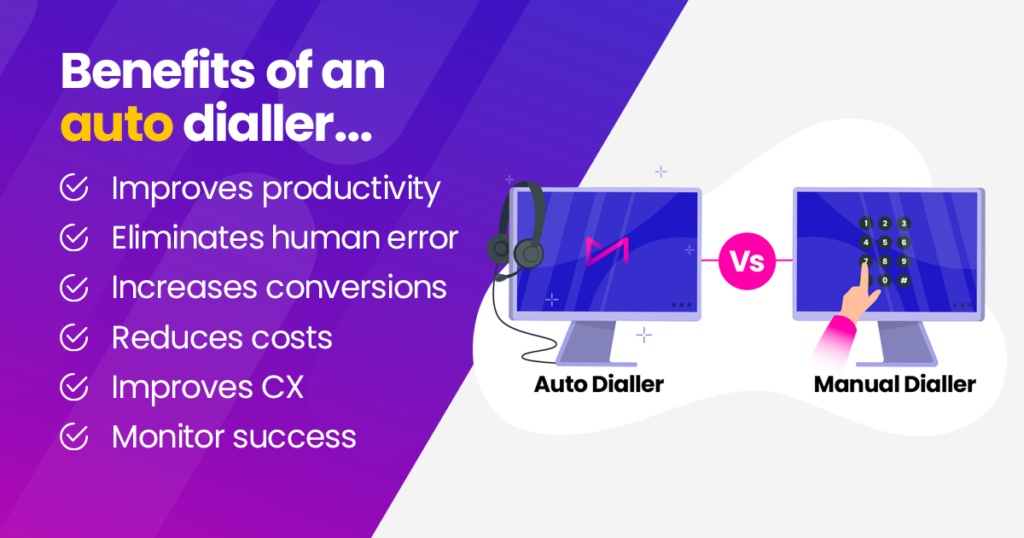
Manual vs Auto Dialler
Why would you choose one over another? Most call centres now opt for auto dialling, because it significantly boosts productivity. Agents spend more time talking to customers and less time dialling unresponsive numbers.
Manual dialling can still be useful, but only for campaigns involving a small number of high value customers who demand a more personal approach.
The different outbound dialler modes
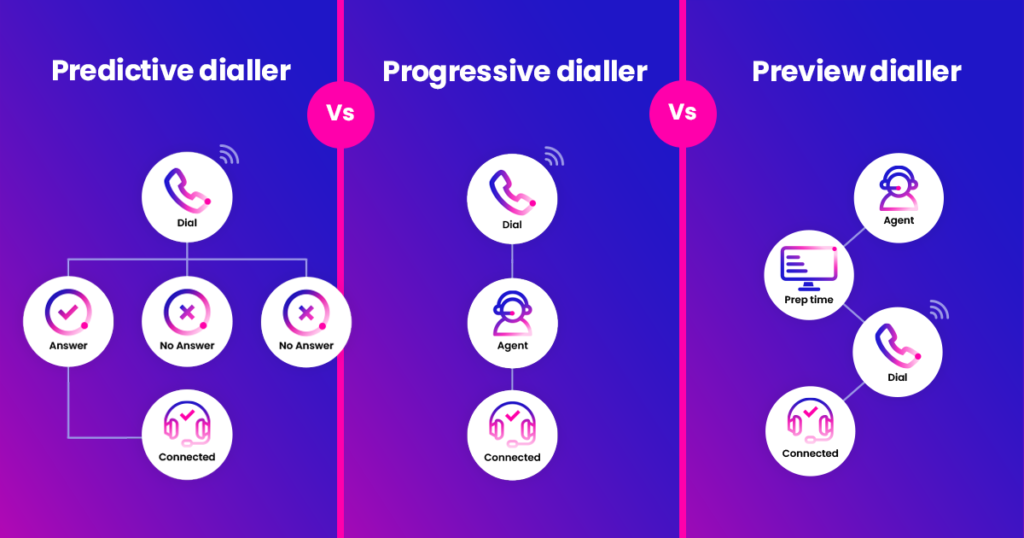
If you’re using an auto-dialler, there are likely three dialler modes that you’ll frequently use, depending on the type of outbound calling you are doing. These are predictive diallers, progressive diallers and preview diallers.
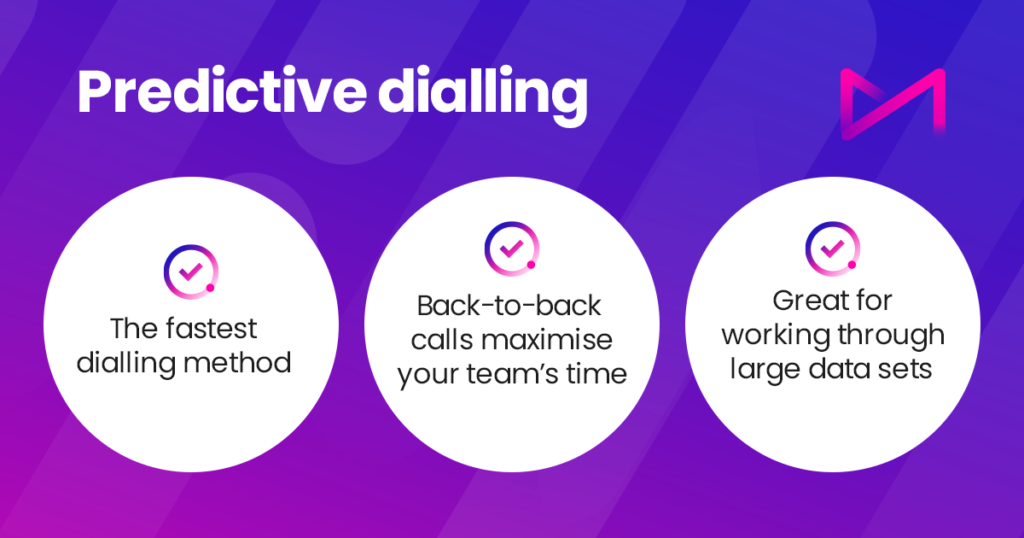
What is it? When most people think of outbound dialling software, they tend to think of predictive dialling. Predictive dialling places calls based on the software’s predictions of agent availability. It dials multiple numbers simultaneously, so that when agents finish one call they can be instantly connected to the next.
What are the benefits? The best predictive diallers minimise abandoned calls (and the amount of time customers spend on hold) and maximise the time your agents spend having conversations. When should I use it? Predictive dialling is the standard for straightforward, high volume sales campaigns (like commodity sales) or debt collection activity.
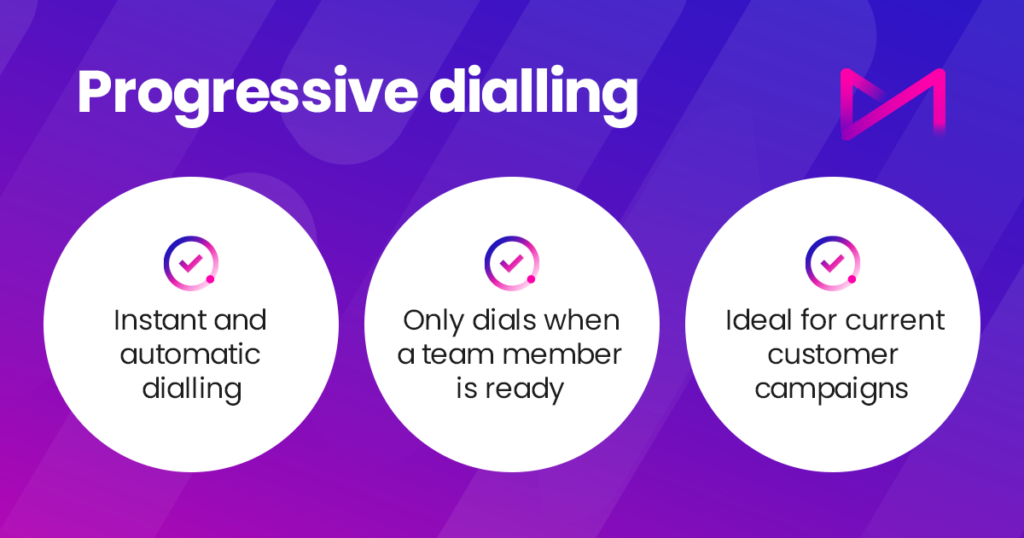
What is it?Progressive diallers are predictive diallers that slow the pace down by only dialling a number when an agent is available to take the call. Dialling is instant and automatic, so the system still allows for a relatively high number of calls.
What are the benefits? Progressive dialling eliminates the risk of customers abandoning calls or waiting a frustratingly long time before being connected to an agent. Because an agent is always available, the customers you have painstakingly nurtured over a period of time feel valued and importan
When should I use it? It is often used in campaigns that target current customers. It’s a low risk option that can improve customer experience and effectively help agents upsell additional products and services.
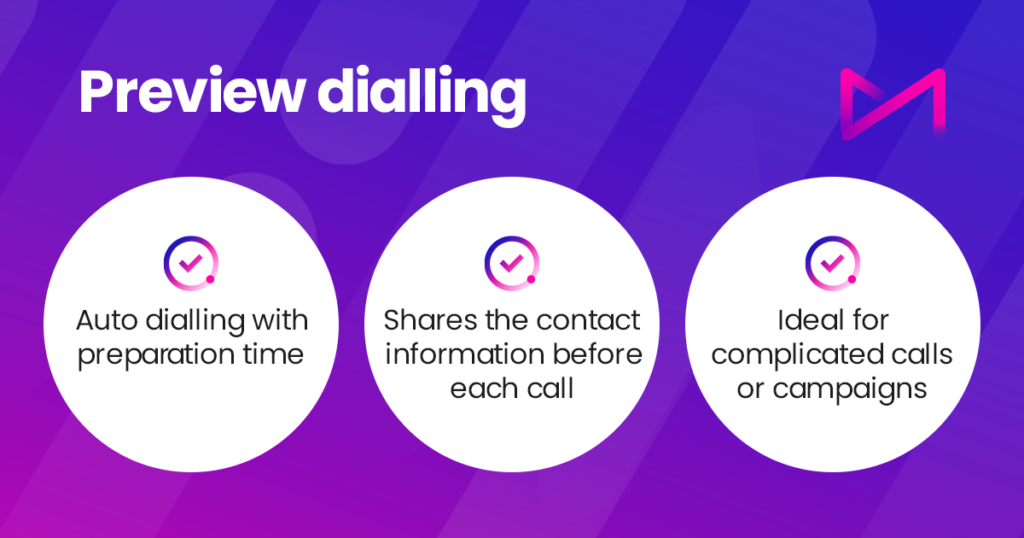
What is it? A preview dialler takes the pace down another notch. When an agent indicates availability, information about the next call is sent to the agent for preview.
After a set amount of time – say, one minute – the number is automatically dialled. This delay lets the agent prepare for the call, using information typically taken from the company CRM system – which are often integrated into the dialler.
What are the benefits? Agents can have more in-depth, focused conversations, based on a customer’s real experiences and challenges. It can improve customer experience and increase the number of positive outcomes.
When should I use it? Preview diallers are particularly helpful when the reason for the call is complex or sensitive. For example, following up with web leads or dealing with customer complaint calls.
Outbound diallers can be integrated into many industries. Any company with an outbound contact centre who are cold calling or making high volume phone calls can benefit from outbound dialler software.
Power up your sales teams
Sales campaigns are often high volume and low touch. Predictive dialling is the gold standard for straightforward, high volume outbound campaigns (like commodity sales). It can quickly and efficiently work through large datasets, making sure leads are contacted while they’re still warm.
The best predictive diallers minimise abandoned calls (and the amount of time customers spend on hold) and maximise the time your agents spend having conversations. They can be set to play messages if they meet an answerphone, and will recycle numbers (placing unanswered calls back into the call queue) in a way that ensures your customers or leads are contacted, but never pestered.
The right outbound dialler can make selling straightforward by helping to connect your sales people to the right customers at the right time. Combined with the contact centre-specific features mentioned earlier, it can offer powerful tools for contacting customers, winning business and exceeding customer expectations.
Increase debt collection rates
Your credit and debt resolution teams can use effective targeting to reach priority customers at times that suit them. Maximise collection rates using advanced data segmentation and encourage self-serve with automated communications. Automate payments with self-serve options providing customers choice and improving satisfaction.
Preview diallers are particularly helpful when the reason for the call is complex or sensitive. For example, debt collection calls are more likely to end positively if agents have the time to gather all the information they need beforehand.
Elevate your customer service teams
Customer service teams often use progressive dialling to target current customers with after sales information or courtesy communications. It’s a low risk option that can improve customer experience, help nurture loyalty and effectively help agents upsell additional products and services. Because an agent is always available to have a conversation, the customers you have painstakingly nurtured over a period of time feel valued.
5 must-have outbound dialler features
Answer Machine Detection (AMD)
Answer Machine Detection (AMD) lets your auto-dialler software identify answering machines before connecting calls to agents. This means agents only spend time on live conversations, saving them valuable time and boosting productivity.
AMD is particularly helpful for high-volume sales campaigns where every minute counts. MaxContact’s AMD boasts a 90% success rate in detecting answering machines, freeing up agents to focus on reaching real people.
Speech analytics
Forget manually reviewing call recordings! Speech analytics uses AI to analyse every conversation, automatically identifying customer sentiment, call quality, and agent performance. This lets you:
Spot frustrated or vulnerable customers who need extra care.
Ensure agents follow compliance guidelines.
Understand what customers are saying about your products and competitors.
Speech analytics gives you valuable insights from all calls, not just a select few. It saves time and helps you improve the overall performance of your contact centre.
A secure payment manager
A secure payment IVR gives customers the payment options they want, while giving teams the time they need to deal with more complex or sensitive cases.
Payment automation helps you speed up debt collection and improve cash flow. When you give customers more convenient ways to pay, they’re more likely to stick to payment schedules.
MaxContact’s payment IVR is fully PCI compliant, protecting customer information at all times. We offer both assisted payments, in which staff safely guide customers through the payment process, and automated payments, which are fully self-serve and available 24/7.
Analytics and reporting
You can only improve contact centre performance when you can measure it. When you’ve done that, you need to present the data in a way that is easy to understand and act on. That’s where analytics and reporting come in.
MaxContact’s pre-configured reporting gives you complete visibility around productivity, issue resolution rates, revenue and customer satisfaction, to name just a few. You can set targets for campaigns, channels, teams and agents and track performance over time.
All teams – sales, service and debt resolution – benefit from better information. Pre-configured reports give you the data you need in the quickest and most hassle-free way.
Easy integration
A powerful dialler is even better when it works hand in hand with your existing systems. Imagine a sales agent having instant access to customer history, preferred contact methods, and past feedback – all within the dialler interface (thanks to CRM integration).
This allows for personalised conversations that address specific needs, leading to happier customers and improved outcomes. Easy integration applies to after-sales and debt resolution teams too. By connecting your dialler with other systems, you can put all relevant information at agents’ fingertips, reducing hold times and boosting overall efficiency.
The benefits of auto-dialler software you can’t ignore
Improve contact centre metrics like AHT
Average Handling Time (AHT) is a calculation based on the time agents spend talking to a customer, the amount of time callers are on hold and the time taken on follow up tasks, divided by the number of calls handled. The lower your AHT, the better. It means you can handle more calls, improve efficiency and reduce costs. A good dialler can improve AHT and a host of other contact centre metrics, by allowing agents to handle more calls, more efficiently.
Excel at sales and debt collection
Whether it’s sales or debt collection, the best results happen when good agents talk to customers. Whether it’s a high volume, low touch sales campaign, or more sensitive debt resolution calls, the right dialler means your agents spend more time in conversation with customers, and less time processing unanswered calls or connecting to answering machines.
Keep your contact centre compliant
A powerful predictive dialling algorithm speeds up and slows down depending on the conditions in your contact centre. If fewer agents are available, the dialling slows down, helping to ensure you stay within compliant boundaries for abandoned and dropped calls. Or you can switch to progressive or preview modes for more personal contacts. The dialler can also ensure that the frequency of calls to a contact never exceeds official limits.
Seamlessly integrate with your CMS
A dialler that integrates with your CMS system is a huge advantage. It means that the systems feed information to each other, so your agents always have the details of previous contacts at their fingertips. That reduces the risk of customers becoming annoyed by having to repeat information they’ve already previously given. It can also provide insights into customer satisfaction rates, preferred times and methods of communication and so on.
These companies boosted performance with auto diallers
We worked with these companies to replace ageing systems with modern cloud-based diallers – and the results are impressive.
Compare My Insurance
Compare My Insurance is one of the largest independent insurance and protection specialists in the UK. But dialler downtime, data issues and missed opportunities were hampering the business.
MaxContact’s dialler solution integrated seamlessly with the company back office systems. It has significantly increased contact rates while providing complete transparency around performance and progress.
APJ Solicitors
APJ Solicitors, a leading financial mis-selling specialist, needed to increase call volumes and boost efficiency, but its basic VOIP phone system was no longer up to the task.
MaxContact’s solution increased call volumes by 110% in the first year, and improved average agent call efficiency by 36%. Productivity has risen five fold over the company’s previous solution.
Improve your call centre performance with MaxContact
MaxContact offers the most sophisticated outbound dialler currently available. This continually improving cloud-based dialling solution gives you the flexibility to run your contact centre your way, letting you choose the right blend of productivity and compliance for your business needs. With over a 1,000 unique features, MaxContact’s outbound dialler helps meet your contact centre challenges in new and powerful ways.
Contact centres can be high-pressure environments, with plenty of challenges to tackle; managing customer interactions, staying compliant and helping agents perform at their best, to name a few. That’s where speech analytics comes in.
(() => {
const WORDS_PER_MINUTE = 200;
const MULTIPLIER = 1; // your choice
const estimateMinutes = (el) => {
if (!el) return null;
const text = (el.innerText || el.textContent || "").trim();
if (!text) return 1;
const words = (text.match(/\S+/g) || []).length;
const baseMinutes = Math.max(1, Math.ceil(words / WORDS_PER_MINUTE));
return Math.max(1, Math.ceil(baseMinutes * MULTIPLIER));
};
const findNearestTargetInItem = (itemRoot, rt) => {
if (!itemRoot) return null;
return itemRoot.querySelector('.is-text');
};
const applyWithin = (root) => {
// More forgiving selector: attribute present or equals "true"
root.querySelectorAll('[data-rich-text], [data-rich-text="true"]').forEach((rt) => {
const itemRoot =
rt.closest('[role="listitem"]') ||
rt.closest('.w-dyn-item') ||
rt.parentElement ||
root;
const target = findNearestTargetInItem(itemRoot, rt);
if (!target) return;
const mins = estimateMinutes(rt);
if (mins != null) target.textContent = `${mins} MIN READ`;
});
};
const init = () => {
applyWithin(document);
// Re-apply on dynamic changes (pagination/filters)
const mo = new MutationObserver((mutations) => {
for (const m of mutations) {
for (const n of m.addedNodes) {
if (!(n instanceof Element)) continue;
if (
n.matches('[data-rich-text], [data-rich-text="true"], [role="list"], .w-dyn-items, .w-dyn-item') ||
n.querySelector?.('[data-rich-text], [data-rich-text="true"]')
) {
applyWithin(n);
}
}
}
});
mo.observe(document.body, { childList: true, subtree: true });
};
// Robust bootstrapping
if (window.Webflow && Array.isArray(window.Webflow)) {
window.Webflow.push(init);
} else if (document.readyState === 'loading') {
document.addEventListener('DOMContentLoaded', init, { once: true });
} else {
// DOM is already ready; run now
init();
}
})();
By recording and transcribing 100% of customer conversations, analysing sentiment, categorising topics and ranking agent performance, speech analytics helps contact centre leaders uncover actionable insights, make smarter decisions and optimise business operations.In this article, we’ll explore 10 practical ways our speech analytics platform can be used to transform the way contact centres work. From improving compliance checks to empowering agents and enhancing sales strategies, there’s a lot to gain from this powerful technology.
1. Speeding up call quality assessments
In traditional quality assessments, quality assurance (QA) teams are often required to listen to hundreds of call recordings to evaluate, understand agent-customer conversations, and assess the quality of the call. This manual process is time-consuming, especially for call centres dealing with high call volumes.
Speech analytics speeds up the QA process by transcribing speech-to-text, with every call transcribed into a full text version. Thanks to text transcriptions, QA teams can read through calls – which takes 50% less time than listening to them. This is because QA teams can skip directly to specific points in the conversation that need attention.
By searching within transcripts for specific phrases or keywords, it is much easier and quicker to find sections where issues have arisen, saving significant time but without sacrificing detail.
2. Keyword tracking for compliance
Staying compliant is crucial for contact centres, particularly in industries with strict regulations such as sales, collections, or finance. Agents often need to say specific phrases or mandatory statements during calls – for example, those required by the Financial Conduct Authority (FCA) or Ofcom guidelines.
MaxContact’s Spokn AI makes compliance easier to monitor and achieve, as it can be set up to track and filter certain keywords across all call transcripts. Compliance teams can set up the software to flag calls where those important phrases are missing or not used correctly.
This means you can quickly spot and fix potential compliance issues without spending hours manually checking calls. It’s a simple way to reduce risks, save time, and make sure your team is consistently ticking all the right boxes.
3. Keyword tracking for vulnerability detection
Contact centres need to identify and provide special care for vulnerable customers, such as those who express concerns related to financial or emotional hardship. This is where the ability to search for phrases or mandatory statements across transcripts once again supports the process.
Using speech analytics and keyword filtering, it is possible to detect sensitive language within conversations, flagging words and phrases that may indicate vulnerability. By automating this process, speech analytics software helps agents and supervisors identify potentially vulnerable customers quickly, allowing them to respond with empathy, follow specific support protocols, or even escalate the conversation to a specialist.
This targeted approach improves customer care and means vulnerable individuals receive the assistance they need.
4. Optimising sales playbooks
For sales and collections teams, the ability to handle customer objections effectively can have a huge impact on call outcomes. This is where speech analytics steps in to give agents an edge. By analysing call topics, customer objections and sentiment trends, tools like speech analytics can help call centre supervisors to uncover what’s working (and what’s not) in customer interactions.
Senior call centre leaders can use these insights to tweak call centre scripts, refine sales tactics and even create “battlecards” to tackle competitor comparisons head-on. These resources and insights are then shared with call agents.
On top of that, speech analytics can indicate how call agents respond to objections by looking at phrase level sentiment, helping pinpoint successful techniques and areas for improvement. With these insights, teams can continuously optimise their playbooks, leading to smoother calls, better outcomes and more conversions.
5. Improving agent performance through sentiment analysis
Helping agents improve starts with understanding where they might be struggling or excelling. Sentiment analysis does this by breaking conversations into phrases and identifying words of positive or negative sentiment post-call. It draws attention to areas where an agent might be lacking empathy, patience, or clarity – all key factors that impact how customers feel during a call.
When speech analytics software uncovers calls with high customer frustration or negative sentiment, call supervisors can step in with tailored coaching. Whether it’s working on tone, handling sensitive situations, or improving listening skills, this focused feedback helps agents refine their approach. The result? Happier customers, stronger relationships and call agents who feel more confident.
6. Identifying what works well to amplify success
Improvement is important, but so is recognising what’s already working. Speech analytics helps teams to see moments of positive sentiment in calls, showing where call agents have handled objections and sensitive interactions effectively, striking the right chord with customers.
By considering the ‘why’ behind these successful interactions, managers can uncover tactics, language, or approaches that deliver great results time and time again. These insights can be shared across the team to raise everyone’s game, and they’re also an important resource for marketing or sales teams.
Whether it’s refining scripts or crafting new campaigns, using proven techniques ensures greater consistency and impact across your contact centre.
7. Driving operational efficiencies
Efficiency is key in contact centres, but it shouldn’t come at the expense of quality. Speech analytics helps strike the perfect balance, with tools like call summaries, topic detection and sentiment analysis. These features allow call centre supervisors to identify common call topics and recurring customer issues.
Armed with this data, managers can design targeted training and streamline processes to ensure agents are ready to tackle frequent queries right away. This leads to fewer call transfers and more first-call resolutions, cutting down handling times while boosting customer satisfaction. The outcome is a more efficient operation that saves time, resources and costs – all without compromising on quality.
8. Gaining insight into team dynamics
Understanding your team’s performance isn’t just about numbers or individual performance – it’s about seeing the bigger picture. With speech analytics, call centre managers have a clearer view of overall team performance and can break down calls by agent, objection type or campaign. This level of detail helps uncover collective team performance as well as each agent’s individual strengths and areas where they may need extra support.
By tracking objection trends, comparing metrics across agents and teams, and analysing how individuals handle challenging situations, call centre leaders can make coaching much more targeted. Instead of a one-size-fits-all approach, these data-driven insights allow team leaders to tailor their feedback, helping every agent play to their strengths while improving in areas where they struggle. This leads to a more skilled, confident and well-rounded team.
9. Empowering agents to self-improve
Speech analytics isn’t just a tool for managers – it’s also a powerful way to help agents grow and improve. With features like call recaps, sentiment insights, and objection tracking, managers can share clear, objective feedback based on real data from their agents’ interactions.
By providing tailored feedback, managers can help agents spot patterns, identify areas for improvement and refine their skills – whether it’s handling objections more effectively, improving tone, or building stronger rapport with customers.
This personalised coaching creates a sense of accountability and motivates agents to continuously grow.
With clear, actionable feedback, agents can deliver better customer experiences and contribute to the team’s success. Plus, happier, more capable agents are less likely to burn out, which helps reduce turnover and maintain a strong team.
10. Conducting market research to inform growth strategies
Spokn AI is a powerful tool for uncovering what your customers really want. By evaluating recurring topics and sentiment trends across conversations, it helps contact centres build a clear picture of customer needs, preferences and pain points.
With advanced topic detection and transcription capabilities, speech analytics empower businesses to spot emerging trends and patterns that might not be immediately obvious. Whether it’s identifying new product demands, spotting service gaps, or understanding shifts in customer sentiment, these insights are invaluable for shaping future strategies.
This customer-first approach gives contact centres a new-level of visibility into customer information. Often, customer information is recorded in siloed notes (particularly in hybrid working environments) making them inaccessible at a top data level. Speech analytics aggregates and analyses conversations, uncovering actionable insights into sentiment, trends and preferences. This enables businesses to adapt to market changes, create targeted campaigns and design products and services that truly meet customer needs.
Speech analytics is powerful software that makes the way for smarter, more efficient and more impactful operations in your contact centre. By analysing 100% of customer interactions, platforms like Spokn AI offer insights that help tackle the unique challenges of a fast-paced call centre floor, from improving compliance and agent performance to refining sales strategies and uncovering customer needs.
The key to success lies in using these insights to take action: refining processes, tailoring coaching and aligning your strategy with the data. Not only does this lead to better outcomes for your team and business – it also creates a stronger, more positive experience for your customers too.
As customer expectations grow and contact centres become more complex, embracing speech analytics tools can give you the clarity, confidence and competitive edge you need to thrive.
By leaning into the capabilities of speech analytics, you’re not just keeping up; you’re staying ahead.
Blog
5 min read
Invosys and MaxContact Partner to Deliver AI-Enhanced Customer Engagement
MaxContact, an AI-powered customer engagement and contact centre software provider, is excited to announce a strategic partnership with Invosys, a leading provider of secure communications, UCaaS and CCaaS technology solutions.
(() => {
const WORDS_PER_MINUTE = 200;
const MULTIPLIER = 1; // your choice
const estimateMinutes = (el) => {
if (!el) return null;
const text = (el.innerText || el.textContent || "").trim();
if (!text) return 1;
const words = (text.match(/\S+/g) || []).length;
const baseMinutes = Math.max(1, Math.ceil(words / WORDS_PER_MINUTE));
return Math.max(1, Math.ceil(baseMinutes * MULTIPLIER));
};
const findNearestTargetInItem = (itemRoot, rt) => {
if (!itemRoot) return null;
return itemRoot.querySelector('.is-text');
};
const applyWithin = (root) => {
// More forgiving selector: attribute present or equals "true"
root.querySelectorAll('[data-rich-text], [data-rich-text="true"]').forEach((rt) => {
const itemRoot =
rt.closest('[role="listitem"]') ||
rt.closest('.w-dyn-item') ||
rt.parentElement ||
root;
const target = findNearestTargetInItem(itemRoot, rt);
if (!target) return;
const mins = estimateMinutes(rt);
if (mins != null) target.textContent = `${mins} MIN READ`;
});
};
const init = () => {
applyWithin(document);
// Re-apply on dynamic changes (pagination/filters)
const mo = new MutationObserver((mutations) => {
for (const m of mutations) {
for (const n of m.addedNodes) {
if (!(n instanceof Element)) continue;
if (
n.matches('[data-rich-text], [data-rich-text="true"], [role="list"], .w-dyn-items, .w-dyn-item') ||
n.querySelector?.('[data-rich-text], [data-rich-text="true"]')
) {
applyWithin(n);
}
}
}
});
mo.observe(document.body, { childList: true, subtree: true });
};
// Robust bootstrapping
if (window.Webflow && Array.isArray(window.Webflow)) {
window.Webflow.push(init);
} else if (document.readyState === 'loading') {
document.addEventListener('DOMContentLoaded', init, { once: true });
} else {
// DOM is already ready; run now
init();
}
})();
This partnership brings together two innovators focused on transforming customer experience and operational efficiency for contact centres and enterprise teams worldwide.
Invosys has built a reputation for delivering comprehensive technology solutions that enable SMB organisations to streamline communications, accelerate digital transformation, and enhance customer and workforce experiences. From unified communications and telephony to full-featured CCaaS platforms, Invosys Chorus solution helps businesses modernise how they connect, collaborate, and serve customers across channels.
MaxContact empowers contact centres and customer-facing teams with an AI-driven engagement platform designed to turn conversations into measurable business outcomes. With capabilities such as predictive dialling, omnichannel engagement, intelligent routing, and autonomous AI agents, MaxContact enables organisations to scale efficiently while enhancing revenue generation and customer satisfaction.
Through this partnership, Invosys will integrate MaxContact’s AI-driven contact centre capabilities into its portfolio, giving customers a simpler way to combine intelligent engagement with Invosys' secure cloud communications. Together, the two companies will support organisations looking to elevate sales performance, contact centre productivity and customer experience with reliable, cutting-edge technology.
“We’re thrilled to partner with MaxContact to bring even greater capabilities to our customers,” said Jane Anderson, CEO of Invosys. “By combining Invosys’ trusted Chorus communications platform with MaxContact’s AI-driven engagement technology, organisations will be able to deliver more personalised, efficient, and impactful interactions at every touchpoint.”
MaxContact’s leadership echoed the enthusiasm for the collaboration:
“This partnership with Invosys marks a significant step forward in how we help businesses transform their customer engagement,” said Ben Booth, CEO at MaxContact. “Together, we’re giving customers access to a seamless integration of powerful communications and AI-enabled contact centre solutions, helping teams work smarter, handle more conversations and deliver better outcomes for customers and the business.
The Invosys–MaxContact partnership reinforces both companies’ commitment to innovation, scalability and customer success. Organisations leveraging this combined technology stack can look forward to enhanced performance, deeper insights into customer interactions, and a stronger foundation for long-term CX improvement.
For more information about how Invosys and MaxContact are working together to deliver advanced contact centre solutions, contact our team.
Blog
5 min read
Maxcontact 2026 Roadmap: What's Next for AI-Powered Customer Engagement
We reveal our 2026 roadmap, featuring AI agents, conversation analytics, workflow automation, and connected insights to transform customer engagement.
(() => {
const WORDS_PER_MINUTE = 200;
const MULTIPLIER = 1; // your choice
const estimateMinutes = (el) => {
if (!el) return null;
const text = (el.innerText || el.textContent || "").trim();
if (!text) return 1;
const words = (text.match(/\S+/g) || []).length;
const baseMinutes = Math.max(1, Math.ceil(words / WORDS_PER_MINUTE));
return Math.max(1, Math.ceil(baseMinutes * MULTIPLIER));
};
const findNearestTargetInItem = (itemRoot, rt) => {
if (!itemRoot) return null;
return itemRoot.querySelector('.is-text');
};
const applyWithin = (root) => {
// More forgiving selector: attribute present or equals "true"
root.querySelectorAll('[data-rich-text], [data-rich-text="true"]').forEach((rt) => {
const itemRoot =
rt.closest('[role="listitem"]') ||
rt.closest('.w-dyn-item') ||
rt.parentElement ||
root;
const target = findNearestTargetInItem(itemRoot, rt);
if (!target) return;
const mins = estimateMinutes(rt);
if (mins != null) target.textContent = `${mins} MIN READ`;
});
};
const init = () => {
applyWithin(document);
// Re-apply on dynamic changes (pagination/filters)
const mo = new MutationObserver((mutations) => {
for (const m of mutations) {
for (const n of m.addedNodes) {
if (!(n instanceof Element)) continue;
if (
n.matches('[data-rich-text], [data-rich-text="true"], [role="list"], .w-dyn-items, .w-dyn-item') ||
n.querySelector?.('[data-rich-text], [data-rich-text="true"]')
) {
applyWithin(n);
}
}
}
});
mo.observe(document.body, { childList: true, subtree: true });
};
// Robust bootstrapping
if (window.Webflow && Array.isArray(window.Webflow)) {
window.Webflow.push(init);
} else if (document.readyState === 'loading') {
document.addEventListener('DOMContentLoaded', init, { once: true });
} else {
// DOM is already ready; run now
init();
}
})();
In our January product webinar, we shared MaxContact's vision for 2026 and the roadmap that will help businesses turn every customer conversation into revenue-driving outcomes. Led by Kayleigh Tait, Marketing Director, and Conor Bowler, Principal Product Manager, the session revealed how we're evolving our platform to address the challenges contact centres face today.
The Challenges Driving Our Roadmap
Three clear themes dominate conversations with customers across every sector we support:
Costs and customer expectations are rising faster than teams can keep up. Contact centres deal with higher expectations, more channels, and greater variability in customer behaviour. The volume of complex interactions continues to increase as routine queries shift to automation.
Data and insight remain fragmented. When information sits in disconnected systems, fixing problems becomes guesswork. Teams need unified visibility to make confident decisions in real time.
Organisations know AI can help but don't know where to start. The gap between AI adoption intentions and actual implementation remains significant. Businesses need clear, practical pathways to AI deployment with proven ROI.
Our Product Vision: Maximising Every Moment
MaxContact's 2026 roadmap centres on three interconnected pillars that work together to deliver smarter contact strategies:
Intelligent Automation: AI handles routine, high-volume interactions automatically, allowing human agents to focus on conversations that require empathy, judgement, and relationship-building. This includes both voice and digital AI agents that can manage everything from FAQs to payment arrangements.
Smart Operations: Workflow automation, real-time agent assistance, and predictive routing ensure teams operate at peak efficiency. We're building capabilities that reduce manual effort, eliminate context-switching, and help agents deliver better outcomes in every interaction.
Connected Insight: Conversation analytics, quality management, and unified reporting transform customer conversations into clear, actionable insight. Teams can understand what's driving performance, identify compliance risks, and make data-backed decisions across the entire operation.
2026 Roadmap Highlights
Q1 2026: Foundation and Enhancement
The year begins with significant updates to our core capabilities. AI Agent functionality expands to chatbot channels, enabling businesses to automate digital conversations with the same sophistication they've experienced with voice agents. Conversation analytics introduces custom scorecards, allowing teams to measure what matters most to their specific operations.
AI Assist Notes delivers quick post call notes cuts down after call admin, whilst enhanced dashboard manager gives teams clearer visibility into performance.
Q2 2026: Real-Time Assist and Advanced Routing
The new Interaction Routing capabilities allow sophisticated inbound flow management, moving interactions between queues based on real-time conditions.
Real-time agent assist features provide agents with instant guidance, next-best-action recommendations, and contextual information during live conversations.
Q3 2026: Predictive Intelligence and Quality Automation
The third quarter introduces behavioural driven workflows that responds to signals and customer context. Further quality management automation reduces the manual effort required for call scoring and compliance monitoring whilst improving accuracy and consistency.
Portfolio integration brings all products—Contact Centre, Conversation Analytics, AI Agents, and AI Chatbot—into a single view, providing business-wide insight into customer engagement performance.
Q4 2026: Agentic AI and Self-Optimising Systems
The final quarter of 2026 begins to deliver the most transformative capabilities. Agentic AI orchestration enables AI agents to work together, handling complex, multi-step processes and hand over to a person where required.
Self-optimising workflows (in development in Q4 2026 and into 2027) use machine learning to continuously improve processes based on outcomes, reducing the need for manual tuning.
Built for Real-World Impact
Every roadmap item addresses a specific customer challenge. The AI agent features, for example, solve the pressure sales and collections teams face to hit outcomes with fewer resources. The conversation analytics enhancements help teams move beyond guesswork when diagnosing performance issues.
Design Partner Programme: Shape What's Next
MaxContact is actively seeking design partners who want early access to new features and the opportunity to influence product development. Design partners receive priority availability, direct access to the product team, and the chance to solve their specific challenges with cutting-edge capabilities before general release.
A Platform That Evolves with You
The 2026 roadmap reflects months of listening to customers, analysing industry trends through research like the Voice of Consumer Report and the annual Benchmark Report, and identifying the capabilities businesses need next.
MaxContact is now a multi-product company—Contact Centre, Conversation Analytics, AI Agents, and AI Chatbot—but it's all one connected platform. The roadmap ensures these capabilities work together seamlessly, supporting smarter contact strategies that drive measurable business outcomes.
Whether your priority is reducing costs, improving customer experience, scaling operations, or ensuring compliance, the 2026 roadmap provides a clear path forward.
Blog
5 min read
Workload squeeze: 52.6% of contact centres report rising agent workload as turnover remains high at 31.2%
New research finds contact centre agent workload pressure is accelerating as AI investment becomes a top priority.
(() => {
const WORDS_PER_MINUTE = 200;
const MULTIPLIER = 1; // your choice
const estimateMinutes = (el) => {
if (!el) return null;
const text = (el.innerText || el.textContent || "").trim();
if (!text) return 1;
const words = (text.match(/\S+/g) || []).length;
const baseMinutes = Math.max(1, Math.ceil(words / WORDS_PER_MINUTE));
return Math.max(1, Math.ceil(baseMinutes * MULTIPLIER));
};
const findNearestTargetInItem = (itemRoot, rt) => {
if (!itemRoot) return null;
return itemRoot.querySelector('.is-text');
};
const applyWithin = (root) => {
// More forgiving selector: attribute present or equals "true"
root.querySelectorAll('[data-rich-text], [data-rich-text="true"]').forEach((rt) => {
const itemRoot =
rt.closest('[role="listitem"]') ||
rt.closest('.w-dyn-item') ||
rt.parentElement ||
root;
const target = findNearestTargetInItem(itemRoot, rt);
if (!target) return;
const mins = estimateMinutes(rt);
if (mins != null) target.textContent = `${mins} MIN READ`;
});
};
const init = () => {
applyWithin(document);
// Re-apply on dynamic changes (pagination/filters)
const mo = new MutationObserver((mutations) => {
for (const m of mutations) {
for (const n of m.addedNodes) {
if (!(n instanceof Element)) continue;
if (
n.matches('[data-rich-text], [data-rich-text="true"], [role="list"], .w-dyn-items, .w-dyn-item') ||
n.querySelector?.('[data-rich-text], [data-rich-text="true"]')
) {
applyWithin(n);
}
}
}
});
mo.observe(document.body, { childList: true, subtree: true });
};
// Robust bootstrapping
if (window.Webflow && Array.isArray(window.Webflow)) {
window.Webflow.push(init);
} else if (document.readyState === 'loading') {
document.addEventListener('DOMContentLoaded', init, { once: true });
} else {
// DOM is already ready; run now
init();
}
})();
The workload squeeze on UK contact centres is intensifying. In the latest 2025/6 UK Contact Centre KPI Benchmarking Insights Report, 52.6% of respondents report increased agent workload, up from 42% in 2024, a 10% rise. The report also highlights the people impact of sustained pressure: average annual agent turnover is 31.2%, up from 30.2% last year.
The report, based on a survey of 300 UK contact centre decision makers, highlights a sector balancing high customer expectations with tough economic conditions, and increasingly looking to technology to relieve pressure.
“Customer facing teams are being asked to do more - and the data shows that pressure is rising year-on-year,” said Ben Booth, CEO, MaxContact. “When workload increases, it doesn’t just affect service levels. It affects quality, morale, and the capacity to improve. The most sustainable response is to reclaim time - removing avoidable work and using AI to handle routine interactions and provide team’s with support, so they can focus on the conversations that truly need a human.”
AI moves from experiment to strategy
The research suggests AI is quickly becoming central to contact centre operations and investment. 66% of respondents say their organisations are using or piloting AI, with a further 20% planning implementation in 2025/26.
Looking ahead, 60% of respondents say AI and automation tools will be a main area of increased investment in 2026, while 55% cite AI and automation implementation as a top technology priority for 2025/26.
Among those already using or piloting AI, the report finds:
48% say AI has improved customer experience
30% say AI has driven a significant transformation, with AI becoming central to service delivery
99% are confident AI will improve contact centre effectiveness over the next three years
“This isn’t AI for AI’s sake,” added Booth. “Businesses are clear on the goal: protect customer experience or drive the desired business outcomes while reclaiming capacity for teams. The winners will be those who build AI into day-to-day service - not just a bolt-on tool.”
Competitive advantage is shifting towards technology, speed and insight
When asked what delivers the most competitive advantage, respondents point to:
Advanced technology/automation (42%)
Speed and responsiveness (42%)
Better customer data and insights (38%)
At the same time, the report highlights constraints contact centres must navigate as they scale AI. 45% cite data security concerns as a leading challenge holding back AI ambitions.
Reclaiming time in the contact centre
In response to the findings, MaxContact is urging leaders to focus AI investment on one tangible outcome, reclaiming time.
That means:
Shifting high-volume, repetitive interactions to self-serve and automation to reduce operational pressure
Using insight from conversations to spot objections, knowledge gaps and coaching opportunities - so you improve performance faster, across sales and service
Supporting agents with better context and guidance so human time goes to high-value, high-impact conversations